
珠海宝镜湾遗址出土玉石器无损分析研究
收藏Mendeley Data2024-01-31 更新2024-06-27 收录
下载链接:
https://www.scidb.cn/en/detail?dataSetId=c3ce82650cb242ff83bd568a5a66138f
下载链接
链接失效反馈官方服务:
资源简介:
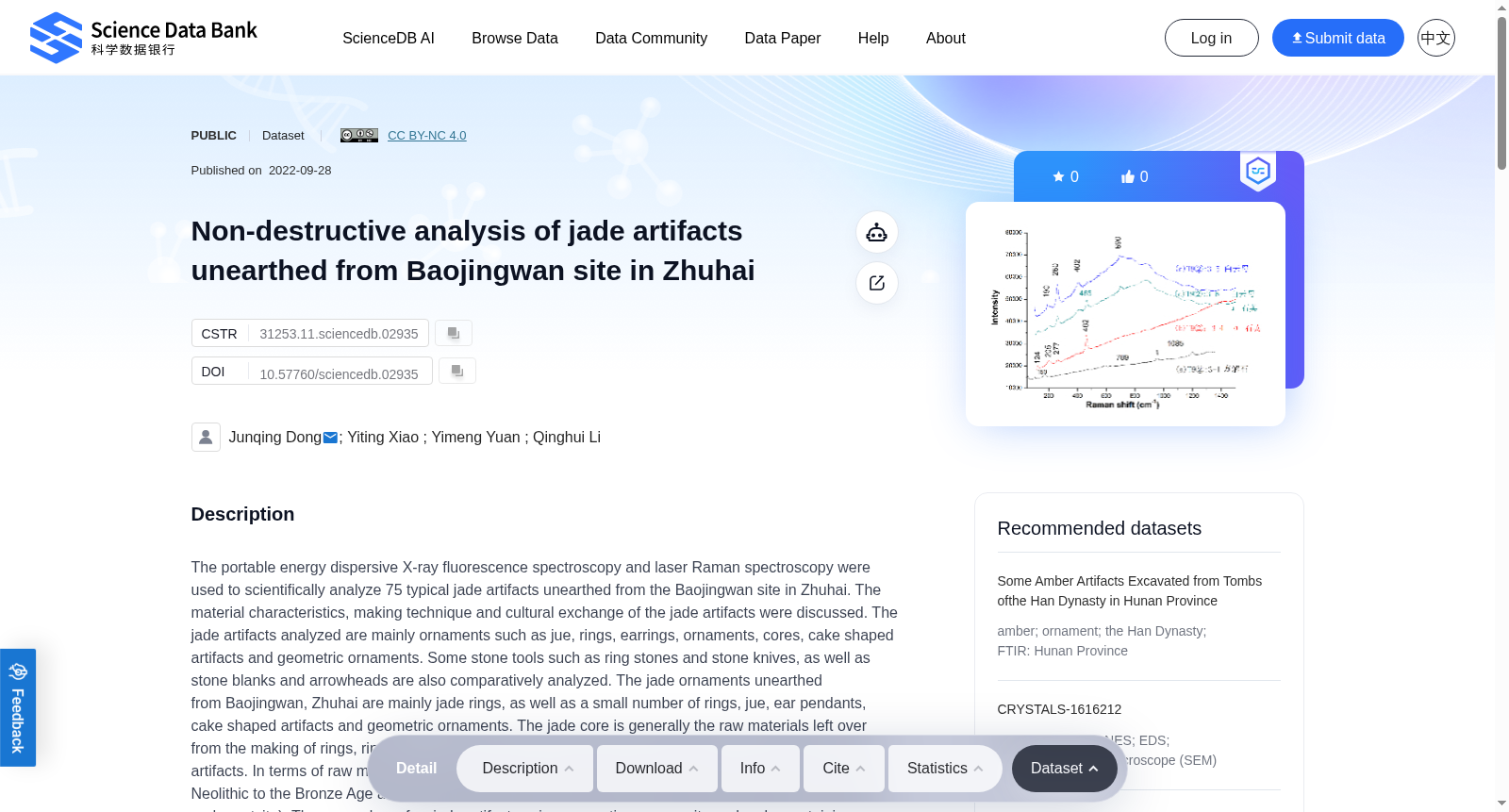
The portable energy dispersive X-ray fluorescence spectroscopy and laser Raman spectroscopy were used to scientifically analyze 75 typical jade artifacts unearthed from the Baojingwan site in Zhuhai. The material characteristics, making technique and cultural exchange of the jade artifacts were discussed. The jade artifacts analyzed are mainly ornaments such as jue, rings, earrings, ornaments, cores, cake shaped artifacts and geometric ornaments. Some stone tools such as ring stones and stone knives, as well as stone blanks and arrowheads are also comparatively analyzed. The jade ornaments unearthed from Baojingwan, Zhuhai are mainly jade rings, as well as a small number of rings, jue, ear pendants, cake shaped artifacts and geometric ornaments. The jade core is generally the raw materials left over from the making of rings, rings and ornaments, which are also used to make cakes, earrings and other artifacts. In terms of raw materials, the jade artifacts unearthed from Baojingwan site dated from the late Neolithic to the Bronze Age are mainly made of quartz (including crystal, agate, chalcedony, vein quartz and quartzite). There are also a few jade artifacts using serpentine, muscovite and rocks containing muscovite, quartz, calcite and other minerals. All the stone tools such as stone knives, stone arrowheads, ring stones and stone slabs are made by rocks. The making technology of jade artifacts in Baojing site mainly uses solid drills to drill holes on one side, but a few jade wares also use pipe drills to drill holes, which shows that the craftsmen in Baojing site have been able to use different drilling methods due to different characteristics of the products.
本研究采用便携式能量色散X射线荧光光谱法(portable energy dispersive X-ray fluorescence spectroscopy)与激光拉曼光谱法(laser Raman spectroscopy),对珠海宝镜湾遗址出土的75件典型玉器文物开展科学分析,并围绕这批玉器的材质特征、制作工艺与文化交流展开探讨。本次分析的玉器以饰件为主,包括玉玦(jue)、玉环、耳饰、坠饰、玉芯、饼形器与几何形饰件等;同时还对环石、石刀等石器,以及石料毛坯与箭镞开展对比分析。珠海宝镜湾遗址出土的玉饰以玉环为主,另有少量玉环、玉玦、耳坠、饼形器与几何形饰件。玉芯一般为制作玉环与饰件过程中产生的原料余料,亦可用于制作饼形器、耳饰等器物。就原料而言,宝镜湾遗址出土的年代介于新石器时代晚期至青铜时代的玉器,主要以石英质材料为主,涵盖水晶、玛瑙、玉髓、脉石英与石英岩;另有少量玉器采用蛇纹石、白云母以及含白云母、石英、方解石等矿物的岩石作为原料。所有石器(包括石刀、石箭镞、环石与石板)均由岩石制成。宝镜湾遗址玉器的制作工艺以单面实心钻钻孔为主,少数玉器亦采用管钻钻孔,这表明该遗址的工匠已能够根据器物的不同特征选用适配的钻孔技法。
创建时间:
2024-01-31
搜集汇总
数据集介绍
背景与挑战
背景概述
该数据集通过无损分析技术(如X射线荧光光谱和激光拉曼光谱)对珠海宝镜湾遗址出土的75件玉石器进行了科学分析,聚焦于材料特性、制作工艺和文化交流。数据集涵盖从新石器时代晚期到青铜时代的玉石饰品和石制工具,主要原材料为石英类矿物,并揭示了不同钻孔技术的应用。
以上内容由遇见数据集搜集并总结生成


