
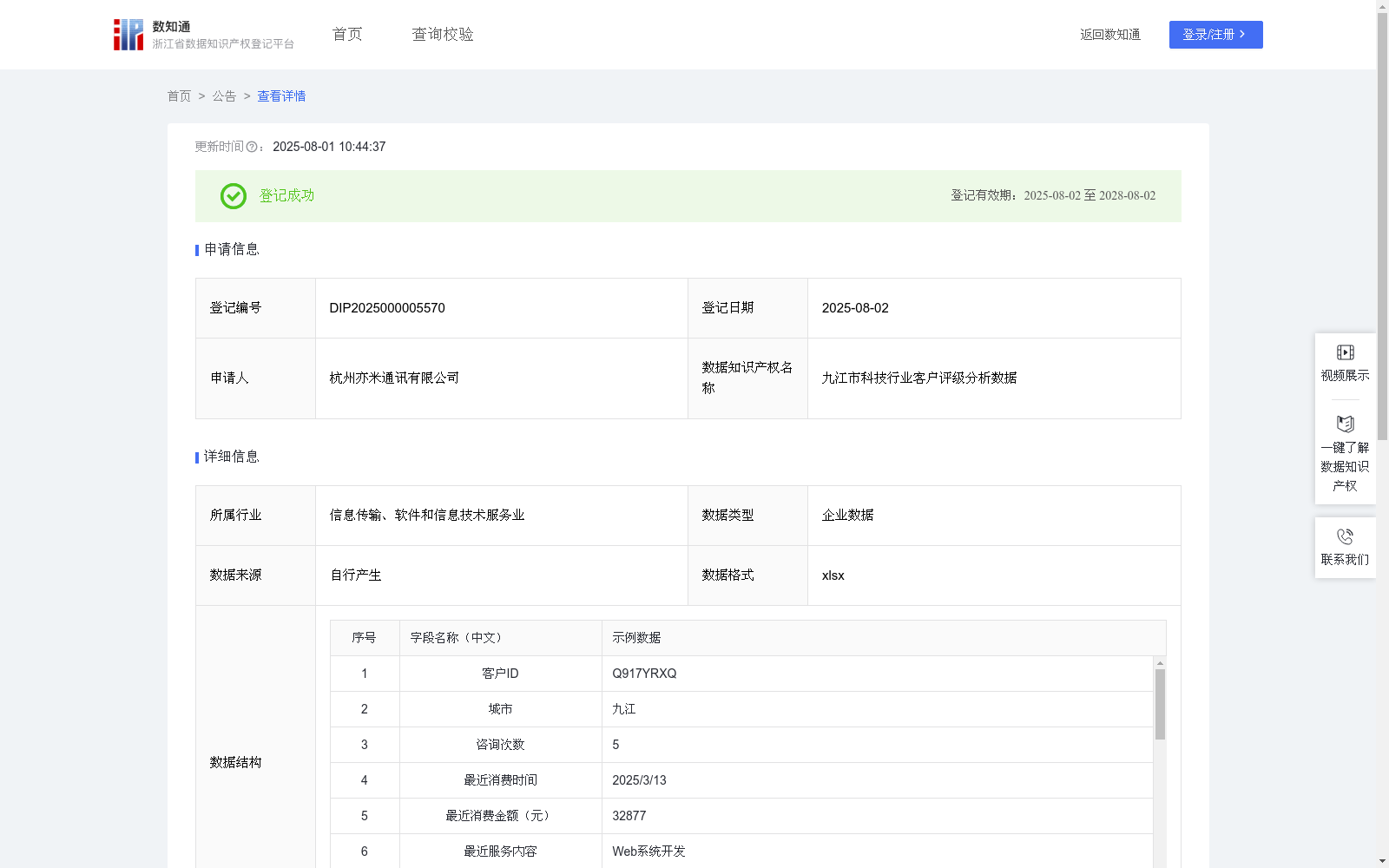
九江市科技行业客户评级分析数据
收藏浙江省数据知识产权登记平台2025-08-01 更新2025-08-02 收录
下载链接:
https://www.zjip.org.cn/home/announce/trends/157516
下载链接
链接失效反馈官方服务:
资源简介:
1. 精准营销策略制定 场景:根据客户评级,为不同等级客户提供差异化服务 S 级客户:专属客户经理、优先服务、定制化解决方案 A 级客户:定期回访、产品推荐、优惠活动 B/C 级客户:标准化服务、促销信息推送 D 级客户:自动化服务、低成本转化策略 行业价值:提高营销资源利用率,提升高价值客户满意度,降低获客成本 2. 客户流失预警 场景:对活跃度下降、贡献度降低的客户进行预警 监控指标:咨询频率、成交次数、交易金额、成交稳定性 预警机制:设置阈值,触发自动提醒或挽留策略 行业价值:提前干预潜在流失客户,降低客户流失率 3. 产品优化方向指引 场景:分析不同等级客户的需求偏好 S/A 级客户:重点关注其功能需求和体验反馈 B/C 级客户:挖掘需求痛点,优化基础功能 D 级客户:分析流失原因,改进入门体验 行业价值:优化产品功能和体验,提高产品市场竞争力 4. 销售团队绩效考核 场景:将客户评级提升纳入销售团队考核指标 考核维度:客户升级率、高价值客户增长率 激励机制:与奖金、晋升挂钩 行业价值:激励销售团队关注客户长期价值,而非短期业绩 5. 资源分配决策支持 场景:根据客户评级分配服务资源 服务资源:客服人力、技术支持、培训资源 分配原则:高价值客户优先保障,低价值客户高效服务 行业价值:优化资源配置,提高整体服务效率 6. 市场拓展策略制定 场景:分析高价值客户共同特征,指导市场拓展 目标客户画像:行业、规模、需求特征 渠道选择:根据目标客户偏好选择推广渠道 行业价值:提高市场拓展精准度,降低市场开发成本。通过多维度评分体系,对客户价值进行量化评估,为企业制定差异化营销策略提供数据支持。一、 活跃度得分(最高100分)=咨询行为分 (最高50分)+成交次数分(最高50分); 咨询行为得分(最高50分)=咨询次数×10 分; 成交次数得分(最高50分)=成交次数×5分。 二、贡献度得分(最高50分)=成交稳定性得分×40% +累计金额得分×60%; 累计金额得分(最高50分): 累计金额<10000元则10分; 10000元≤累计金额≤50000元则30分; 累计金额>50000元则50分。 三、成交稳定性得分=近6个月成交稳定性。 四、价值排名得分(最高100分)=金额排名得分*70%+复购率排名得分*30% 金额排名得分按累计金额全局排名百分比划分: 前10%:100分; 10%-20%:80分; 20%-30%:60分; 30%-40%:40分; 40%-50%:20分; 后50%:0分。 复购率排名得分按复购率全局排名百分比划分: 前10%:50分、 10%-20%:40分; 20%-30%:30分; 30%-40%:20分; 40%-50%:10分; 后50%:0分。 五、综合评分计算公式:综合评分=活跃度得分×30% +贡献度得分×50% +价值排名得分×20%; 六、评级等级划分:S级:综合评分≥90分;A级:75分≤综合评分< 90分;B级:60分≤综合评分< 75分;C级:40分≤综合评分<60分;D级:综合评分<40分。
1. Precise Marketing Strategy Formulation
Scenario: Provide differentiated services for customers of different tiers based on their customer ratings.
- Tier S customers: Dedicated account manager, priority service, customized solutions
- Tier A customers: Regular follow-up visits, product recommendations, preferential activities
- Tier B/C customers: Standardized services, promotional information push
- Tier D customers: Automated services, low-cost conversion strategies
Industry Value: Improve the utilization efficiency of marketing resources, enhance the satisfaction of high-value customers, and reduce customer acquisition costs.
2. Customer Churn Warning
Scenario: Issue warnings for customers with declining activity levels and reduced contribution value.
Monitoring Indicators: Consultation frequency, number of transactions, transaction amount, transaction stability
Early Warning Mechanism: Set thresholds to trigger automatic alerts or retention strategies
Industry Value: Intervene with potential churn customers in advance to reduce customer churn rate.
3. Product Optimization Direction Guidance
Scenario: Analyze the demand preferences of customers at different tiers.
- Tier S/A customers: Focus on their functional requirements and experience feedback
- Tier B/C customers: Dig out demand pain points and optimize basic functions
- Tier D customers: Analyze churn causes and improve onboarding experience
Industry Value: Optimize product functions and user experience, and enhance the market competitiveness of products.
4. Sales Team Performance Appraisal
Scenario: Include customer rating improvement as an assessment indicator for the sales team.
Assessment Dimensions: Customer upgrade rate, growth rate of high-value customers
Incentive Mechanism: Link with bonuses and promotion opportunities
Industry Value: Motivate the sales team to focus on the long-term value of customers rather than short-term performance.
5. Resource Allocation Decision Support
Scenario: Allocate service resources based on customer ratings.
Service Resources: Customer service manpower, technical support, training resources
Allocation Principle: Prioritize high-value customers, and serve low-value customers efficiently
Industry Value: Optimize resource allocation and improve overall service efficiency.
6. Market Expansion Strategy Formulation
Scenario: Analyze the common characteristics of high-value customers to guide market expansion.
Target Customer Profile: Industry, scale, demand characteristics
Channel Selection: Select promotion channels based on the preferences of target customers
Industry Value: Improve the accuracy of market expansion and reduce market development costs.
This dataset provides data support for enterprises to formulate differentiated marketing strategies through a multi-dimensional scoring system for quantitative evaluation of customer value.
I. Activity Score (max. 100 points) = Consultation Behavior Score (max. 50 points) + Transaction Frequency Score (max. 50 points);
Consultation Behavior Score (max. 50 points) = Number of consultations × 10 points;
Transaction Frequency Score (max. 50 points) = Number of transactions × 5 points.
II. Contribution Score (max. 50 points) = Transaction Stability Score × 40% + Cumulative Amount Score × 60%;
Cumulative Amount Score (max. 50 points):
10 points if cumulative amount < 10,000 RMB;
30 points if 10,000 RMB ≤ cumulative amount ≤ 50,000 RMB;
50 points if cumulative amount > 50,000 RMB.
III. Transaction Stability Score = Transaction stability over the past 6 months.
IV. Value Ranking Score (max. 100 points) = Amount Ranking Score × 70% + Repurchase Rate Ranking Score × 30%
Amount Ranking Score is divided based on the global ranking percentage of cumulative amount:
Top 10%: 100 points; 10%-20%: 80 points; 20%-30%: 60 points; 30%-40%: 40 points; 40%-50%: 20 points; Bottom 50%: 0 points.
Repurchase Rate Ranking Score is divided based on the global ranking percentage of repurchase rate:
Top 10%: 50 points; 10%-20%: 40 points; 20%-30%: 30 points; 30%-40%: 20 points; 40%-50%: 10 points; Bottom 50%: 0 points.
V. Comprehensive Score Calculation Formula: Comprehensive Score = Activity Score × 30% + Contribution Score × 50% + Value Ranking Score × 20%;
VI. Rating Tier Classification:
Tier S: Comprehensive Score ≥ 90;
Tier A: 75 ≤ Comprehensive Score < 90;
Tier B: 60 ≤ Comprehensive Score < 75;
Tier C: 40 ≤ Comprehensive Score < 60;
Tier D: Comprehensive Score < 40.
提供机构:
杭州亦米通讯有限公司
创建时间:
2025-05-16
搜集汇总
数据集介绍
背景与挑战
背景概述
九江市科技行业客户评级分析数据是一个包含601条记录的企业数据集,每年更新一次,用于评估客户价值并支持差异化营销策略。数据集包含22个字段,涵盖客户活跃度、贡献度和价值排名等多个维度,适用于精准营销、客户流失预警、产品优化等多种应用场景。
以上内容由遇见数据集搜集并总结生成



