
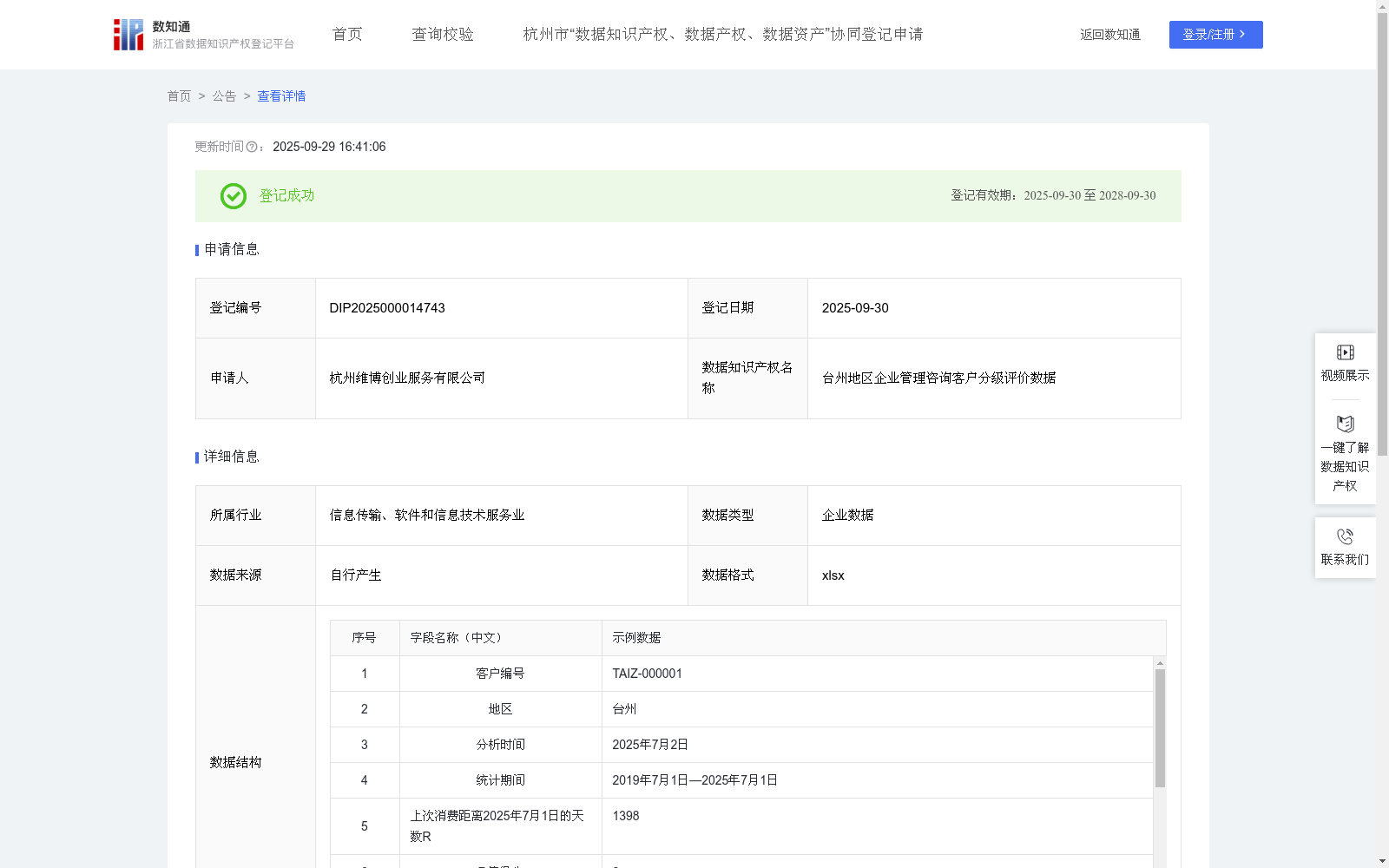
台州地区企业管理咨询客户分级评价数据
收藏浙江省数据知识产权登记平台2025-09-29 更新2025-09-30 收录
下载链接:
https://www.zjip.org.cn/home/announce/trends/187635
下载链接
链接失效反馈官方服务:
资源简介:
采集销售记录表中台州地区的数据,通过客户在2019年7月1日距离2025年7月1日间隔的最近一次消费时间天数R、客户在2019年7月1日至2025年7月1日之间消费频次F和客户在2019年7月1日至2025年7月1日之间消费M元, 采用 RFM 模型对客户进行价值评级,实现精准化运营,通过对台州地区客户价值管理,满足不同价值客户的个性化需求。对A级客户,每个月进行一次回访维护,对B级客户,每个季度进行一次回访维护,对C级客户每半年进行一次回访维护,对D级客户每年进行一次回访维护。另外可以为本地区客户群体高度重叠企业提供不同价值类型的客户个性化服务的数据支持。对从销售记录表中采集到的数据进行脱敏、降噪、清洗、聚集、分析。2、数据加工:运用RFM模型结合客户在2019年7月1日距离2025年7月1日间隔的最近一次消费时间天数R、客户在2019年7月1日距离2025年7月1日之间消费频次F和客户在2019年7月1日距离2025年7月1日之间消费M元的得分排名对客户进行一个综合排名,最终得出一个RFM总评分。a.提取出最近一次消费时间距离当前分析时间的天数R、客户在2019年7月1日距离2025年7月1日之间消费频次F和客户在2019年7月1日距离2025年7月1日之间消费M元进行分类,最近一次消费时间间隔最短的客户排在最上面。按照从1-5评分,前20%的客户获得5分,接下来的20%用户获得4分,再下来20%的客户为3分,再下来20% 的客户为2分,最后20% 的客户为1分。 b.根据客户在2019年7月1日距离2025年7月1日消费频次F从高到底依次对用户进行分类,前20%的客户在用户活动频率的分数为5,以此类推。 C, 根据客户在2019年7月1日距离2025年7月1日消费金额M元,前20%的客户在消费金额的分数为5,以此类推。消费金额最少的20%客户则分数为1。 RFM得分=0.3*(R得分)+0.3*(F得分)+0.4*(M得分) 评分大于等于4分的为A级客户,大于等于3小于4的为B级客户,大于等于2小于3的为C 级客户,低于2的为D级客户。
This dataset is developed by extracting sales records of the Taizhou region from the overall sales log. Based on the transaction timeframe from July 1, 2019 to July 1, 2025, three core metrics are calculated for each customer: Recency (R, the number of days since the customer's most recent purchase prior to July 1, 2025), Frequency (F, the total number of transactions made during the same period), and Monetary value (M, the total consumption amount over the same timeframe). The RFM model is adopted to grade customer value, enabling precise operational management and meeting personalized demands of customers with different value tiers.
For Grade A customers, monthly maintenance visits will be conducted; Grade B customers will receive quarterly maintenance visits; Grade C customers will get bi-annual maintenance visits; and Grade D customers will have annual maintenance visits. Additionally, this dataset can provide data support for locally highly overlapping enterprises to deliver personalized services tailored to different customer value segments.
Prior to formal analysis, the collected sales data undergo a series of preprocessing steps including data anonymization, denoising, cleaning, aggregation, and exploratory analysis.
For the data processing workflow: A comprehensive customer ranking and final RFM total score are generated based on percentile-based scoring of the R, F, and M metrics.
1. Metric-specific scoring rules: All three metrics are divided into 5 equal percentile groups, with scores ranging from 1 to 5.
a. For Recency (R): Customers are sorted in ascending order of the number of days since their most recent transaction (i.e., a shorter interval indicates higher recent engagement). The top 20% of customers receive a score of 5, the next 20% receive 4, followed by 3, 2, and the bottom 20% receive a score of 1.
b. For Frequency (F): Customers are sorted in descending order of total transaction count during the study period. The top 20% receive a score of 5, with subsequent percentile groups assigned scores of 4, 3, 2, and 1 in sequence.
c. For Monetary value (M): Customers are sorted in descending order of total consumption amount over the study period. The top 20% receive a score of 5, while the bottom 20% receive a score of 1, with intermediate groups assigned scores 4, 3, and 2 correspondingly.
2. The final RFM total score is calculated using the formula: RFM Score = 0.3 * R_score + 0.3 * F_score + 0.4 * M_score.
3. Customer grading criteria are defined as follows: Customers with a total score ≥ 4 are classified as Grade A; 3 ≤ score < 4 as Grade B; 2 ≤ score < 3 as Grade C; and score < 2 as Grade D.
提供机构:
杭州维博创业服务有限公司
创建时间:
2025-08-12
搜集汇总
数据集介绍
背景与挑战
背景概述
该数据集包含台州地区601条企业管理咨询客户记录,采用RFM模型对客户进行价值评级,基于最近消费时间、消费频次和消费金额计算得分,将客户划分为A、B、C、D四个等级。数据集主要用于实现精准化客户运营,通过分级管理满足不同价值客户的个性化需求,并为本地企业提供数据支持。
以上内容由遇见数据集搜集并总结生成



