
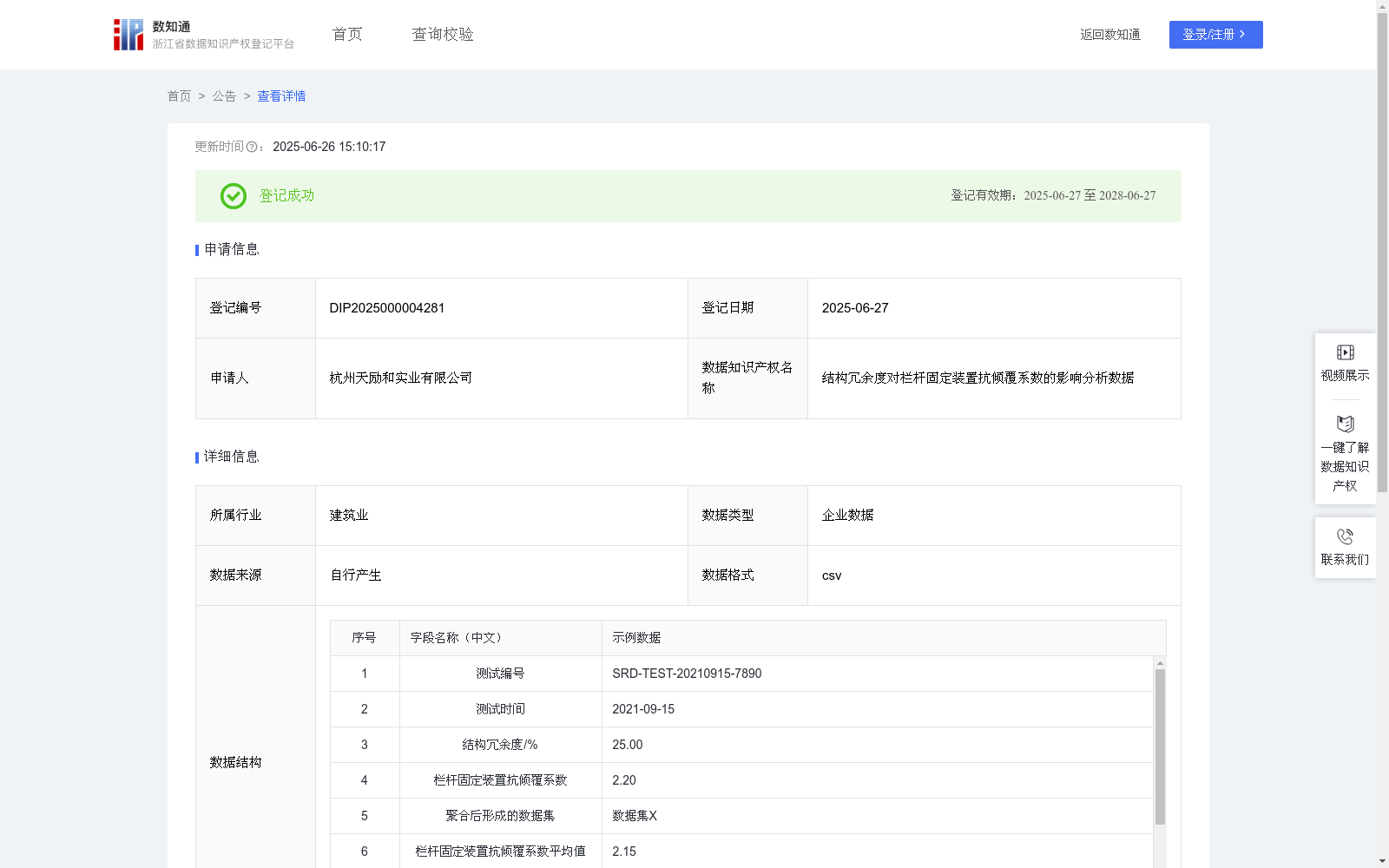
结构冗余度对栏杆固定装置抗倾覆系数的影响分析数据
收藏浙江省数据知识产权登记平台2025-06-26 更新2025-06-27 收录
下载链接:
https://www.zjip.org.cn/home/announce/trends/142256
下载链接
链接失效反馈官方服务:
资源简介:
本研究聚焦于分析结构冗余度对栏杆固定装置抗倾覆系数的影响,揭示了结构冗余度与栏杆固定装置抗倾覆能力之间的定量关系。企业可通过该数据分析不同结构冗余度设置下栏杆固定装置的抗倾覆性能变化规律,从而优化设计和施工方案,提高固定装置的安全性和稳定性。该数据可为建筑工程领域的科研人员、材料科学家、结构工程师以及质量控制专家提供重要支持,助力他们围绕栏杆固定装置的安全性提升、结构优化及工程应用等方向开展预测分析、机理研究、性能评估和技术改进工作。通过科学设定合理的结构冗余度,不仅可以实现增强栏杆固定装置抗倾覆系数的目标,还能提升整体结构的安全性和耐久性,为建筑项目的长期稳定提供有力保障。1.数据采集:记录不同结构冗余度下的栏杆固定装置抗倾覆系数测试数据,具体包括测试编号、测试时间、结构冗余度/%、栏杆固定装置抗倾覆系数等字段。
2.数据预处理:(1)对采集的数据进行去噪处理,确保数据准确性。(2)把历史采集的数据(包含本次采集)进行聚合,形成数据集X,并针对数据集X中的栏杆固定装置抗倾覆系数字段,计算出其平均值。
3.计算线性回归斜率a和截距b:基于数据集X(以结构冗余度为自变量、栏杆固定装置抗倾覆系数为因变量),运用SLOPE函数和INTERCEPT函数,基于最小二乘法原理确定斜率a和截距b。斜率a表示单位结构冗余度变化对立柱固定装置抗倾覆系数的影响程度,截距b表示基准冗余度下栏杆固定装置的抗倾覆系数。
4.结果运用:(1)计算比例系数k:k=|a/栏杆固定装置抗倾覆系数平均值|×100%;(2)若k≥10%,则判定为“高影响”,若5%≤k<10%,则判定为“中影响”,若k<5%,则判定为“低影响”。
This study focuses on analyzing the impact of structural redundancy on the anti-overturning coefficient of railing fixing devices, and reveals the quantitative relationship between structural redundancy and the anti-overturning capacity of such devices. Enterprises can use this dataset to analyze the variation rules of the anti-overturning performance of railing fixing devices under different structural redundancy settings, so as to optimize design and construction schemes and improve the safety and stability of the fixing devices. This dataset can provide important support for researchers, materials scientists, structural engineers and quality control experts in the field of construction engineering, helping them carry out predictive analysis, mechanism research, performance evaluation and technical improvement work focusing on improving the safety of railing fixing devices, structural optimization and engineering applications. By scientifically setting reasonable structural redundancy, the goal of enhancing the anti-overturning coefficient of railing fixing devices can be achieved, and the safety and durability of the overall structure can also be improved, providing a strong guarantee for the long-term stability of construction projects.
1. Data Collection: Record the test data of the anti-overturning coefficient of railing fixing devices under different structural redundancy levels, specifically including fields such as test number, test time, structural redundancy (%), and anti-overturning coefficient of railing fixing devices.
2. Data Preprocessing: (1) Perform denoising processing on the collected data to ensure data accuracy. (2) Aggregate the historically collected data (including this collection) to form dataset X, and calculate the average value of the anti-overturning coefficient of railing fixing devices in dataset X.
3. Calculation of Linear Regression Slope a and Intercept b: Based on dataset X (taking structural redundancy as the independent variable and the anti-overturning coefficient of railing fixing devices as the dependent variable), use the SLOPE and INTERCEPT functions to determine slope a and intercept b based on the principle of least squares. Slope a represents the degree of influence of unit change in structural redundancy on the anti-overturning coefficient of railing fixing devices, and intercept b represents the anti-overturning coefficient of railing fixing devices under the reference redundancy level.
4. Application of Results: (1) Calculate the proportional coefficient k: k = |a / average value of the anti-overturning coefficient of railing fixing devices| × 100%; (2) If k ≥ 10%, it is classified as "high impact"; if 5% ≤ k < 10%, it is classified as "medium impact"; if k < 5%, it is classified as "low impact".
提供机构:
杭州天励和实业有限公司
创建时间:
2025-05-06
搜集汇总
数据集介绍
背景与挑战
背景概述
该数据集聚焦于分析结构冗余度对栏杆固定装置抗倾覆系数的影响,包含606条记录,每日更新。数据通过线性回归分析揭示了结构冗余度与抗倾覆系数之间的定量关系,为建筑工程领域的科研和工程优化提供支持。
以上内容由遇见数据集搜集并总结生成


