
临安停车场充电桩分析预估数据
收藏浙江省数据知识产权登记平台2025-09-15 更新2025-09-16 收录
下载链接:
https://www.zjip.org.cn/home/announce/trends/180140
下载链接
链接失效反馈官方服务:
资源简介:
通过对杭州市临安区智慧停车场的数据进行清洗、整合与深度分析,计算出推荐安装充电桩的数量,将原本分散的充电需求信息转化为科学合理的选址建议与建设优先级评估,为多维度决策提供可靠依据。这一成果不仅能协助能源管理部门实现电网负荷的动态调控与基础设施的优化布局,还能支持城市规划部门基于实时需求热点布局新建充电站、改造现有低效设施,同时助力运营团队制定差异化的服务策略与市场推广计划。通过将潜在的用电需求转化为前瞻性、智能化的城市能源配套策略,该数据体系还可为能源研究机构提供高质量的研究基础,推动绿色交通与智慧城市的协同发展。1. 数据收集:智慧停车项目停车场采集到的停车场基本信息和每日车辆进出流水数据;
2. 数据处理:对收集到的数据进行清洗,检查并处理缺失值、异常值、统一各字段的格式;
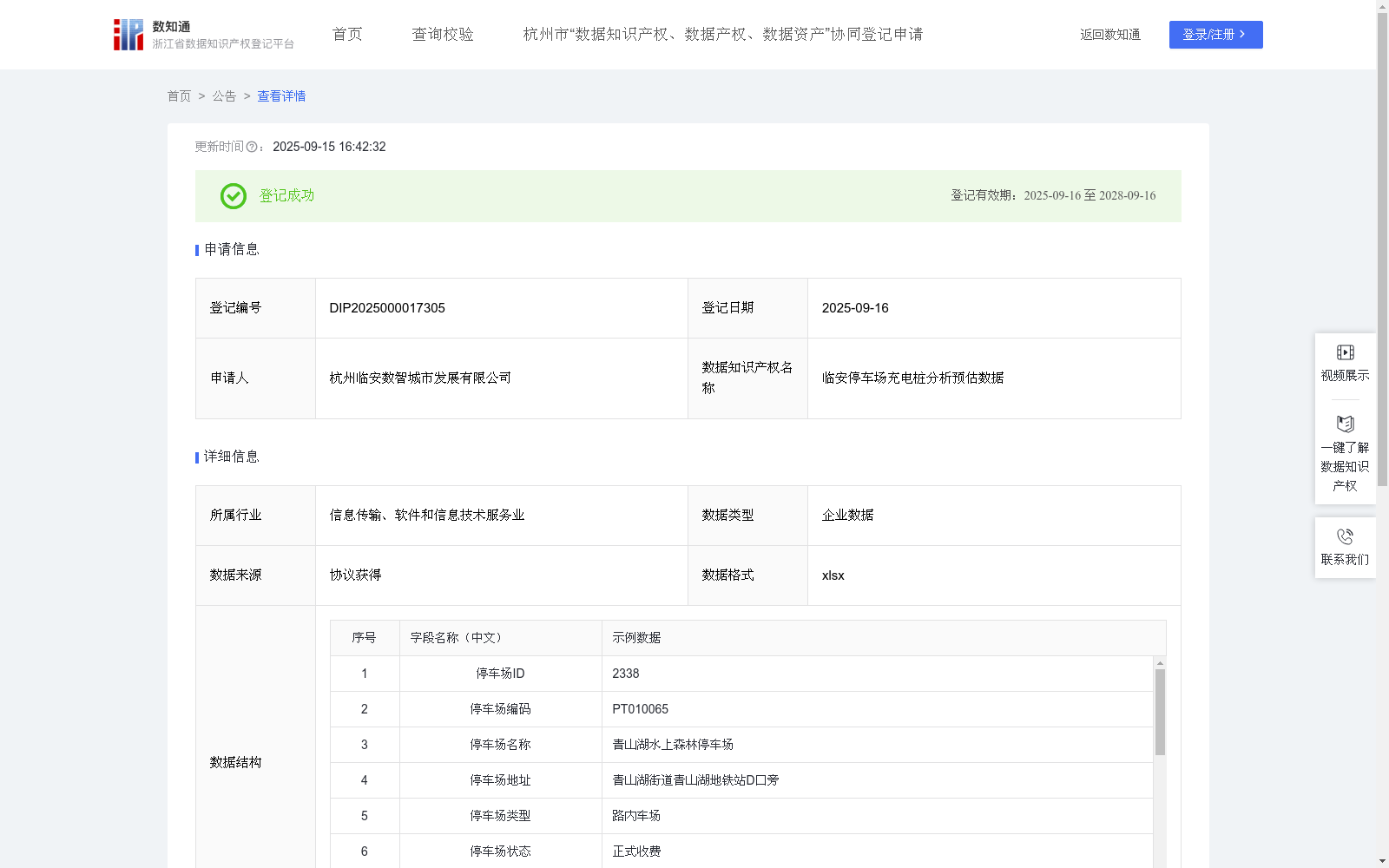
然后进行数据加工,通过对原始实时停车数据进行统计,得出统一的字段信息,包括停车场ID、停车场编码、停车场名称、停车场地址、停车场类型、停车场状态、停车场总泊位数(个)、日期、蓝牌车辆停车次数(次)、绿牌车辆停车次数(次)、未知颜色车牌停车次数(次)、蓝牌车辆停车时长(秒)、绿牌车辆停车时长(秒)、未知颜色车牌停车时长(秒)、入场车辆数量(辆)、出场车辆数量(辆);
3. 数据计算
推荐安装充电桩系数 = 绿牌车辆停车次数 / (蓝牌车辆停车次数 + 绿牌车辆停车次数 + 未知颜色车牌停车次数) ;(推荐安装充电桩系数边界说明: 当推荐安装充电桩系数 < 0.8 时取 0.8,当推荐安装充电桩系数 > 1.5 取 1.5);
推荐安装充电桩数 = 停车场总泊位数 * 推荐安装充电桩系数 * 0.1。
Through cleaning, integrating and conducting in-depth analysis on the data of smart parking lots in Lin'an District, Hangzhou, this work calculates the recommended number of charging piles, transforming scattered charging demand information into scientific and reasonable site selection suggestions and construction priority assessment, providing reliable basis for multi-dimensional decision-making.
This achievement can not only assist energy management departments in realizing dynamic regulation of power grid load and optimized layout of infrastructure, but also support urban planning departments in arranging new charging stations and renovating inefficient existing facilities based on real-time demand hotspots, while helping operation teams formulate differentiated service strategies and marketing plans.
By translating potential electricity demand into forward-looking and intelligent urban energy supporting strategies, this data system can also provide high-quality research foundation for energy research institutions, promoting the coordinated development of green transportation and smart cities.
1. Data Collection: Basic parking lot information and daily vehicle entry and exit flow data collected by the parking lots of the smart parking project;
2. Data Processing: Clean the collected data, check and handle missing values and outliers, and unify the format of each field; Then conduct data enrichment: by statistically analyzing the original real-time parking data, derive unified field information, including parking lot ID, parking lot code, parking lot name, parking lot address, parking lot type, parking lot status, total parking spaces (units), date, number of blue-plate vehicle parking times, number of green-plate vehicle parking times, number of unknown-color license plate parking times, parking duration of blue-plate vehicles (seconds), parking duration of green-plate vehicles (seconds), parking duration of unknown-color license plates (seconds), number of incoming vehicles (units), number of outgoing vehicles (units);
3. Data Calculation
Recommended Charging Pile Installation Coefficient = Number of Green-plate Vehicle Parking Times / (Number of Blue-plate Vehicle Parking Times + Number of Green-plate Vehicle Parking Times + Number of Unknown-color License Plate Parking Times); (Boundary description of the recommended charging pile installation coefficient: take 0.8 when the coefficient < 0.8, take 1.5 when the coefficient > 1.5);
Recommended Number of Charging Piles = Total Parking Spaces * Recommended Charging Pile Installation Coefficient * 0.1.
提供机构:
杭州临安数智城市发展有限公司
创建时间:
2025-08-21
搜集汇总
数据集介绍
背景与挑战
背景概述
该数据集包含杭州市临安区智慧停车场的2661条记录,通过分析车辆停车数据(如绿牌车辆比例)计算推荐充电桩安装系数和数量,用于支持充电基础设施规划、能源管理和城市决策,数据按需更新并以xlsx格式存储。
以上内容由遇见数据集搜集并总结生成



