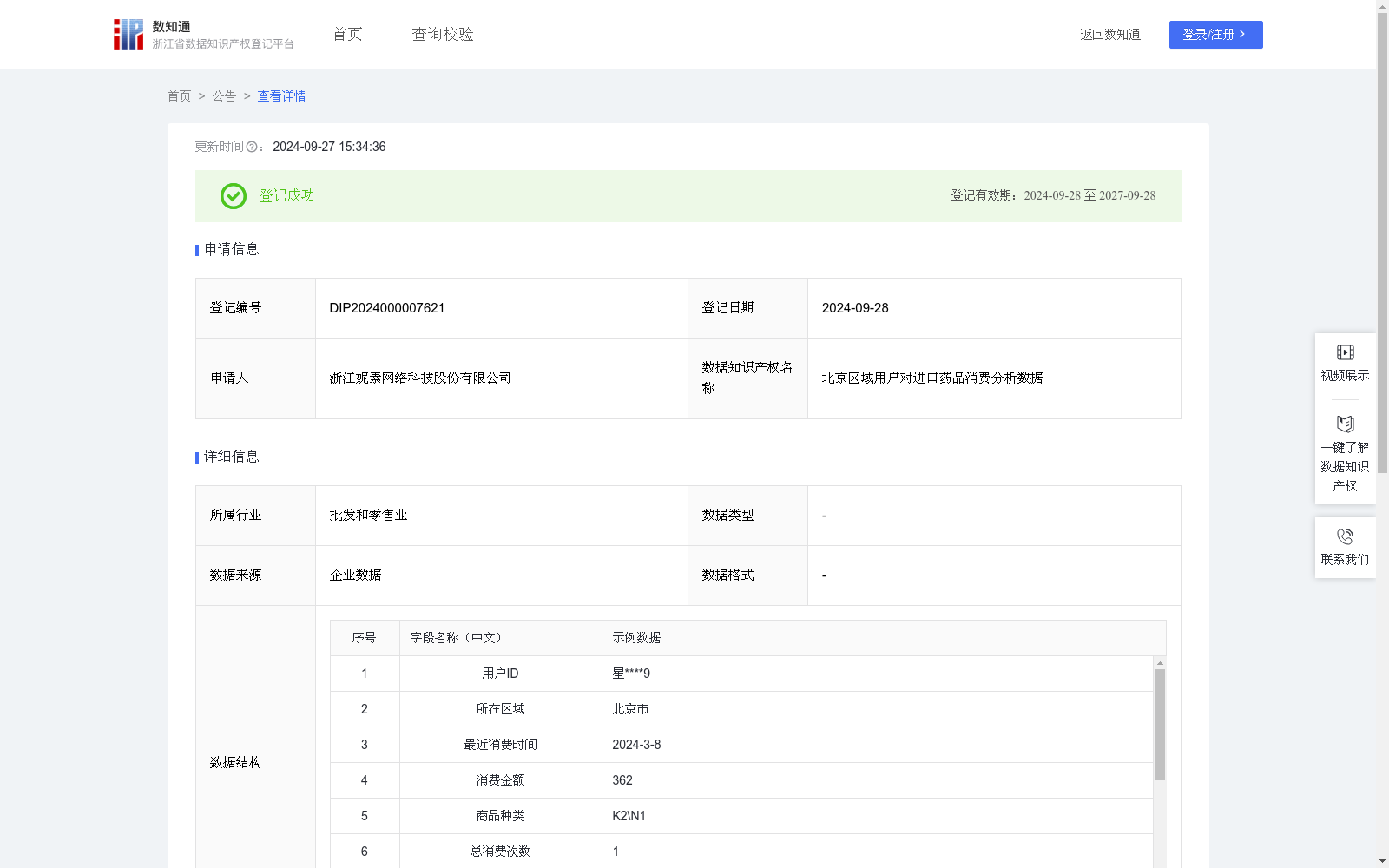
北京区域用户对进口药品消费分析数据
收藏资源简介:
通过对天猫平台北京区域的旗舰店用户的最近消费日期、消费频次、消费金额来衡量其价值和创利能力。电商平台的商家可以通过该方法对用户进行分类分级,来帮助商家制定个性化运营策略,以实现精细化运营,提高用户满意度和忠诚度。对于被多家商家标为高价值的用户,平台可以为用户提供极速退款等便利措施,促进电商行业良好发展,为客户提供更优质的服务,实现互利共赢。1.数据采集:采集产品运营数据,订单时间、订单金额、上一次消费时间等数据。 2.数据处理:对采集到数据进行去重、合并、累加,便于分析使用。数据清洗时,查看是否有缺失值和异常值,对数据进行整理。并基于RFM模型:R表示客户最近一次购买的时间有多远,F表示客户在时间内购买的次数,M 表示客户在时间内购买的金额。R=365-(截止日期-最近一次购买日期),日期越近,数值越大;F=购买次数;M=消费金额。将所有用户分别按照R、F、M值,由大排列到小,前20%的客戶给5分,前20%~40%的客戶给4分,以此类推,最后的20%给1分,分别记为r,f,m。 3.数据分析:根据RFM的数值可以对用户进行分类分级,客户类型=if(and(r=5,f=5,m=5),“高价值客户”,if(and(r=5,m<5),“高潜力客户”,if(and(r<5,m=5),“重点维护客户”,if(and(r=1,f=1,m=1),“无效客户”,“一般客户”)))) 4.数据应用:可以推测用户的异动状况,根据用户流失的可能性,列出用户列表,就可以把重点放在贡献度高且流失机会也高的用户上,重点制定召回策略。
This dataset evaluates the value and profit-generating capability of users from flagship stores in the Beijing region of the Tmall platform, using their latest consumption date, consumption frequency, and total consumption amount as core indicators. Merchants on e-commerce platforms can use this method to classify and grade users, enabling them to formulate personalized operation strategies for refined operations, thereby enhancing user satisfaction and loyalty. For users labeled as high-value by multiple merchants, the platform can offer convenient services such as instant refunds, which will facilitate the healthy development of the e-commerce industry, deliver better services to customers, and achieve win-win outcomes. 1. Data Collection: Collect product operation-related data, including order time, order amount, last consumption time and other relevant metrics. 2. Data Processing: Deduplicate, merge and aggregate the collected data to facilitate subsequent analysis. During data cleaning, check for missing values and outliers, and organize the cleaned data. Based on the RFM model: R represents the time elapsed since a customer's most recent purchase, F represents the total number of purchases made by the customer within a specified period, and M represents the total consumption amount of the customer within that period. The formula for calculating R is: R = 365 - (deadline date - latest purchase date), where a closer purchase date corresponds to a larger R value. F is the total number of purchases, and M is the total consumption amount. Rank all users in descending order based on their respective R, F, and M scores, assign 5 points to the top 20% of customers, 4 points to the top 20%–40% of users, and so on, with the bottom 20% assigned 1 point. These scores are denoted as r, f, and m respectively. 3. Data Analysis: Users can be classified and graded based on their R, F, and M scores. The customer type is determined via the following nested logical judgment: Customer Type = IF(AND(r=5, f=5, m=5), "High-Value Customer", IF(AND(r=5, m<5), "High-Potential Customer", IF(AND(r<5, m=5), "Key Maintenance Customer", IF(AND(r=1, f=1, m=1), "Invalid Customer", "General Customer")))) 4. Data Application: This dataset can be used to predict user churn dynamics. By generating a user list based on the probability of user churn, merchants can prioritize users with high contribution and high churn risk, and develop targeted customer recall strategies.