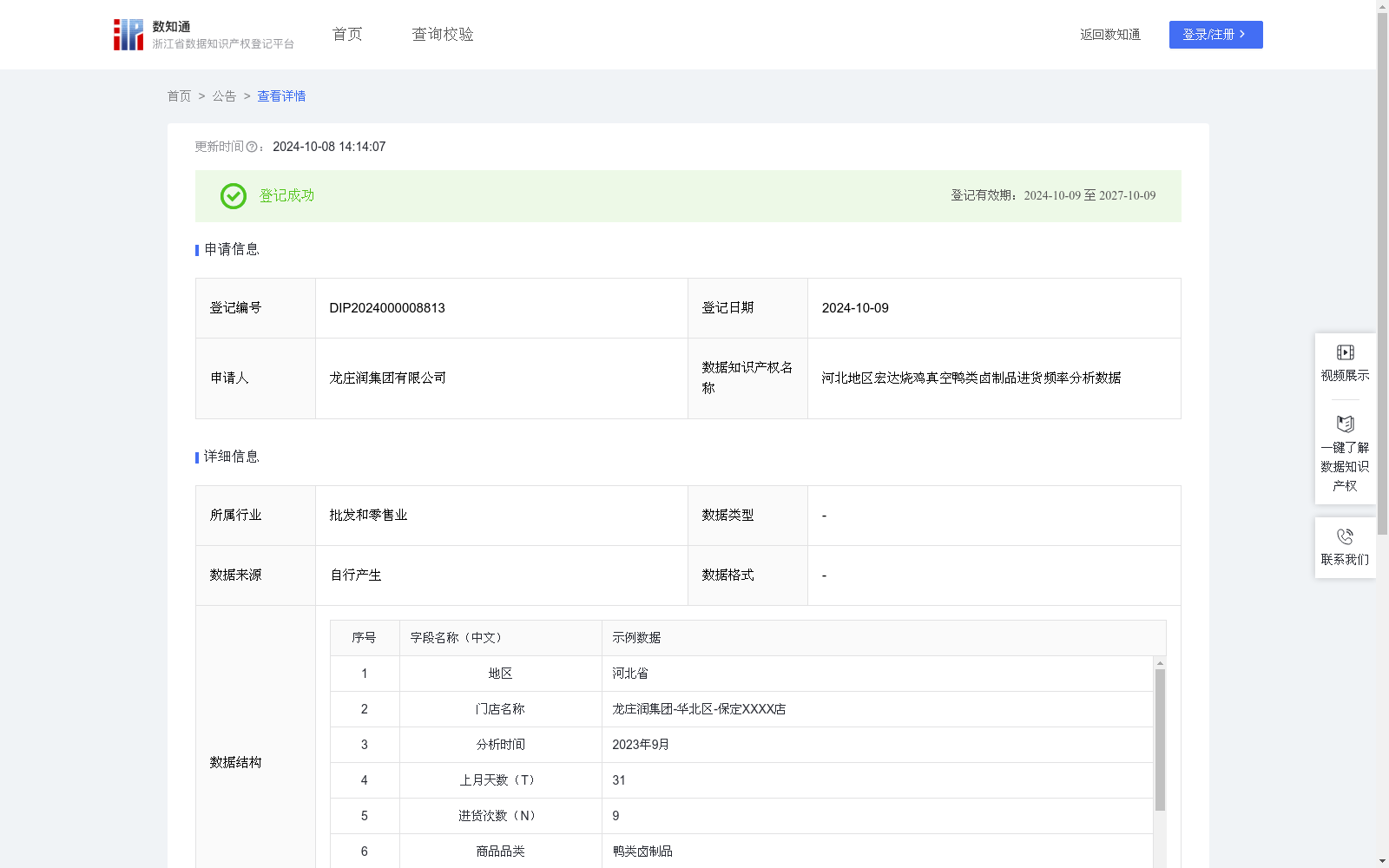
河北地区宏达烧鸡真空鸭类卤制品进货频率分析数据
收藏资源简介:
统计河北地区各门店真空鸭类卤制品一个月的进货次数,精确计算进货频率。供应商能据此洞悉门店需求差异,灵活调整库存分配与补货节奏,提升供应链响应速度。物流供应商则依据频率数据,科学规划配送路径,精准安排配送时间,实现高效、低成本的物流运作。门店排名机制促使企业迅速识别运营瓶颈,及时干预改善。同时,比较各门店进货频率,企业能精准把握市场动态,评估竞争态势,为制定差异化市场策略提供坚实数据支撑,推动整个产业链协同发展,增强市场竞争力。 1、数据统计:采集河北省每个门店一个月进货次数,对采集到数据进行分类、合并、累加,便于分析。2、数据分析:该时间段内的进货次数为 N,上月天数 T。计算平均进货间隔时间 I=T/N,进货频率F=1/I。3、将进货频率进行排名,占比排名进货频率从大到小进行排名;4、根据进货频率排名,对门店等级进行“高、中、低”的评价,定义进货频率排名前5名的门店等级为“高”,第6-10名的门店等级为“中”,第11名及以后的门店等级为“低”。
This dataset counts the monthly restocking times of vacuum-packed braised duck products for each retail store in Hebei Province, and accurately calculates their restocking frequencies. Suppliers can use this data to gain insights into demand disparities across stores, flexibly adjust inventory allocation and restocking rhythms, and improve supply chain response efficiency. Logistics suppliers can scientifically plan delivery routes and accurately arrange delivery schedules based on the frequency data, achieving efficient and low-cost logistics operations. The store ranking mechanism enables enterprises to quickly identify operational bottlenecks and take timely intervention measures for improvement. Meanwhile, by comparing the restocking frequencies of different stores, enterprises can accurately grasp market trends, assess competitive landscapes, provide solid data support for formulating differentiated market strategies, promote coordinated development of the entire industrial chain, and enhance overall market competitiveness. 1. Data Statistics: Collect the monthly restocking times of each store in Hebei Province, then classify, merge and accumulate the collected data to facilitate subsequent analysis. 2. Data Analysis: Let N represent the total restocking times within the statistical period, and T denote the number of days in the previous month. Calculate the average restocking interval I = T/N, and the restocking frequency F = 1/I. 3. Rank the restocking frequencies in descending order. 4. Classify stores into three tiers ("High", "Medium", "Low") based on their restocking frequency rankings: stores ranked within the top 5 are categorized as "High" tier, those ranked 6th to 10th as "Medium" tier, and those ranked 11th and beyond as "Low" tier.