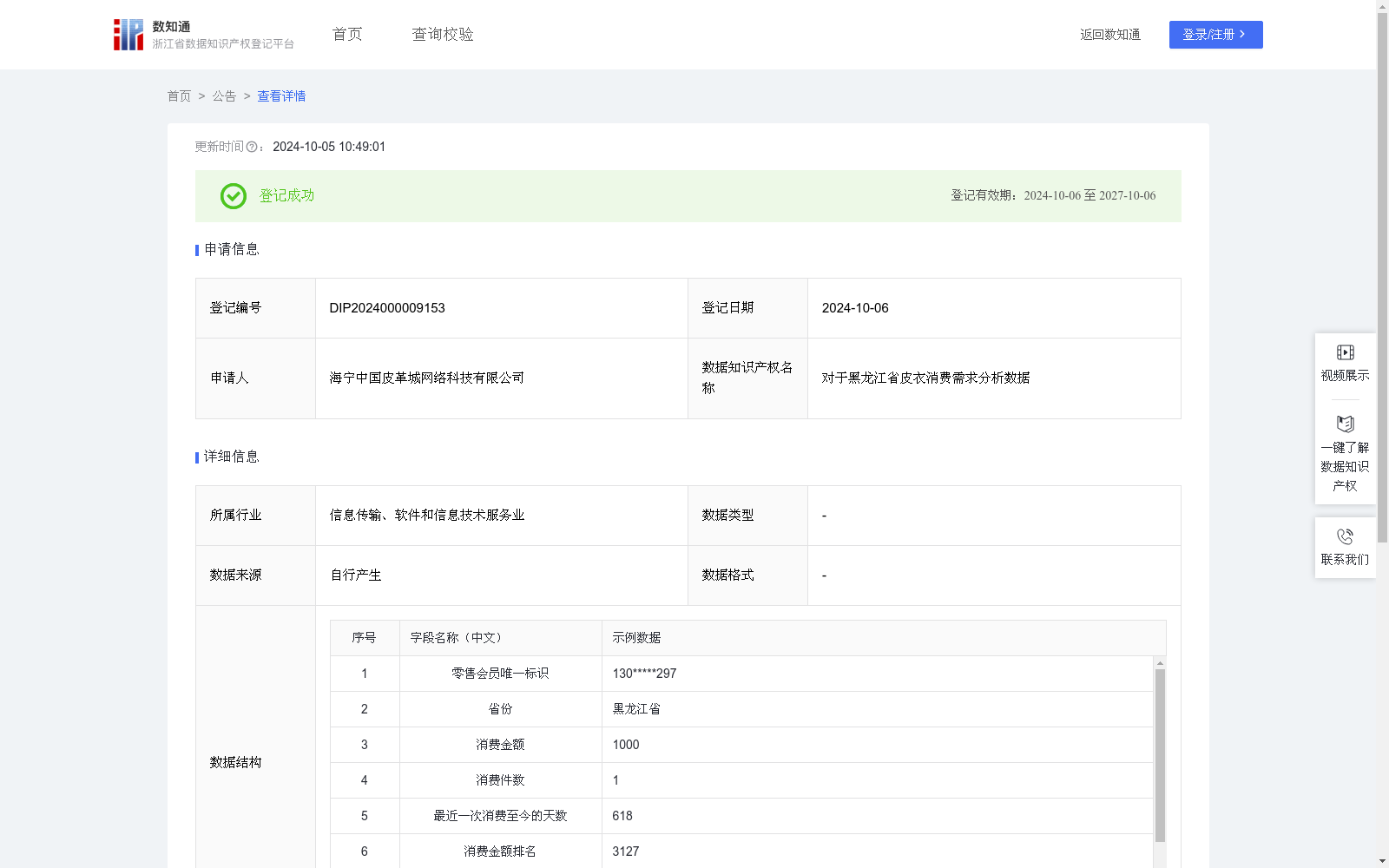
对于黑龙江省皮衣消费需求分析数据
收藏资源简介:
通过收集和分析黑龙江消费者对皮衣消费相关数据,了解消费者对皮衣的购买力水平和消费偏好,从而了解该产品是否畅销,从而为本行业的所有企业制定生产策略,更好地为该地区消费者提供个性化的产品和服务。1、数据处理:对采集到的数据进行降噪、清洗、脱敏、聚集、分析。 2.数据加工:需求评分=ROUND((满分上限100-(ROUND(消费金额排名/总记录数(7162)*100,0)))/3+(满分上限100-(ROUND(消费件数排名/总记录数(7162)*100,0)))/3+(满分上限100-(ROUND(最近消费天数排名/总记录数(7162)*100,0)))/3,2);得到的需求评分:80-100分标记为“高需求客户”,50-80分区间内标记为“中需求客户”,50分以下标记为“低需求客户”。
This dataset is developed by collecting and analyzing leather apparel purchase-related data of consumers in Heilongjiang Province, with the goals of understanding consumers' purchasing power and consumption preferences for leather apparel, assessing the market popularity of this product, and assisting enterprises across the industry in formulating production strategies to better provide personalized products and services for local consumers. 1. Data Processing: Perform denoising, cleaning, desensitization, aggregation and analysis on the collected raw data. 2. Data Scoring and Classification: The demand score is calculated via the following formula: Demand Score = ROUND( (100 - ROUND( (Consumption Amount Rank / Total Records (7162)) * 100, 0 )) / 3 + (100 - ROUND( (Consumption Quantity Rank / Total Records (7162)) * 100, 0 )) / 3 + (100 - ROUND( (Recent Consumption Days Rank / Total Records (7162)) * 100, 0 )) / 3, 2 ). Customers are categorized into three groups based on their demand scores: those with a score of 80-100 are marked as "High-demand Customers", those with a score between 50 and 80 are marked as "Medium-demand Customers", and those with a score below 50 are marked as "Low-demand Customers".