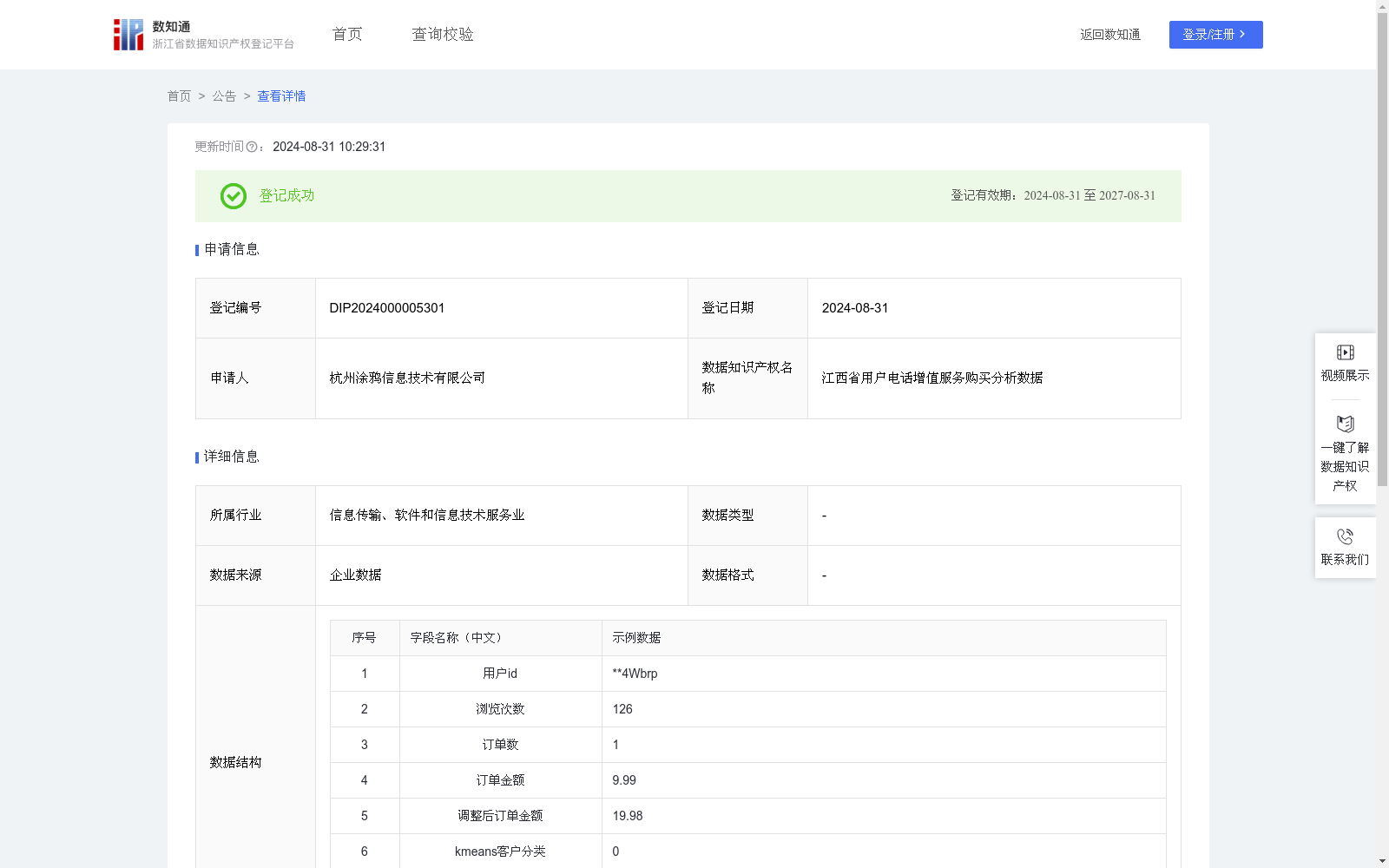
江西省用户电话增值服务购买分析数据
收藏资源简介:
基于精细化运营的需求,需要精准地对购买增值服务的用户进行分类,确定高价值用户和低价值用户群体,从而为不同价值的用户提供差异化服务和营销策略。1、数据收集:采集公司自己平台的短信增值服务销售数据 ; 2、特征选择:选择购买的订单数、调整后订单金额和浏览次数作为特征值。结合实际情况,通过调整金额特征的权重系数来确保订单金额在聚类决策中占主导地位,本模型的权重系数为订单金额*2作为调整后订单金额。 3、使用轮廓系数方法确定最佳聚类数k=4。 4、使用选定的特征值和k值,运行k-means算法对用户进行聚类。算法随机初始化k个质心,然后迭代地将每个样本分配给最近的质心,并更新质心位置,直到满足收敛条件。 5、分析每个簇的特征,包括簇内用户的平均购买订单数、订单金额和商品浏览次数等。根据业务目标和簇的特征,实现客户的分类。结合聚类分组数量和分组阀值及企业实际情况,调优用户的分类结果,将用户最终分类为运营所需的4类群体“A.高价值用户、B.潜力发展用户、C.一般价值用户、D.低价值用户”,用3表示高价值用户,2表示低价值用户,1表示一般价值用户,0表示潜力发展用户,从而帮助运营实现精准营销和服务。
To support refined business operations, it is necessary to accurately classify users who purchase value-added services, distinguish high-value and low-value user groups, and deliver differentiated services and marketing strategies for users of different value tiers. 1. Data Collection: Collect sales data of SMS value-added services from the company's own internal platform; 2. Feature Selection: Select three feature values, namely the number of purchased orders, adjusted order amount, and number of product browsing sessions. In line with actual business scenarios, adjust the weight of the order amount feature to ensure its dominance in clustering decision-making. For this model, the adjusted order amount is calculated as order amount × 2. 3. Determine the optimal cluster number k=4 via the silhouette coefficient method. 4. Execute the k-means clustering algorithm on users using the selected feature values and the determined k value. The algorithm randomly initializes k centroids, then iteratively assigns each sample to the nearest centroid and updates the centroid positions until the convergence criterion is satisfied. 5. Analyze the characteristics of each cluster, including the average number of purchased orders, order amount, and product browsing sessions of users within the cluster. Implement customer classification based on business objectives and cluster characteristics. Fine-tune the user classification results by combining the number of clustering groups, grouping thresholds and actual enterprise operating conditions, and finally classify users into 4 target groups required for operations: "A. High-value users, B. Potential development users, C. General value users, D. Low-value users". Specifically, use 3 to represent high-value users, 2 for low-value users, 1 for general value users, and 0 for potential development users, so as to assist operations in achieving precise marketing and personalized services.