
智能物料管理柜客户价值评估数据
收藏浙江省数据知识产权登记平台2025-08-01 更新2025-08-02 收录
下载链接:
https://www.zjip.org.cn/home/announce/trends/157895
下载链接
链接失效反馈官方服务:
资源简介:
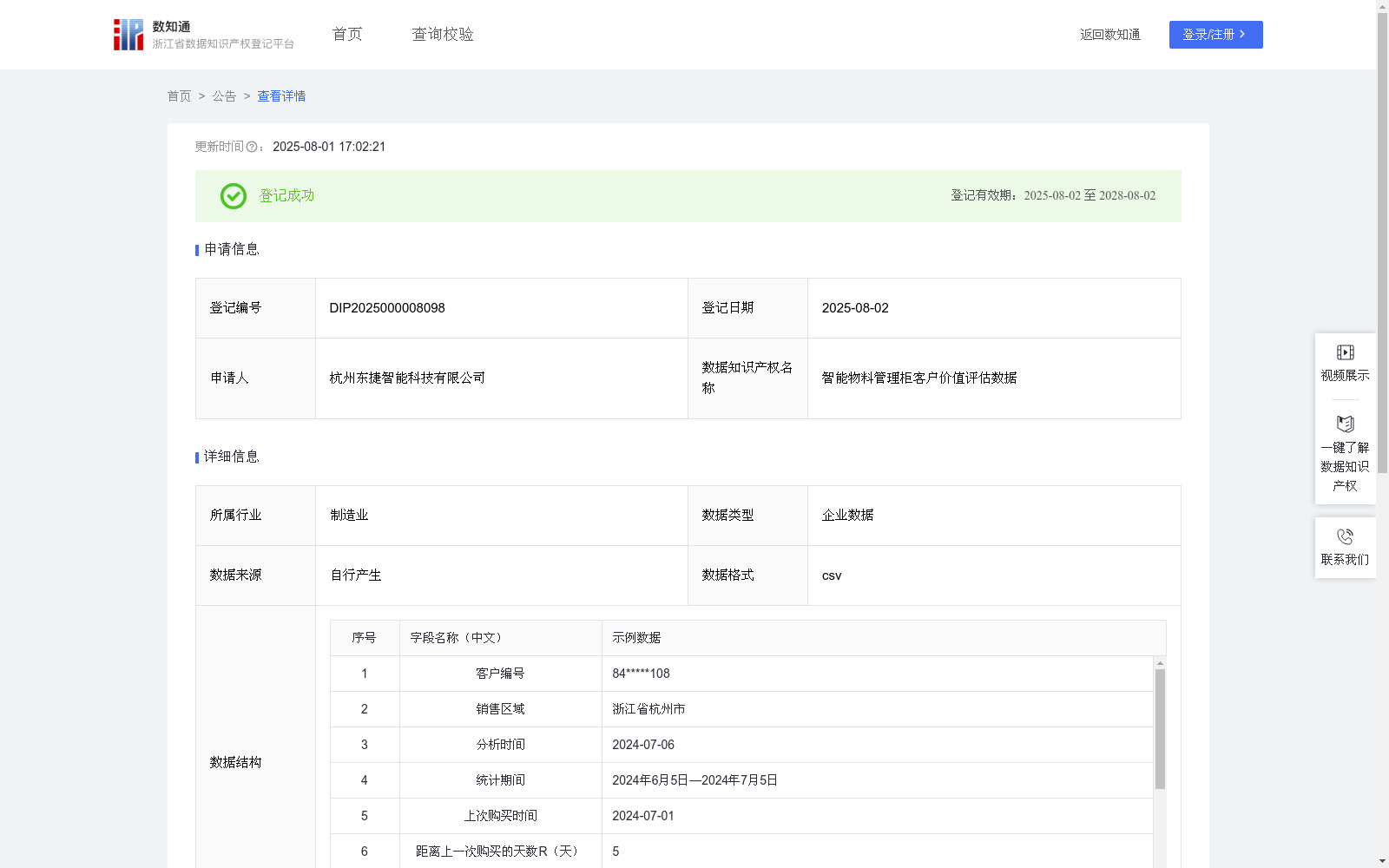
本数据聚焦于公司智能物料管理柜产品对客户的价值度分级评价,揭示了客户的价值层次及其特点。对公司而言,通过客户价值度分级,可以识别高价值客户并制定差异化的营销和服务策略,优化资源配置,提升客户满意度和忠诚度,实现客户价值的最大化。对智能物料管理柜的经销商和代理商而言,基于客户价值度分级数据,可以更科学地规划客户关系管理和服务投入,针对不同价值等级的客户提供定制化的支持和服务,优化运营效率,增强市场竞争力。1.数据采集:采集公司智能物料管理柜产品的销售情况数据,包括客户编号、销售区域、分析时间、统计期间、上次购买时间、距离上一次购买的天数R(天)、最近一段时间购买频次F(次)、最近一段时间购买金额M(元)等数据字段。其中,最近一段时间指最近30天。
2.数据预处理:对采集到的数据进行清洗,去除重复记录,处理缺失值。
3.数据加工:运用RFM模型并结合该客户的R、F、M的排名,分别得出该客户的R、F、M的得分。赋分规则如下:提取所有客户的R,R最短的客户排在最上面,按照从1-5评分,前20%的客户获得5分,接下来的20%用户获得4分,再下来20%的客户为3分,再下来20%的客户为2分,最后20%的客户为1分;提取所有客户的F,从高到底依次对用户进行分类,前20%的客户在用户活动频率的分数为5,以此类推;提取所有客户的M,前20%的客户在消费金额的分数为5,以此类推。
4.数据处理:(1)RFM得分计算:RFM得分=0.3*R得分+0.3*F得分+0.4*M得分。(2)客户等级划分:评分≥4分(A级客户),3≤评分<4(B级客户),2≤评分<3(C级客户),评分<2(D级客户)。
This dataset focuses on the value degree grading evaluation of the company's intelligent material management cabinet products for customers, aiming to reveal the customer value hierarchy and its characteristics.
For the company, customer value degree grading can identify high-value customers, formulate differentiated marketing and service strategies, optimize resource allocation, improve customer satisfaction and loyalty, and maximize customer value. For dealers and agents of intelligent material management cabinets, based on the customer value degree grading data, they can plan customer relationship management and service investment more scientifically, provide customized support and services for customers of different value levels, optimize operational efficiency, and enhance market competitiveness.
1. Data Collection
Collect sales data of the company's intelligent material management cabinet products, including data fields such as customer ID, sales region, analysis time, statistical period, last purchase time, number of days since last purchase (R, in days), purchase frequency (F, times) in the recent period, and purchase amount (M, yuan) in the recent period. The term "recent period" refers to the last 30 days.
2. Data Preprocessing
Clean the collected data, remove duplicate records, and handle missing values.
3. Data Enrichment
Apply the RFM model combined with the rankings of each customer's R, F, and M metrics to calculate the respective R, F, and M scores for the customer. The scoring rules are as follows:
- Extract the R metrics of all customers, sort customers in ascending order of days since last purchase, and assign scores from 1 to 5: the top 20% of customers receive 5 points, the next 20% receive 4 points, the subsequent 20% receive 3 points, the next 20% receive 2 points, and the last 20% receive 1 point;
- Extract the F metrics of all customers, sort customers in descending order of purchase frequency, and assign scores accordingly: the top 20% receive 5 points, and so on;
- Extract the M metrics of all customers, sort customers in descending order of purchase amount, and assign scores accordingly: the top 20% receive 5 points, and so on.
4. Data Calculation and Classification
(1) RFM Score Calculation: RFM Score = 0.3 * R Score + 0.3 * F Score + 0.4 * M Score.
(2) Customer Level Classification: Divide customers into four tiers based on their RFM scores: Tier A (score ≥ 4), Tier B (3 ≤ score < 4), Tier C (2 ≤ score < 3), and Tier D (score < 2).
提供机构:
杭州东捷智能科技有限公司
创建时间:
2025-06-18
搜集汇总
数据集介绍
背景与挑战
背景概述
该数据集为智能物料管理柜产品的客户价值评估数据,包含614条记录,采用RFM模型对客户进行价值度分级,旨在帮助优化营销策略和资源配置。
以上内容由遇见数据集搜集并总结生成


