
冰川气候敏感性区划图(2000-2017)
收藏国家青藏高原科学数据中心2022-09-29 更新2024-03-06 收录
下载链接:
https://data.tpdc.ac.cn/zh-hans/data/59e8efb3-e1e5-4209-87d2-5c08a76e3600
下载链接
链接失效反馈官方服务:
资源简介:
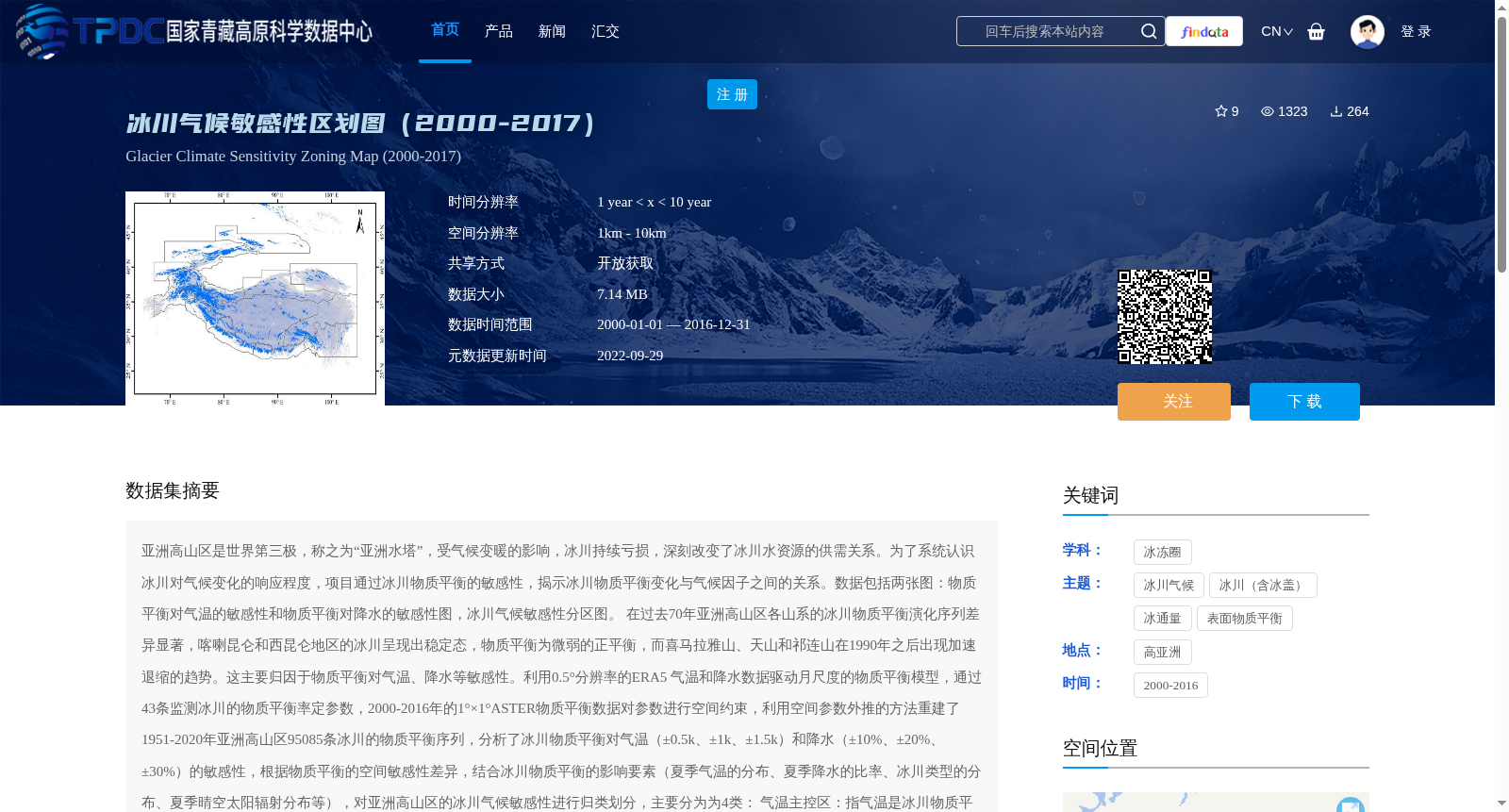
亚洲高山区是世界第三极,称之为“亚洲水塔”,受气候变暖的影响,冰川持续亏损,深刻改变了冰川水资源的供需关系。为了系统认识冰川对气候变化的响应程度,项目通过冰川物质平衡的敏感性,揭示冰川物质平衡变化与气候因子之间的关系。数据包括两张图:物质平衡对气温的敏感性和物质平衡对降水的敏感性图,冰川气候敏感性分区图。
在过去70年亚洲高山区各山系的冰川物质平衡演化序列差异显著,喀喇昆仑和西昆仑地区的冰川呈现出稳定态,物质平衡为微弱的正平衡,而喜马拉雅山、天山和祁连山在1990年之后出现加速退缩的趋势。这主要归因于物质平衡对气温、降水等敏感性。利用0.5°分辨率的ERA5 气温和降水数据驱动月尺度的物质平衡模型,通过43条监测冰川的物质平衡率定参数,2000-2016年的1°×1°ASTER物质平衡数据对参数进行空间约束,利用空间参数外推的方法重建了1951-2020年亚洲高山区95085条冰川的物质平衡序列,分析了冰川物质平衡对气温(±0.5k、±1k、±1.5k)和降水(±10%、±20%、±30%)的敏感性,根据物质平衡的空间敏感性差异,结合冰川物质平衡的影响要素(夏季气温的分布、夏季降水的比率、冰川类型的分布、夏季晴空太阳辐射分布等),对亚洲高山区的冰川气候敏感性进行归类划分,主要分为为4类: 气温主控区:指气温是冰川物质平衡变化的主要控制因素,降水占据次要位置; 降水控制区:指冰川主要受降水控制,全年的冰川区气温低于0℃; 冬季累积型冰川气温、降水控制区:指冰川主要受冬季的降水补给,冰川的物质平衡变化是气温和降水共同作用的结果; 夏季累积型冰川气温、降水控制区:指冰川的补给方式是夏季降水,冰川的物质平衡是气温和降水共同作用的结果。
The High Mountain Asia (HMA), known as the "Third Pole of the World" and the "Asian Water Tower", has been experiencing sustained glacier mass loss under the influence of climate warming, which has profoundly altered the supply and demand relationship of glacial water resources. To systematically understand the response of glaciers to climate change, this project reveals the relationship between changes in glacier mass balance and climatic factors by analyzing the sensitivity of glacier mass balance. The dataset comprises three maps: the map of glacier mass balance sensitivity to air temperature, the map of glacier mass balance sensitivity to precipitation, and the zoning map of glacier climatic sensitivity in High Mountain Asia.
Over the past seven decades, the evolutionary sequences of glacier mass balance across various mountain ranges in High Mountain Asia have differed significantly. Glaciers in the Karakoram and West Kunlun Mountains regions exhibit a stable state with weak positive mass balance, while glaciers in the Himalayas, Tianshan Mountains and Qilian Mountains have shown an accelerated retreat trend since 1990. This is mainly attributed to the sensitivity of mass balance to air temperature, precipitation and other climatic factors.
The monthly glacier mass balance model was driven by ERA5 temperature and precipitation datasets at 0.5° spatial resolution. Model parameters were calibrated using data from 43 monitored glaciers, and spatially constrained by ASTER-derived mass balance data at 1°×1° resolution during 2000–2016. The mass balance time series of 95,085 glaciers in High Mountain Asia from 1951 to 2020 were reconstructed using spatial parameter extrapolation. The sensitivity of glacier mass balance to air temperature (±0.5 K, ±1 K, ±1.5 K) and precipitation (±10%, ±20%, ±30%) was analyzed. Based on the spatial differences in mass balance sensitivity, combined with influencing factors of glacier mass balance including summer air temperature distribution, summer precipitation proportion, glacier type distribution, summer clear-sky solar radiation distribution and others, the glacier climatic sensitivity in High Mountain Asia was classified into four main categories:
1. Temperature-dominated Zone: Air temperature is the primary controlling factor for changes in glacier mass balance, while precipitation plays a secondary role;
2. Precipitation-controlled Zone: Glaciers are mainly controlled by precipitation, with annual air temperature in glacial areas below 0°C;
3. Winter-accumulation Glacier Zone (co-regulated by temperature and precipitation): Glaciers are mainly recharged by winter precipitation, and changes in glacier mass balance are the result of the combined effects of air temperature and precipitation;
4. Summer-accumulation Glacier Zone (co-regulated by temperature and precipitation): Glaciers are recharged mainly by summer precipitation, and glacier mass balance is the result of the combined effects of air temperature and precipitation.
提供机构:
上官冬辉
创建时间:
2022-08-28
搜集汇总
数据集介绍
背景与挑战
背景概述
该数据集提供了亚洲高山区冰川气候敏感性区划图(2000-2017),包括物质平衡对气温和降水的敏感性图,以及冰川气候敏感性分区图。数据集通过分析冰川物质平衡对气温和降水的敏感性,揭示了冰川对气候变化的响应程度,并划分了四种不同的敏感性区域。
以上内容由遇见数据集搜集并总结生成


