
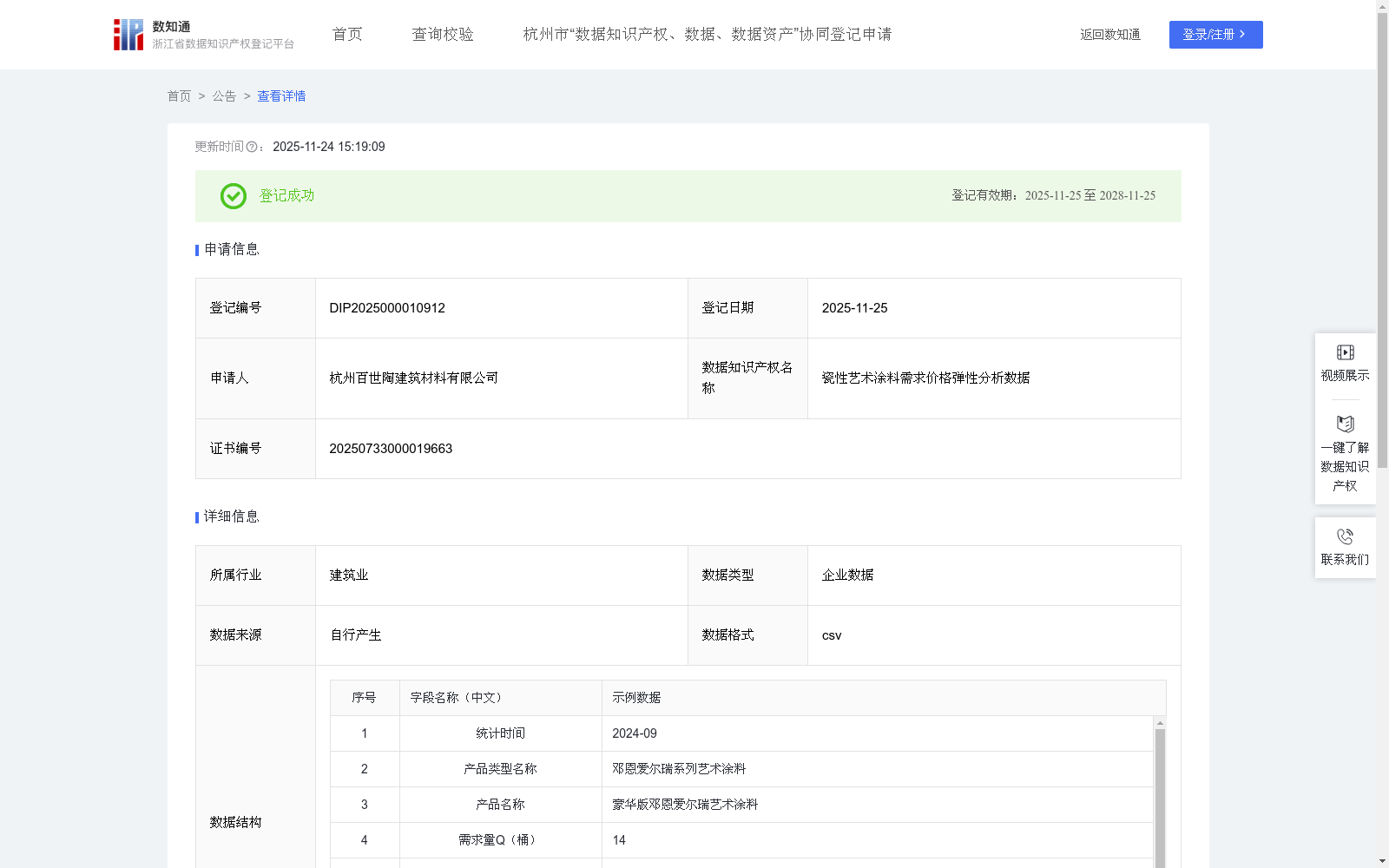
瓷性艺术涂料需求价格弹性分析数据
收藏浙江省数据知识产权登记平台2025-11-24 更新2025-11-26 收录
下载链接:
https://www.zjip.org.cn/home/announce/trends/8405256
下载链接
链接失效反馈官方服务:
资源简介:
本分析聚焦于瓷性艺术涂料的需求价格弹性,揭示了价格与市场需求之间的量化关系。通过分析,供应商可精准制定定价策略,在保障利润的同时提升市场接受度和产品竞争力。对于家装公司、室内设计机构及高端建材经销商等合作伙伴而言,该分析数据有助于优化产品选型与销售策略,提升资源配置效率与市场响应能力,降低因价格波动带来的经营风险。帮助各方灵活应对市场变化,满足消费者对高品质装饰材料的需求,实现经济效益与市场份额的同步提升。1.数据采集:采集瓷性艺术涂料每个月的需求数据和价格数据,具体包括:统计时间、产品类型名称、产品名称、需求量Q(件)、单价P(元)、需求量同比变动值△Q(件)、价格同比变动值△P(元)等。
2.数据预处理:(1)对采集的数据进行去噪处理,确保数据准确性。(2)验证数据的合理性(如采购金额或产品次数为负数的情况)。
3.算法规则:(1)对采集得到的数据进行计算:需求弹性系数Ed=-(ΔQ/Q)/(ΔP/P),得到需求弹性系数。(2)其中,Q表示该类产品的需求量;P表示该类产品的价格;ΔQ表示需求量同比变动值;ΔP表示价格同比变动值。(3)取需求弹性系数的绝对值∣Ed∣作为分析数据时的参考系数。
4.数据分析:根据∣Ed∣的数值可分析该类产品的需求价格弹性:
∣Ed∣=1(单位需求价格弹性),说明需求量变动幅度与价格变动幅度相同;
∣Ed∣>1(需求富有弹性),说明需求量变动幅度大于价格变动幅度;
∣Ed∣<1(需求缺乏弹性),说明需求量变动幅度小于价格变动幅度。
This analysis focuses on the price elasticity of demand for ceramic artistic coatings, uncovering the quantitative relationship between price and market demand. Through this analysis, suppliers can accurately formulate pricing strategies, thereby enhancing market acceptance and product competitiveness while ensuring profitability. For partners such as home decoration companies, interior design institutions, and high-end building material distributors, this analysis data helps optimize product selection and sales strategies, improve resource allocation efficiency and market responsiveness, and reduce operational risks arising from price fluctuations. It enables all parties to flexibly respond to market changes, meet consumers' demand for high-quality decorative materials, and achieve simultaneous growth in economic benefits and market share.
1. Data Collection: Collect monthly demand and price data of ceramic artistic coatings, specifically including: statistical time, product type name, product name, demand quantity Q (unit: piece), unit price P (yuan), year-on-year change in demand ΔQ (unit: piece), year-on-year change in price ΔP (yuan), etc.
2. Data Preprocessing: (1) Denoise the collected data to ensure data accuracy. (2) Verify the rationality of the data (e.g., situations where the purchase amount or product count is negative).
3. Algorithm Rules: (1) Calculate the demand elasticity coefficient Ed = -(ΔQ/Q)/(ΔP/P) using the collected data to obtain the demand elasticity coefficient. (2) In this formula, Q represents the demand quantity of this product category; P represents the unit price of this product category; ΔQ represents the year-on-year change in demand; ΔP represents the year-on-year change in price. (3) Take the absolute value of the demand elasticity coefficient |Ed| as the reference coefficient for subsequent analysis.
4. Data Analysis: Analyze the price elasticity of demand for the product category based on the value of |Ed|:
- When |Ed| = 1 (unitary price elasticity of demand): it indicates that the change magnitude of demand is consistent with that of price;
- When |Ed| > 1 (price-elastic demand): it indicates that the change magnitude of demand is greater than that of price;
- When |Ed| < 1 (price-inelastic demand): it indicates that the change magnitude of demand is less than that of price.
提供机构:
杭州百世陶建筑材料有限公司
创建时间:
2025-07-11
搜集汇总
数据集介绍
背景与挑战
背景概述
该数据集记录了瓷性艺术涂料的需求价格弹性分析数据,包含641条记录,每月更新,涵盖产品类型、需求量、单价和需求弹性系数等字段。通过计算需求弹性系数,帮助供应商和合作伙伴优化定价策略,提升市场响应能力和竞争力,适用于建筑业和高端建材销售场景。
以上内容由遇见数据集搜集并总结生成


