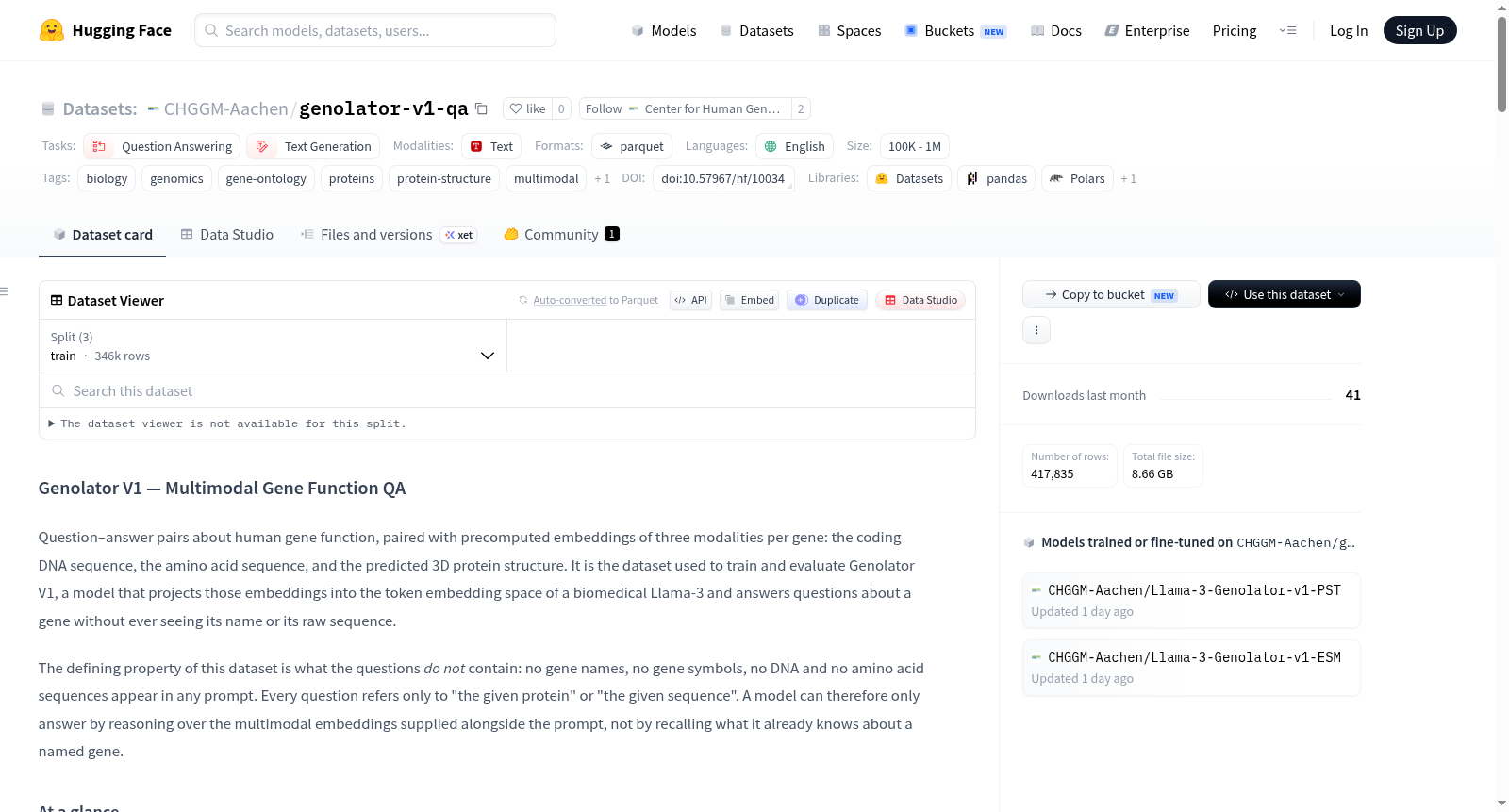
genolator-v1-qa
收藏资源简介:
Genolator V1 Multimodal Gene Function QA 是一个用于人类基因功能问答的多模态数据集。该数据集旨在训练和评估 Genolator V1 模型,该模型通过将基因的三种模态嵌入(编码DNA序列、氨基酸序列和预测的3D蛋白质结构)投影到生物医学 Llama-3 的标记嵌入空间,从而在不接触基因名称或原始序列的情况下回答关于基因的问题。 数据集包含 417,835 个问答对,覆盖 17,732 个基因(MANE Select 1.4 版本,代表转录本)。数据按基因划分,训练集、验证集和测试集分别占比 80%、10% 和 10%,且基因不重叠。每个样本包含 prompt(问题,不含基因名称或序列)、response(基于GO slim本体的答案)、kind(问题类型:confirmation、denial 或 generic)、go_aspect(GO方面:molecular_function, cellular_component, biological_process)、以及三种序列和对应的嵌入:cdna_seq_embedding(Evo2 7B 生成的4096维嵌入)、aa_seq_embedding(ESM-2生成的2560维嵌入)、pst_embedding(PST结构嵌入,1280维)。所有嵌入完整且无缺失。 问题分为三类:confirmation(确认基因已注释的GO术语)、denial(否认基因未注释的GO术语,构成平衡的二元任务)、generic(开放性问题,描述可能的功能、过程或定位)。答案由GPT-4.1生成,并由两位研究者独立审查了56个基因的样本。 数据集适用于需要模型仅通过多模态嵌入推理基因功能的任务,不适合需要识别基因名称的场景。注意:答案为模型生成,可能不完整;denial项基于证据缺失而非生物学否定;覆盖仅限于MANE Select的蛋白质编码基因;结构为AlphaFold预测;generic答案较长,需语义评估。
Genolator V1 Multimodal Gene Function QA is a multimodal dataset for human gene function question answering. The dataset is designed to train and evaluate the Genolator V1 model, which projects three modalities of gene embeddings (encoding DNA sequence, amino acid sequence, and predicted 3D protein structure) into the token embedding space of biomedical Llama-3, enabling it to answer questions about genes without accessing gene names or raw sequences. The dataset contains 417,835 question-answer pairs covering 17,732 genes (MANE Select v1.4, representative transcripts). Data is split by gene into training, validation, and test sets with 80%, 10%, and 10% ratios respectively, without gene overlap. Each sample includes a prompt (question, without gene name or sequence), response (answer based on GO slim ontology), kind (question type: confirmation, denial, or generic), go_aspect (GO aspect: molecular_function, cellular_component, biological_process), and three types of sequences with corresponding embeddings: cdna_seq_embedding (4096-dim from Evo2 7B), aa_seq_embedding (2560-dim from ESM-2), pst_embedding (1280-dim PST structure embedding). All embeddings are complete without missing values. Questions are categorized into three types: confirmation (confirming annotated GO terms), denial (denying unannotated GO terms, forming a balanced binary task), and generic (open-ended questions describing possible functions, processes, or localization). Answers are generated by GPT-4.1 and independently reviewed by two researchers for a sample of 56 genes. The dataset is suitable for tasks requiring models to infer gene function solely from multimodal embeddings, and is not suitable for scenarios requiring gene name recognition. Note: answers are model-generated and may be incomplete; denial items are based on absence of evidence rather than biological negation; coverage is limited to protein-coding genes in MANE Select; structures are AlphaFold predictions; generic answers are longer and require semantic evaluation.
Genolator V1 多模态基因功能问答数据集
概述
Genolator V1 是一个用于训练和评估多模态大语言模型(Genolator V1)的人类基因功能问答数据集。数据集的核心设计理念是:每个问答对不包含任何基因名称、符号或原始序列信息,模型必须仅通过提供的三种模态嵌入(编码DNA序列、氨基酸序列、预测的3D蛋白质结构)来回答关于"给定蛋白质"或"给定序列"的问题,而无法依赖对已知基因名称的记忆。
数据集规模
| 划分 | 行数 | 基因数 | 文件大小 |
|---|---|---|---|
| 训练集 | 345,927 | 14,186 | 6.7 GiB |
| 验证集 | 36,521 | 1,773 | 0.71 GiB |
| 测试集 | 35,387 | 1,773 | 0.68 GiB |
| 总计 | 417,835 | 17,732 | 8.1 GiB |
数据集采用基因不重叠划分,即每个基因仅出现在一个划分中,基因级比例精确为80%/10%/10%。
数据列说明
| 列名 | 类型 | 描述 |
|---|---|---|
gene_name |
string | HGNC基因符号,仅作为元数据,不提供给模型 |
prompt |
string | 问题文本,不含基因名称、符号或原始序列 |
response |
string | 基于GO slim本体论的目标答案 |
kind |
string | 问题类型:confirmation、denial 或 generic |
go_aspect |
string | GO方面:molecular_function、cellular_component 或 biological_process |
dna_seq |
string | MANE Select转录本的编码序列(CDS),仅含ACGT |
cdna_seq |
string | 含UTR的完整转录本序列,包含dna_seq作为子串 |
aa_seq |
string | 编码蛋白质的氨基酸序列 |
cdna_seq_embedding |
list<float>[4096] | Evo2 7B对cdna_seq的嵌入,均值池化 |
aa_seq_embedding |
list<float>[2560] | ESM-2对aa_seq的嵌入,均值池化 |
pst_embedding |
list<float>[1280] | PST结构信息嵌入,均值池化 |
group |
int64 | 仅训练集,轮次旋转子集(1–3) |
所有嵌入列在三个划分中均完整且格式正确,每行嵌入维度精确,无空值或非有限值。序列列在同一基因的所有问答行中重复,这是文件体积相对行数较大的原因。
三类问题
数据集由三种问题类型 × 三个GO方面组合成九个子数据集,通过kind和go_aspect列区分:
confirmation(确认类):询问基因已注释的GO术语,正确答案为肯定。denial(否定类):询问基因未注释的GO术语,正确答案为否定,与confirmation构成平衡的二元任务。generic(通用类):开放式问题,邀请描述可能的功能、过程或定位,答案采用描述性表述而非命名实体。
类别组成
| 划分 | confirmation | denial | generic | molecular_function | cellular_component | biological_process |
|---|---|---|---|---|---|---|
| 训练集 | 115,113 | 115,113 | 115,701 | 106,586 | 124,712 | 114,629 |
| 验证集 | 15,965 | 15,417 | 5,139 | 11,832 | 12,494 | 12,195 |
| 测试集 | 15,463 | 14,943 | 4,981 | 11,363 | 12,480 | 11,544 |
验证集和测试集中每个基因和GO方面各有一个generic项,是confirmation或denial数量的约三分之一。训练集则实现了类别平衡。
构建方法
- 基因与注释:基于MANE Select 1.4版本(GRCh38),每个典型蛋白质编码基因一个代表性转录本,使用Gene Ontology术语注释。
- 问题生成:使用GPT-4.1(Azure AI Foundry托管),为每个GO方面设计专用系统提示词和至少六个手工制作的少样本示例,全程不提供基因名称、符号、DNA或氨基酸序列,防止标识符泄漏到问答中。
- 质量评估:随机选取56个基因的QA样本由两名研究人员独立盲审,使用自托管Arize Phoenix跟踪生成过程。
- 嵌入计算:
- DNA嵌入(4096维):Evo2 7B基因组基础模型,取
blocks.28.mlp.l3层,均值池化。 - 氨基酸嵌入(2560维):通过ESMFold 3B访问ESM-2,超过1000残基的序列分段推断后拼接并均值池化。
- 结构嵌入(1280维):Protein Structure Transformer(PST),基于AlphaFold预测结构,均值池化。
- DNA嵌入(4096维):Evo2 7B基因组基础模型,取
- 相似性感知划分:将三种嵌入拼接成多模态表示,使用KMeans(k=3)在余弦相似度下聚类,使结构性和功能性相似的基因落入同一簇,映射到训练/验证/测试划分,比例约80/10/10。
加载方式
支持通过datasets库直接加载(默认加载全部三个划分),训练集可流式加载以避免占用磁盘空间,也可通过PyArrow直接读取parquet文件以选择所需列。train.parquet按20,000行行组写入(18个行组),批量读取内存有界;验证集和测试集各为单个行组。
预期用途与局限性
预期用途:专门用于训练和评估仅通过投影嵌入接收基因信息的语言模型。
局限性:
- 所有答案由GPT-4.1模型生成,仅经56基因的盲审抽查,非穷尽式人工整理。
denial项基于注释缺失,而非生物学上的事实否定,应理解为"未注释"而非"不存在"。- 覆盖范围仅限于MANE Select的典型转录本,不含异构体、非编码基因或非典型转录本。
- 结构嵌入来自AlphaFold预测,带有预测方法的不确定性。
generic答案较长且具描述性,评估需采用语义度量,精确匹配评分无意义。
来源与许可
衍生自MANE Select 1.4、Gene Ontology注释、AlphaFold蛋白质结构数据库,以及GPT-4.1生成的问答文本。嵌入由Evo2 7B、ESM-2和PST计算。
联系方式
数据集创建者为Martin Danner,来自亚琛人类遗传学与基因组医学中心(mdanner@ukaachen.de)和scieneers GmbH(martin.danner@scieneers.de)。