direct-edge-damage-effects
收藏资源简介:
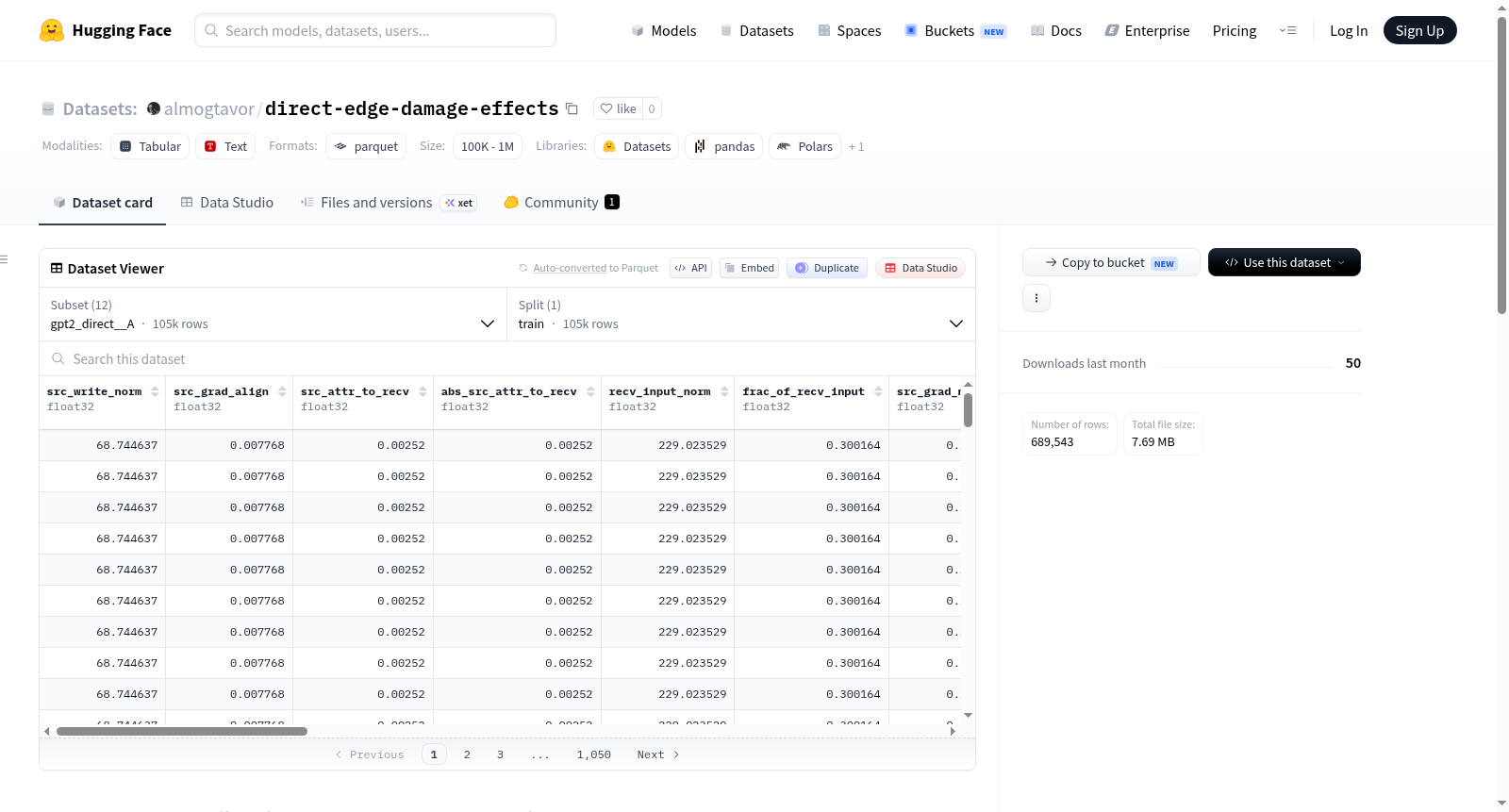
该数据集名为“直接边损伤效应(仅提示边干预)”,旨在为变压器语言模型(LM)中边粒度的摊销因果干预效应预测提供数据支持,无需使用干净/损坏提示对。数据集中,干预的基本单元是计算图中的有向边(例如,从注意力头7到头18输入的贡献)。对于每个输入提示,通过精确移除源组件对接收组件输入的贡献(同时保留源组件对所有其他下游组件的可用性),并记录完整模型与干预后模型在下一次令牌预测分布之间的精确KL散度,从而生成数据标签。此外,数据集还捕获了源残差写入范数、一阶边归因、接收输入占比、梯度范数以及边结构描述符等多种廉价特征。数据集包含多个配置,分别基于GPT-2、Qwen-3和Pythia等不同模型,并区分了不同的实验设计(如A、B、mediated、design3)。具体而言,`*__A`配置提供单边直接KL损伤数据,包含约22个列,其中`kl`为标签;`*__B`配置提供电路条件化的边际直接KL数据,在A类列的基础上增加了电路密度、动作(添加/移除)、当前电路KL值以及边际KL变化(`y_marginal`)等列。所有数据均以Parquet格式存储,且仅包含训练集分割。提示文本涵盖多种领域,包括网页、代码、数学、对话、问答、长上下文以及特定的推理任务(如IOI、归纳)。该数据集的目标是作为一种可扩展的预训练信号,用于开发通用、提示级的机制可解释性方法。
This dataset is named Direct Edge Damage Effect (Prompt-Only Edge Intervention) and aims to provide data support for amortized causal intervention effect prediction at the edge granularity in transformer language models (LMs), without using clean/damaged prompt pairs. In the dataset, the basic unit of intervention is a directed edge in the computational graph (e.g., the contribution from attention head 7 to the input of head 18). For each input prompt, data labels are generated by precisely removing the contribution of the source component to the input of the receiving component (while retaining the availability of the source component to all other downstream components) and recording the exact KL divergence between the full model and the intervened model in the next token prediction distribution. Additionally, the dataset captures various cheap features such as source residual write norm, first-order edge attribution, receiving input proportion, gradient norm, and edge structural descriptors. The dataset includes multiple configurations based on different models like GPT-2, Qwen-3, and Pythia, and distinguishes between different experimental designs (e.g., A, B, mediated, design3). Specifically, the `*__A` configuration provides single-edge direct KL damage data with approximately 22 columns, where `kl` is the label; the `*__B` configuration provides circuit-conditioned marginal direct KL data, adding columns such as circuit density, action (add/remove), current circuit KL value, and marginal KL change (`y_marginal`) on top of the A-type columns. All data is stored in Parquet format and includes only the training set split. The prompt texts cover various domains, including web pages, code, mathematics, dialogue, question-answering, long context, and specific reasoning tasks (e.g., IOI, induction). The goal of this dataset is to serve as a scalable pre-training signal for developing general, prompt-level mechanistic interpretability methods.