zjunlp/MemTraceBench
收藏资源简介:
MemTraceBench是一个与论文《MemTrace: Tracing and Attributing Errors in Large Language Model Memory Systems》一同发布的基准测试数据集。它旨在通过将内存管道转换为执行图,以细粒度追踪大型语言模型内存系统中的信息流,包括信息的提取、更新、删除、检索和最终在响应中的利用。数据集包含精心策划的失败注释,用于系统研究内存故障模式,每个失败查询都标注了根本原因错误类型和执行图中的决定性故障操作。数据集结构分为四个部分,分别对应不同的内存系统:rag(朴素RAG)、mem0(Mem0)、evermemos(EverMemOS)和long_context(长上下文),每个部分包含JSON格式的执行图文件,这些文件来自多个会话内存数据集(如LoCoMo、LongMemEval和RealMem)。每个JSON文件遵循smartcomment执行图格式,包含节点、边、操作、会话和注释等字段。注释部分详细描述了失败查询的信息,如查询文本、参考答案、预测结果、错误类型和故障操作标识。数据集加载需要smartcomment包,并支持可视化操作子图。数据集的生成通过将四个代表性内存系统运行在轨迹数据上,并经过人工标注和GPT-5.5聚合整理而成。
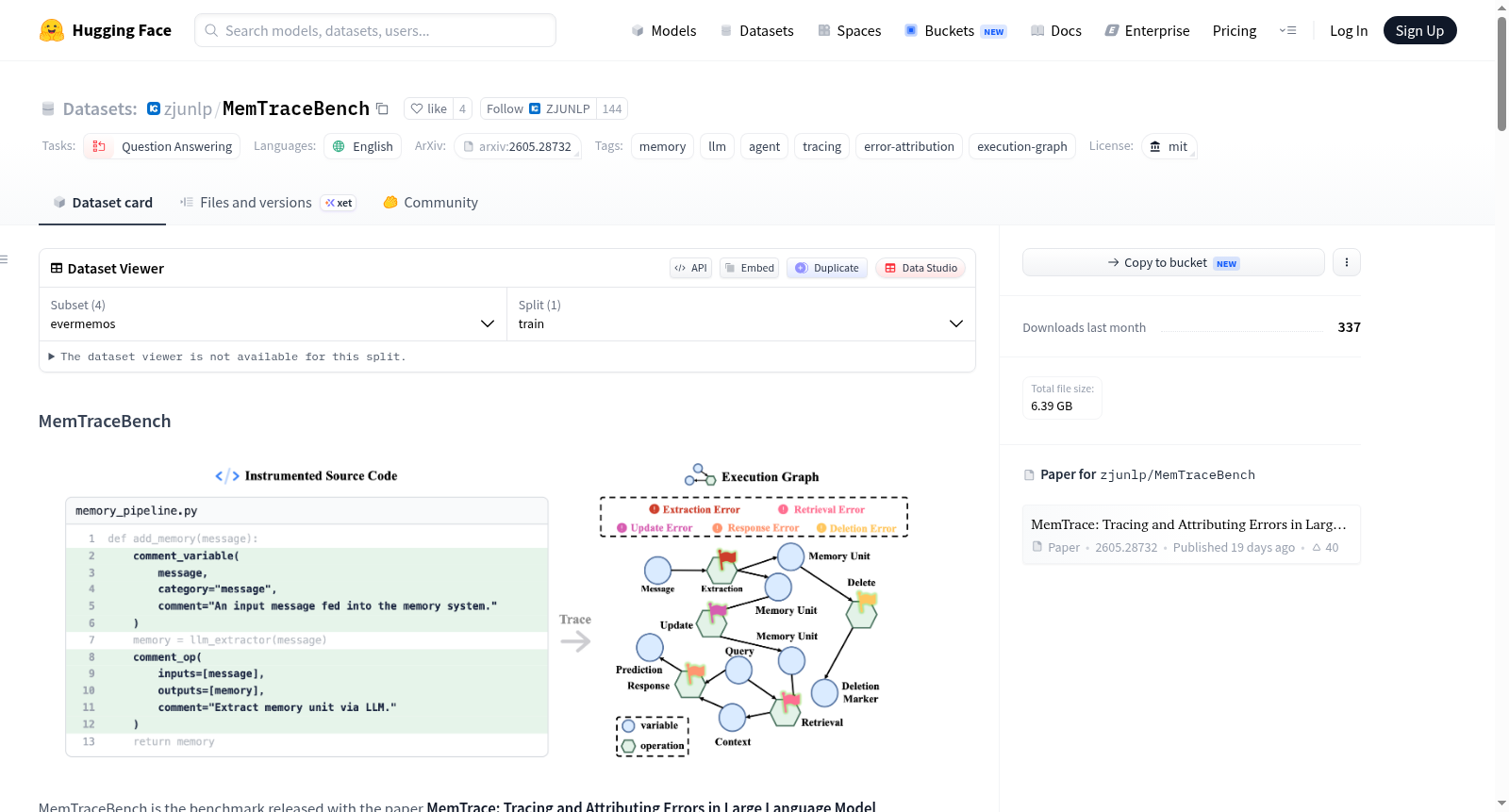
MemTraceBench is the benchmark released with the paper MemTrace: Tracing and Attributing Errors in Large Language Model Memory Systems. It transforms a memory pipeline into an execution graph to trace the operational information flow inside a memory system at fine granularity, covering how information is extracted, updated, deleted, retrieved, and finally utilized in the response. The dataset packages these execution graphs together with curated failure annotations so that memory failure modes can be studied systematically. Each failed query is labelled with a root-cause error type and the decisive faulty operation in the graph. The dataset is split by the memory system that produces the trajectories, with four splits: rag (Naive RAG), mem0 (Mem0), evermemos (EverMemOS), and long_context (Long-Context). Each split is a directory of JSON files, where every file is one serialized execution graph collected from representative memory systems, sourced from multi-session memory datasets like LoCoMo, LongMemEval, and RealMem. Each JSON file follows the smartcomment execution-graph format, containing nodes, edges, operations, sessions, and annotations. The annotations describe failed queries with fields such as query text, golden answers, prediction, error type, and faulty operation identifier. Loading the dataset requires the smartcomment package and supports visualization of operation subgraphs. The execution graphs are produced by running four memory systems over trajectories, with human annotation and GPT-5.5 aggregation for error attribution.