
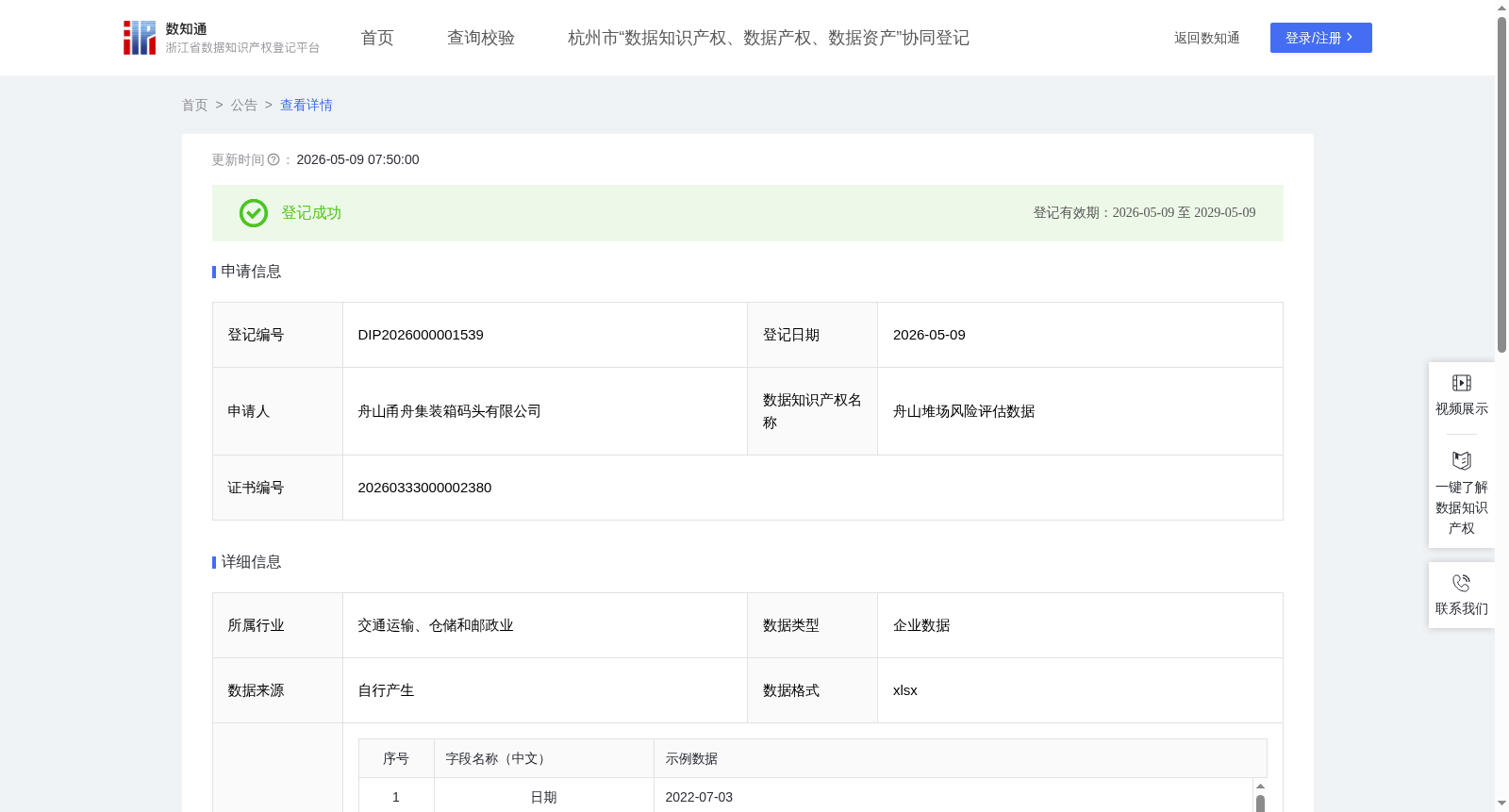
舟山堆场风险评估数据
收藏浙江省数据知识产权登记平台2026-05-09 更新2026-05-10 收录
下载链接:
https://www.zjip.org.cn/home/announce/trends/8442282
下载链接
链接失效反馈官方服务:
资源简介:
通过对舟山堆场安全风险进行多维量化评估,实时分析综合风险指数、容量压力、动态趋势动量、箱型结构集中度、核心区域偏差度等关键指标,企业堆场计划与运营团队能够前瞻性地预判堆场拥堵与安全瓶颈。这使得企业能够动态调整堆场作业策略,优化场地资源分配,合理规划危险品箱、残损箱、超限箱等特殊箱型的落位与作业次序,有效降低因场地拥堵造成的无效翻倒柜作业和安全隐患,从而在有限的堆场空间内,最大化提升集装箱的周转处理能力。对于船公司与大型物流企业而言,数据涵盖容量压力、结构风险、区域联动的多维风险指数,是预判港口堆场拥堵程度、优化航线选择与运输计划的"晴雨表",能帮助它们精准决策,是选择加速进港、减速等待还是临时转港,从而有效规避高昂的船舶滞期费用与燃油成本浪费。对于陆运拖车公司和货主,这意味着更透明、更可预期的提/还箱作业窗口,使其能够合理安排车队调度、优化运输路线,进而保障下游工厂的生产计划与零售商的库存稳定。数据也可用于同类型集装箱码头、危险品堆场等场景的安全风险量化评估体系建设,帮助行业从经验式人工巡检转向数据驱动的实时风险预警与智能管控。一、数据采集与预处理 采集字段:日期时间、空箱总量、重箱总量、冷藏箱总量、危险箱总量、残损箱总量、超限箱总量、中转箱量、实时堆存量、额定堆存量、龙门吊场地实时堆存量、龙门吊场地额定堆存量。
二、核心风险指标计算 全场堆存率S(%) = (实时堆存量 / 额定堆存量) × 100; 核心区域堆存率S_core(%) = (龙门吊场地实时堆存量 / 龙门吊场地额定堆存量) × 100; 非核心区域堆存率S_noncore(%) = ((实时堆存量 - 龙门吊实时堆存量) / (额定堆存量 - 龙门吊额定堆存量)) × 100; 日变化率Δ(%) = ((当日S - 前一日S) / 前一日S) × 100; 7日移动平均线S_MA7 = 近7日S的算术平均值; 趋势动量Momentum = 当日S / S_MA7,其中大于1表示上行趋势,小于1表示下行趋势; 波动率Volatility = 近7日S的标准差; 总箱量N_total = 空箱总量 + 重箱总量 + 冷藏箱总量 + 危险箱总量 + 残损箱总量 + 超限箱总量 + 中转箱量; 特殊箱型加权数量N_weighted = (危险箱总量 × W危) + (残损箱总量 × W残) + (超限箱总量 × W超) + (冷藏箱总量 × W冷),其中W危=3, W残=2, W超=1, W冷=1; 特殊箱型风险指数R_special(%) = (N_weighted / N_total) × 100; 信息熵H = -Σ(p_i × log₂(p_i)),其中p_i = 第i类箱型数量 / N_total,共7类箱型; 箱型集中度C(%) = (1 - H / log₂(7)) × 100,数值越高表示箱型分布越不均衡,风险越大; 区域偏差度D(%) = (|S_core - S| / S) × 100。
By conducting a multi-dimensional quantitative safety risk assessment at the Zhoushan Container Yard and performing real-time analysis of key indicators including comprehensive risk index, capacity pressure, dynamic trend momentum, container type structure concentration, core area deviation and others, enterprise yard planning and operation teams can prospectively predict yard congestion and safety bottlenecks. This enables enterprises to dynamically adjust yard operation strategies, optimize site resource allocation, and reasonably plan the placement and operation sequence of special container types such as dangerous goods containers, damaged containers and over-dimensional containers, effectively reducing unnecessary container rehandling operations and safety hazards caused by site congestion, thereby maximizing container turnover and handling capacity within limited yard space.
For shipping companies and large logistics enterprises, the data covers multi-dimensional risk indices including capacity pressure, structural risk and regional linkage, serving as a "barometer" for predicting the degree of port yard congestion and optimizing route selection and transportation plans. It helps them make precise decisions on whether to accelerate berthing, slow down and wait, or temporarily transfer to another port, thus effectively avoiding high ship demurrage fees and wasted fuel costs.
For road haulage companies and shippers, this means more transparent and predictable container pick-up/drop-off windows, enabling them to reasonably arrange fleet scheduling and optimize transportation routes, thereby ensuring the production plans of downstream factories and the inventory stability of retailers. The data can also be used for the construction of safety risk quantitative assessment systems in similar scenarios such as container terminals and dangerous goods yards, helping the industry shift from experience-based manual inspections to data-driven real-time risk early warning and intelligent control.
1. Data Collection and Preprocessing
Collection fields: date and time, total empty containers, total loaded containers, total reefer containers, total dangerous goods containers, total damaged containers, total over-dimensional containers, total transshipment containers, real-time stacking inventory, rated maximum stacking capacity, real-time stacking inventory of gantry crane yards, rated maximum stacking capacity of gantry crane yards.
2. Calculation of Core Risk Indicators
Overall storage rate S(%) = (real-time stacking inventory / rated maximum stacking capacity) × 100;
Core area storage rate S_core(%) = (real-time stacking inventory of gantry crane yards / rated maximum stacking capacity of gantry crane yards) × 100;
Non-core area storage rate S_noncore(%) = ((real-time stacking inventory - real-time stacking inventory of gantry crane yards) / (rated maximum stacking capacity - rated maximum stacking capacity of gantry crane yards)) × 100;
Daily change rate Δ(%) = ((current day's S - previous day's S) / previous day's S) × 100;
7-day moving average S_MA7 = arithmetic mean of S over the past 7 days;
Trend momentum = current day's S / S_MA7, where a value greater than 1 indicates an upward trend and a value less than 1 indicates a downward trend;
Volatility = standard deviation of S over the past 7 days;
Total container volume N_total = total empty containers + total loaded containers + total reefer containers + total dangerous goods containers + total damaged containers + total over-dimensional containers + total transshipment containers;
Weighted quantity of special container types N_weighted = (total dangerous goods containers × W_danger) + (total damaged containers × W_damage) + (total over-dimensional containers × W_over) + (total reefer containers × W_reefer), where W_danger=3, W_damage=2, W_over=1, W_reefer=1;
Special container type risk index R_special(%) = (N_weighted / N_total) × 100;
Information entropy H = -Σ(p_i × log₂(p_i)), where p_i = number of the i-th container type / N_total, totaling 7 container types;
Container type concentration C(%) = (1 - H / log₂(7)) × 100, with higher values indicating more uneven distribution of container types and greater risks;
Area deviation D(%) = (|S_core - S| / S) × 100.
提供机构:
舟山甬舟集装箱码头有限公司
创建时间:
2026-03-16
搜集汇总
数据集介绍
背景与挑战
背景概述
舟山堆场风险评估数据是由舟山甬舟集装箱码头有限公司提供的企业数据,格式为xlsx,包含1005条记录并每日更新。该数据集通过对堆场容量压力、动态趋势动量、箱型结构集中度和区域偏差度等32个字段的多维量化分析,生成综合风险指数和风险等级(如中风险),旨在帮助企业前瞻性地预判堆场拥堵与安全瓶颈,动态调整作业策略和资源分配。该数据适用于集装箱码头、危险品堆场等场景,支持从经验式管理转向数据驱动的实时风险预警与智能管控,为船公司、物流企业和陆运拖车公司提供决策依据,有效降低运营成本和安全隐患。
以上内容由遇见数据集搜集并总结生成



