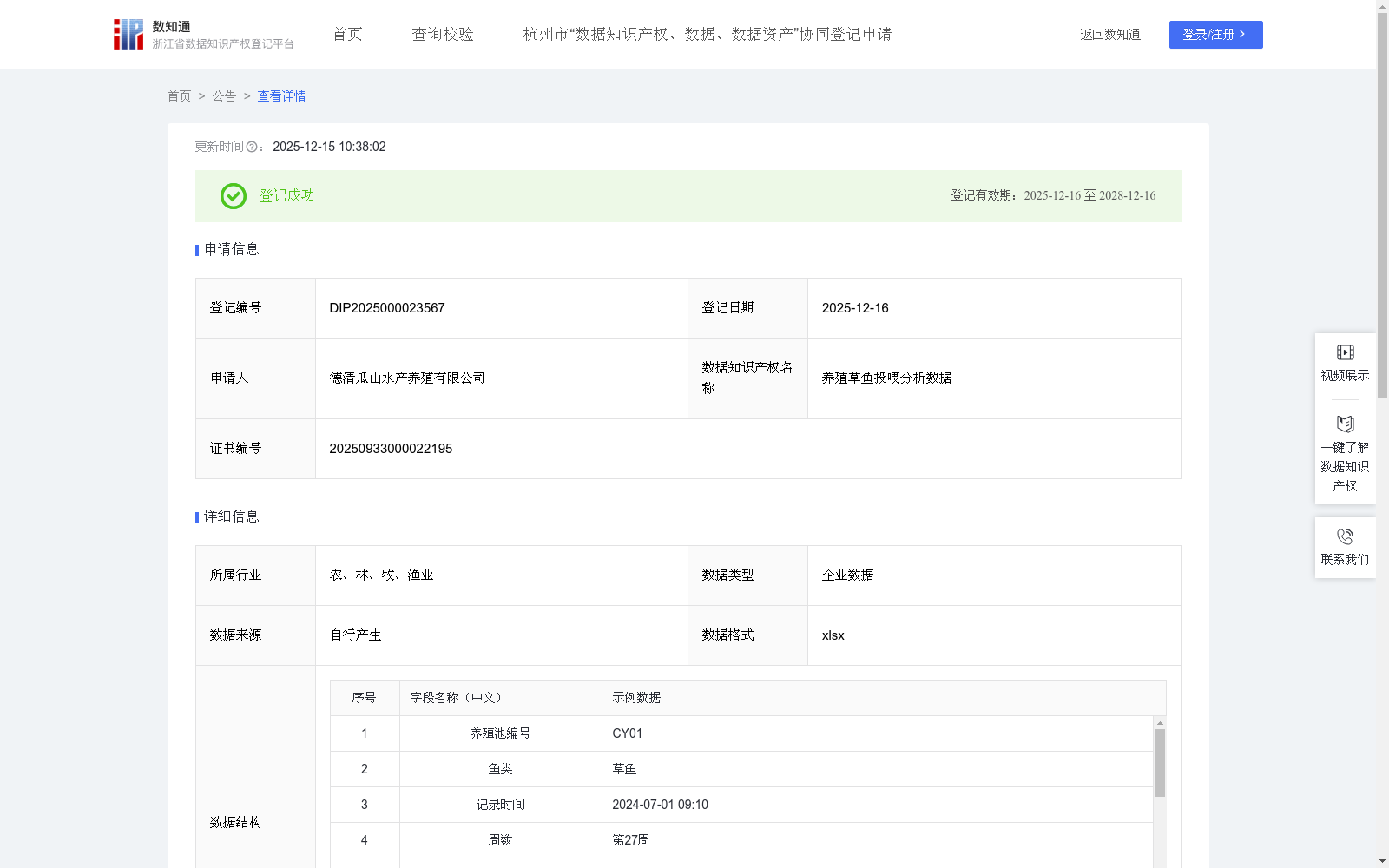
养殖草鱼投喂分析数据
收藏资源简介:
养殖草鱼投喂分析数据面向规模化水产养殖场的投喂管理方法研究。该分析综合溶氧、水温、pH、氨氮、气象条件与鱼群活性等多源数据,研究饲料投喂策略对草鱼生长速度的影响规律,实现科学化、精准化投喂管理。主要应用于日常精准投喂、风险预警应急、成本控制优化、数据驱动决策、合规质量追溯等场景,通过多参数融合、实时监测、数据分析等技术手段,提升饲料利用率、降低养殖成本、保障养殖安全。对养殖行业而言,既避免饲料浪费与残饵污染,降低养殖成本,又能依托数据异常预警水质恶化、鱼群应激等风险,减少病害损失;更可将有效经验转化为标准化体系,推动草鱼养殖从 “凭经验” 的粗放模式向精细化转型。对社会来说,精准投喂减少资源消耗与环境承载压力,契合绿色农业理念;科学投喂提升草鱼品质与养殖成功率,既降低应急用药需求保障食品安全,又稳定市场供应;同时降本增效直接提升养殖户收益,带动产业链发展,为乡村振兴注入产业动力。1、数据采集:通过企业对鱼塘进行数据检测与采集,使用水质传感器对鱼塘进行采集数据,整理后获得原始数据字段:养殖池编号、鱼类、记录时间、周数、季节、活跃度、溶氧、水温、pH、氨氮、鱼群活性评分、摄食活跃度评分、鱼群聚集度、平均体重、放养密度、历史残饵率。 2、算法规则:对鱼类投喂量在基础投喂量计算的基础上,结合环境参数修正因子、鱼群行为修正因子和残饵率修正,采用如下综合算法: 基础日投喂率:根据平均体重设定:0.2–0.5 kg:1.8%–2.5%/日,0.5–1.0 kg:1.2%–1.8%/日,1.0–2.0 kg:0.8%–1.2%/日; 日总投喂量 = 平均体重(kg/尾) × 放养密度(尾/亩) × 基础日投喂率; 环境修正因子 = 1 - (0.35 × |溶氧 - 溶氧最优值| + 0.30 × |水温 - 水温最优值| + 0.20 × |pH - pH最优值| + 0.15 × |氨氮 - 氨氮最优值|); 溶氧最优值:6.0 mg/L,权重:0.35; 水温最优值:26.0 ℃,权重:0.30; pH最优值:7.0,权重:0.20; 氨氮最优值:0.1 mg/L,权重:0.15; 行为修正因子 = 0.4 × 鱼群活性评分/100 + 0.4 × 摄食活跃度评分/100 + 0.2 × 鱼群聚集度/100; 历史残饵率修正系数:根据历史残饵率设定(< 3%:1.10,3%–5%:1.00,> 5%:0.80); 当日投喂次数根据季节设定:春季/秋季3次(8:30、11:30、16:30),夏季4次(7:00、9:30、17:30、20:00),冬季1-2次(中午时段); 最终单次投喂量 = (日总投喂量 × 环境修正因子 × 行为修正因子 × 历史残饵率修正系数) / 当日投喂次数。 3、数据分析: 通过算法规则获得最终单次投喂量去进行投喂,不仅能显著减少饲料浪费,更能精准匹配鱼类不同生长阶段、不同环境下的进食需求,保障其健康生长;从源头可降低历史残饵率,减少残饵分解产生的有机污染物积累,避免水体溶氧消耗、氨氮超标等问题,有效缓解因过量投喂导致的水质恶化,优化下一次测量数据,更精确的得到最终单次投喂量数据,为智慧养殖的降本增效与绿色生态发展提供了可落地的技术路径。
Data for Feeding Analysis of Farmed Grass Carp is intended for research on feeding management methods in large-scale aquaculture farms. This analysis integrates multi-source data including dissolved oxygen, water temperature, pH, ammonia nitrogen, meteorological conditions, and fish school activity to study the influence of feed feeding strategies on the growth rate of grass carp, aiming to achieve scientific and precise feeding management. It is mainly applied in scenarios such as daily precise feeding, risk early warning and emergency response, cost control optimization, data-driven decision-making, and compliant quality traceability. Through technical means like multi-parameter fusion, real-time monitoring, and data analysis, it improves feed utilization efficiency, reduces aquaculture costs, and ensures aquaculture safety. For the aquaculture industry, it not only avoids feed waste and residual bait pollution, reduces aquaculture costs, but also relies on data anomaly warnings to detect risks such as water quality deterioration and fish school stress, thereby reducing disease losses. Furthermore, it can convert effective experiences into a standardized system, promoting the transformation of grass carp aquaculture from an experience-based extensive model to a refined one. For society, precise feeding reduces resource consumption and environmental carrying pressure, aligning with the concept of green agriculture; scientific feeding improves the quality of grass carp and aquaculture success rate, which not only reduces the demand for emergency drugs to ensure food safety but also stabilizes market supply. Meanwhile, cost reduction and efficiency improvement directly increase the income of farmers, drive the development of the industrial chain, and inject industrial momentum into rural revitalization. 1. Data Collection: Enterprises conduct data detection and collection for fish ponds using water quality sensors. After sorting, the original data fields obtained include: aquaculture pond ID, fish species, recording time, week number, season, activity level, dissolved oxygen, water temperature, pH, ammonia nitrogen, fish school activity score, feeding activity score, fish school aggregation degree, average body weight, stocking density, and historical residual bait rate. 2. Algorithm Rules: The fish feeding amount is calculated based on the basic feeding amount, combined with environmental parameter correction factors, fish school behavior correction factors, and residual bait rate correction, using the following comprehensive algorithm: Basic daily feeding rate: Set according to average body weight: 0.2–0.5 kg: 1.8%–2.5% per day; 0.5–1.0 kg:1.2%–1.8% per day;1.0–2.0 kg:0.8%–1.2% per day; Total daily feeding amount = Average body weight (kg/fish) × Stocking density (fish/mu) × Basic daily feeding rate; Environmental correction factor =1 - (0.35 × |Dissolved oxygen - Optimal dissolved oxygen value| +0.30 × |Water temperature - Optimal water temperature value| +0.20 × |pH - Optimal pH value| +0.15 × |Ammonia nitrogen - Optimal ammonia nitrogen value|); Optimal dissolved oxygen value:6.0 mg/L, weight:0.35; Optimal water temperature value:26.0 ℃, weight:0.30; Optimal pH value:7.0, weight:0.20; Optimal ammonia nitrogen value:0.1 mg/L, weight:0.15; Behavior correction factor =0.4 × (Fish school activity score/100) +0.4 × (Feeding activity score/100) +0.2 × (Fish school aggregation degree/100); Historical residual bait rate correction coefficient: Set according to historical residual bait rate (<3%:1.10;3%–5%:1.00;>5%:0.80); Number of feeding times per day: Set according to season: Spring/Autumn:3 times (8:30,11:30,16:30); Summer:4 times (7:00,9:30,17:30,20:00); Winter:1-2 times (noon period); Final single feeding amount = (Total daily feeding amount × Environmental correction factor × Behavior correction factor × Historical residual bait rate correction coefficient) / Number of feeding times per day. 3. Data Analysis: Feeding based on the final single feeding amount obtained from the algorithm rules not only significantly reduces feed waste but also accurately matches the feeding needs of fish at different growth stages and in different environments, ensuring their healthy growth. It can reduce the historical residual bait rate from the source, decrease the accumulation of organic pollutants from residual bait decomposition, avoid problems like water dissolved oxygen consumption and ammonia nitrogen exceeding standards, effectively alleviate water quality deterioration caused by overfeeding, optimize the next measurement data, and obtain more accurate final single feeding amount data, providing a feasible technical path for cost reduction, efficiency improvement, and green ecological development of smart aquaculture.