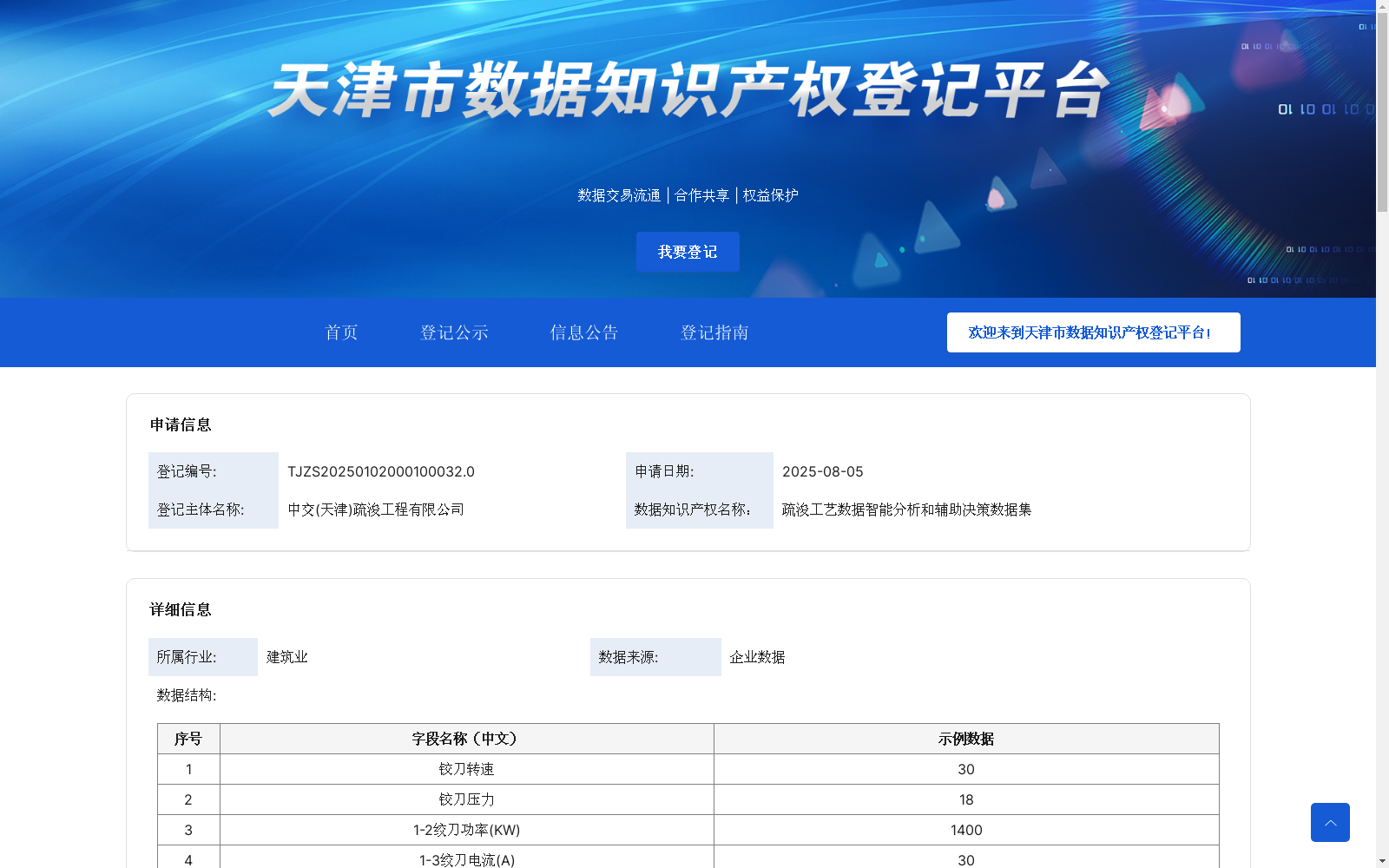
疏浚工艺数据智能分析和辅助决策数据集
收藏资源简介:
1.数据采集:基于疏浚工艺数据分析与辅助决策系统,从数据出发,建立基于关系型数据库的施工日报结构化数据模型。该模型强制定义关键字段的数据类型、取值范围(如绞刀功率、泥泵真空值、流速、产量、经纬度坐标等)和关联关系(项目ID、船舶ID、土质分类ID),构建不同船型日报数据库,通过填报的形式由工程人员采集到系统中,对异常值应用基于业务规则如最大理论产能限制的自动标记算法。构建多维索引(项目、船舶、土质、时间等),实现高效的查询能力。支持复杂组合条件查询,如查询某耙吸船在特定粘土工况过去一年的产量变化。 2.数据加工处理及分析:基于日报数据实现数据的进一步应用分析,将关键参数处理后以曲线图、饼图、分布图等图表分析形式进行数据的有效分析与评估。应用算法分解产量、浓度等关键参数的趋势性,进行如相关性分析: 计算相关系数,量化设备参数(如绞刀转速、泥泵压力)与产量、浓度之间的统计关联。基于GPS坐标,将离散点的产量、浓度等数据插值生成施工区域的分布图。进行分布拟合: 分析不同土质下产量、效率等指标的概率分布。比较不同船型、不同操作手、不同工况参数设置下的效率是否存在显著差异。生成带趋势线/置信区间的序列图: 展示产量、效率随时间变化。生成散点图矩阵: 探索多个设备参数与效率指标间的多元关系。 3.数据建模:针对不同船型选择成熟的产能预估方法并整理为具有标准输入输出的数据模型,通过编程手段实现到软件系统中,为用户提供船舶产能预估功能。建立结构化映射表,明确指定每种船型(绞吸式、耙吸式、抓斗式等)在不同土质类别(淤泥、粘土、砂、砾石、风化岩等)下推荐使用的理论或半经验产能模型,如达西公式、杜兰德公式、公司自研计算公式等。将模型公式化与参数化:如采用基于泥泵特性曲线、管路特性曲线、浓度-流速关系的综合模型。核心算法涉及求解泥泵工作点(流量Q,扬程H)与管道阻力、浓度、土质可泵性的平衡方程组。耙吸船方面应用疏浚装舱时间模型,考虑耙头吸入效率、泥舱沉降特性、溢流损失等。 4.数据应用:建立数据分析体系,将有价值的典型施工数据进行永久性存储,为施工提供数据和工艺支持,实现辅助决策和工艺指导。 不仅存储原始数据,更重要的是存储经过加工分析的高价值"施工工况片段"。包含:项目, 船型, 土质参数, 参数组合 (如绞刀转速、横移速度、泥泵转速), 达到的稳定产量等,并自动生成对应的分析图表和报告。为每个数据打上丰富的标签,建立知识图谱关系(如"某船型" - "在"- "某类土"- "采用" - "某参数组合"- "获得" - "高效率")。当用户在新项目设定施工参数或遇到效率瓶颈时,系统基于多维特征向量(船型、土质、环境参数)进行相似度计算,快速检索历史最优工况片段。
1. Data Collection: Based on the Dredging Process Data Analysis and Auxiliary Decision-Making System, starting from data, a structured data model for construction daily reports based on relational databases is established. This model rigidly defines the data types, value ranges (such as cutter head power, dredge pump vacuum, flow rate, production volume, longitude and latitude coordinates, etc.) and association relationships (project ID, vessel ID, soil classification ID) of key fields. A daily report database for different vessel types is constructed, which engineering personnel fill out to collect data into the system. An automatic marking algorithm based on business rules such as the maximum theoretical production capacity limit is applied to identify abnormal values. Multidimensional indexes (by project, vessel, soil type, time, etc.) are built to enable efficient query capabilities, supporting complex combined conditional queries, such as querying the annual production volume changes of a trailing suction hopper dredger under specific clay working conditions over the past year. 2. Data Processing and Analysis: Further application analysis of data is implemented based on daily report data. Key parameters are processed and effectively analyzed and evaluated through chart forms such as line charts, pie charts, and distribution maps. Algorithms are applied to decompose the trends of key parameters including production volume and concentration, and conduct correlation analysis: calculate correlation coefficients to quantify the statistical correlations between equipment parameters (such as cutter head speed, dredge pump pressure) and production volume/concentration. Based on GPS coordinates, data such as production volume and concentration of discrete points are interpolated to generate distribution maps of the construction area. Distribution fitting is performed to analyze the probability distribution of indicators such as production volume and efficiency under different soil types. Comparisons are made to detect significant differences in efficiency across different vessel types, operators, and working condition parameter settings. Sequence charts with trend lines/confidence intervals are generated to show the changes of production volume and efficiency over time. A scatter plot matrix is generated to explore the multivariate relationships between multiple equipment parameters and efficiency indicators. 3. Data Modeling: For different vessel types, mature production capacity estimation methods are selected and organized into data models with standard input and output, which are implemented into the software system through programming means to provide users with the vessel production capacity estimation function. A structured mapping table is established to clearly specify the theoretical or semi-empirical production capacity models recommended for each vessel type (such as cutter suction dredger, trailing suction hopper dredger, grab dredger, etc.) under different soil categories (silt, clay, sand, gravel, weathered rock, etc.), including Darcy's formula, Durand's formula, and the company's self-developed calculation formulas. The models are formalized and parameterized: for example, a comprehensive model based on dredge pump characteristic curves, pipeline characteristic curves, and concentration-flow rate relationships is adopted. The core algorithms involve solving the system of equilibrium equations for the dredge pump's operating point (flow rate Q, head H) and pipeline resistance, concentration, and soil pumpability. For trailing suction hopper dredgers, a dredging and hopper filling time model is applied, considering the suction efficiency of the cutter head, hopper settlement characteristics, overflow loss, etc. 4. Data Application: A data analysis system is established to permanently store valuable typical construction data, providing data and process support for construction, and realizing auxiliary decision-making and process guidance. In addition to storing raw data, more importantly, high-value "construction working condition segments" processed and analyzed are stored, including: project, vessel type, soil parameters, parameter combinations (such as cutter head speed, traverse speed, dredge pump speed), achieved stable production volume, etc., and automatically generate corresponding analysis charts and reports. Rich tags are attached to each data entry, and a knowledge graph relationship is established (such as "a certain vessel type" - "in" - "a certain type of soil" - "adopts" - "a certain parameter combination" - "achieves" - "high efficiency"). When users set construction parameters for new projects or encounter efficiency bottlenecks, the system quickly retrieves historical optimal working condition segments by performing similarity calculations based on multi-dimensional feature vectors (vessel type, soil type, environmental parameters).