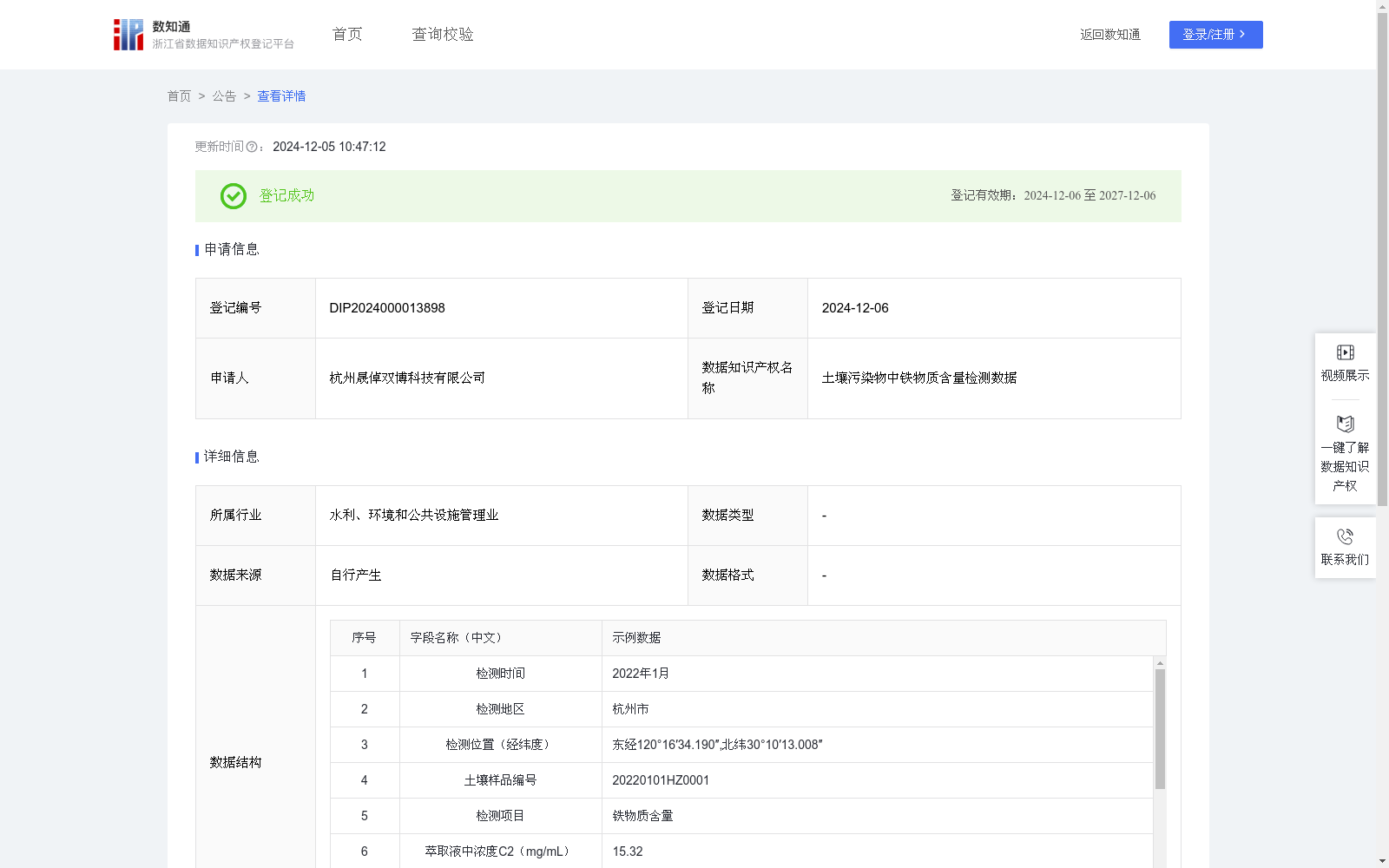
土壤污染物中铁物质含量检测数据
收藏资源简介:
通过检测数据分析研判,我们可以判断土壤污染物中铁物质是否超标,避免因铁物质持续污染而产生的污染问题,有以下几点作用。一、进行土壤污染治理可以减少农作物中的该有害物质含量,确保食品的质量和安全;二、根据检测结果可有针对的改善士壤质量,提高土壤的生产力,可以为农业发展提供可持续的基础,同时也有利于保护和改善环境。另外可结合地理信息系统(GIS)技术,将各地点的土壤地理数据和污染物含量信息进行深度整合和分析,绘制位置-污染物含量地图,以直观的可视化形式呈现给用户,增强地理位置与污染物含量关系的理解,构建起一个包含污染源、污染物种类、污染程度、污染扩散路径等多维度信息的地理图谱。这一图谱不仅能够提供实时的监测数据,还能够通过数据之间的关联性,揭示潜在的污染风险和趋势。数据采集:对各地区不同地点进行土壤采集,不同地点采集的土壤按样品编号进行划分,对采集的土壤污染物中铁物质进行含量检测。数据判定:按X= C2* V0*D/ Vw 公式中X为土壤污染物中铁物质含量,式中C2为萃取液中浓度;V0为萃取液体积,D为稀释倍数,Vw为取样量。铁物质含量标准要求为15mg/kg,若土壤污染物中铁物质含量不大于15mg/kg,则该土壤的检测结果为合格,否则检测结果为不合格。另外当月铁物质含量与上月历史含量相比,污染程度可评为加重、减轻和持平。
Through data analysis and detection, we can determine whether iron substances in soil pollutants exceed standard limits, thereby preventing pollution issues caused by persistent iron contamination, which offers the following benefits. First, soil pollution remediation can reduce the concentration of this harmful substance in crops, ensuring the quality and safety of agricultural products. Second, targeted soil quality improvement can be implemented based on the test results, enhancing soil productivity and providing a sustainable foundation for agricultural development, while also supporting environmental protection and improvement. In addition, by integrating Geographic Information System (GIS) technology, we can conduct in-depth integration and analysis of soil geographic data and pollutant concentration information from each sampling location, and generate a location-pollutant concentration map, which is presented to users in an intuitive visual format to facilitate the understanding of the correlation between geographic location and pollutant levels, and construct a multi-dimensional geographic atlas covering pollution sources, pollutant types, pollution degrees, and pollution diffusion pathways. This atlas can not only provide real-time monitoring data, but also uncover potential pollution risks and trends through the correlation between various datasets. Data Collection: Soil samples are collected from different locations across various regions, and the samples are categorized by their unique sample IDs. The iron substance content in the collected soil pollutants is then detected. Data Judgment: The iron substance content in soil pollutants is calculated using the formula: "X = C2 * V0 * D / Vw", where X represents the iron substance content in soil pollutants, C2 is the concentration of the extract, V0 is the volume of the extract, D is the dilution factor, and Vw is the sampling volume. The standard limit for iron substance content is 15 mg/kg. A soil sample is deemed qualified if its iron substance content is no greater than 15 mg/kg; otherwise, the test result is unqualified. Additionally, when comparing the current month's iron content with the historical content from the previous month, the pollution degree can be classified as aggravated, alleviated, or unchanged.