
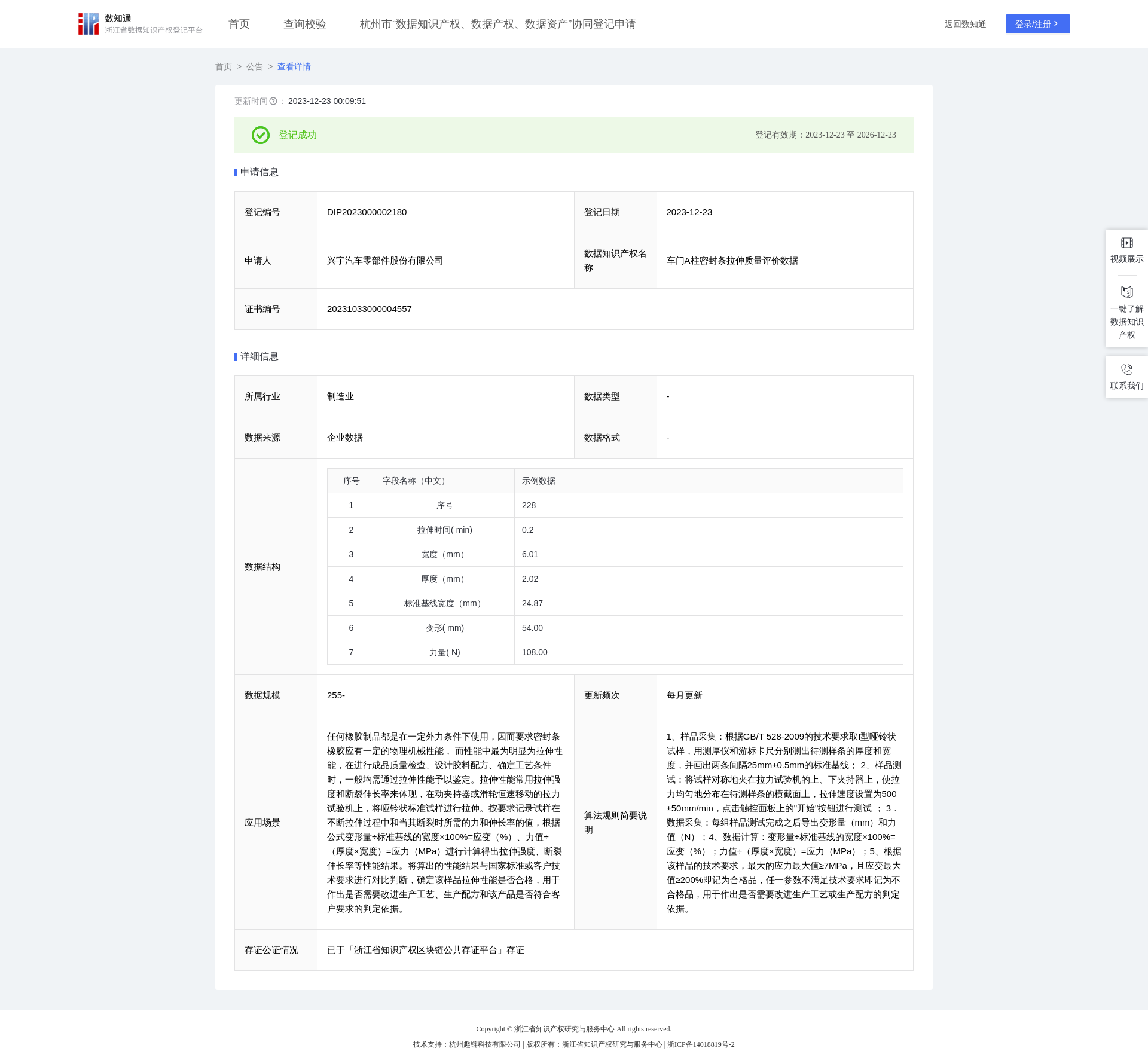
车门A柱密封条拉伸质量评价数据
收藏浙江省数据知识产权登记平台2023-12-23 更新2024-05-08 收录
下载链接:
https://www.zjip.org.cn/home/announce/trends/22274
下载链接
链接失效反馈官方服务:
资源简介:
任何橡胶制品都是在一定外力条件下使用,因而要求密封条橡胶应有一定的物理机械性能, 而性能中最为明显为拉伸性能,在进行成品质量检查、设计胶料配方、确定工艺条件时,一般均需通过拉伸性能予以鉴定。拉伸性能常用拉伸强度和断裂伸长率来体现,在动夹持器或滑轮恒速移动的拉力试验机上,将哑铃状标准试样进行拉伸。按要求记录试样在不断拉伸过程中和当其断裂时所需的力和伸长率的值,根据公式变形量÷标准基线的宽度×100%=应变(%)、力值÷(厚度×宽度)=应力(MPa)进行计算得出拉伸强度、断裂伸长率等性能结果。将算出的性能结果与国家标准或客户技术要求进行对比判断,确定该样品拉伸性能是否合格,用于作出是否需要改进生产工艺、生产配方和该产品是否符合客户要求的判定依据。1、样品采集:根据GB/T 528-2009的技术要求取I型哑铃状试样,用测厚仪和游标卡尺分别测出待测样条的厚度和宽度,并画出两条间隔25mm±0.5mm的标准基线; 2、样品测试:将试样对称地夹在拉力试验机的上、下夹持器上,使拉力均匀地分布在待测样条的横截面上,拉伸速度设置为500±50mm/min,点击触控面板上的"开始"按钮进行测试 ; 3.数据采集:每组样品测试完成之后导出变形量(mm)和力值(N);4、数据计算:变形量÷标准基线的宽度×100%=应变(%);力值÷(厚度×宽度)=应力(MPa);5、根据该样品的技术要求,最大的应力最大值≥7MPa,且应变最大值≥200%即记为合格品,任一参数不满足技术要求即记为不合格品,用于作出是否需要改进生产工艺或生产配方的判定依据。
All rubber products are used under specific external force conditions, thus rubber seal strips must possess certain physical and mechanical properties, among which tensile properties are the most critical. Tensile properties are commonly used for evaluation during finished product quality inspection, compound formulation design, and processing parameter determination. Tensile performance is typically characterized by tensile strength and elongation at break. Standard dumbbell-shaped specimens are tested on a tensile testing machine equipped with constant-speed moving grips or pulleys. Record the applied force and elongation values of the specimen during continuous stretching and at fracture as required, then calculate performance indicators such as tensile strength and elongation at break using the following formulas:
Strain (%) = (Deformation ÷ Reference Gauge Width) × 100%;
Stress (MPa) = Force ÷ (Thickness × Width).
Compare the calculated performance results with national standards or customer technical specifications to determine whether the tensile properties of the sample meet the requirements, which serves as the basis for deciding whether to improve production processes or formulations, and whether the product complies with customer demands.
1. Sample Collection: Prepare Type I dumbbell-shaped specimens in accordance with the technical requirements of GB/T 528-2009. Measure the thickness and width of the test strips using a thickness gauge and vernier caliper respectively, and draw two reference gauge lines with a spacing of 25mm ± 0.5mm.
2. Sample Testing: Clamp the specimen symmetrically on the upper and lower grips of the tensile testing machine to ensure uniform force distribution across the cross-section of the test strip. Set the tensile speed to 500 ± 50 mm/min, and click the "Start" button on the touch control panel to launch the test.
3. Data Collection: Export the deformation (mm) and force (N) values after completing the test for each group of samples.
4. Data Calculation: Apply the following formulas:
Strain (%) = (Deformation ÷ Reference Gauge Width) × 100%;
Stress (MPa) = Force ÷ (Thickness × Width).
5. Qualification Judgment: According to the sample's technical requirements, the product is classified as qualified if the maximum stress value ≥ 7 MPa and the maximum strain value ≥ 200%; otherwise, it is classified as unqualified. This result acts as the basis for judging whether to adjust production processes or formulations.
提供机构:
兴宇汽车零部件股份有限公司
创建时间:
2023-10-22
搜集汇总
数据集介绍
背景与挑战
背景概述
该数据集专注于车门A柱密封条的拉伸质量评价,通过测量拉伸强度和断裂伸长率等物理机械性能,评估产品是否符合国家标准或客户技术要求。评价过程包括样品采集、测试、数据计算,并以最大应力≥7MPa和应变≥200%作为合格判定标准,旨在为生产工艺改进和质量控制提供依据。
以上内容由遇见数据集搜集并总结生成



