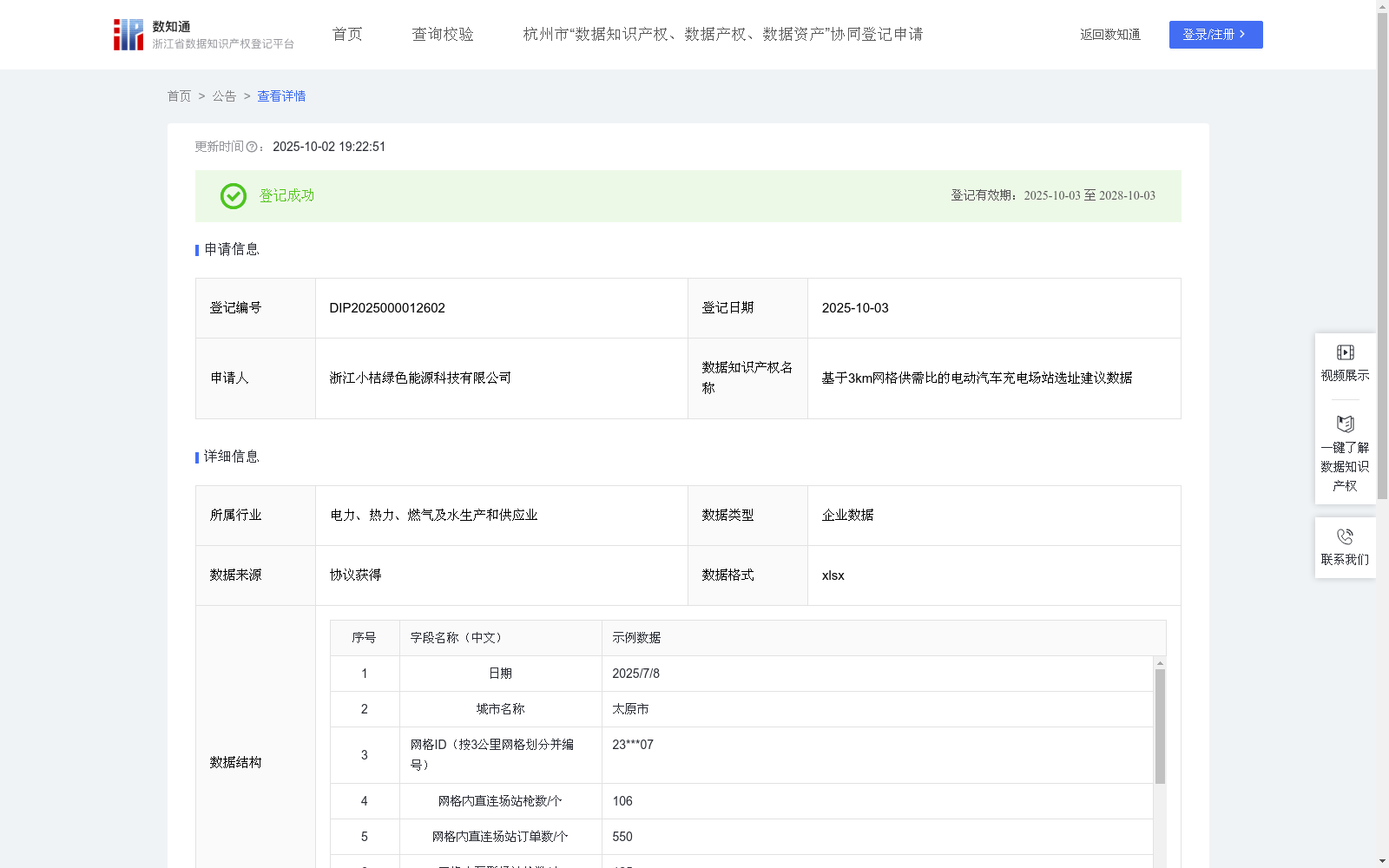
基于3km网格供需比的电动汽车充电场站选址建议数据
收藏资源简介:
本数据集以3km网格为单位,评估中尺度范围内的供需关系失衡状况,特别是识别出高需求但桩位供给不足的片区。具体应用场景如下: 1.对平台(即申请人)而言:可集中规划在“高需低供”区域(即在建供给型和潜力平衡型)布点,提高站点利用效率和网络稳定性; 2.对场站商家而言:可提前布局供需矛盾突出的片区,占据核心流量入口,实现快速回收和稳定运营; 3.对政府而言:可据此调整基础设施投放重心,缓解区域性能源供需不均等问题。1.数据采集:原始数据经授权合法获取,包括日期、城市名称、网格ID(按3公里网格划分并编号)、网格内直连场站枪数、网格内直连场站订单数、网格内互联场站枪数、网格内互联预测订单数、网格内外部场站枪数等字段。 2.网格内供需指标计算:(1)网格内预测充电订单数S=网格内直连场站订单数+网格内互联预测订单数+网格内外部场站枪数×0.7;(2)网格内充电枪数D=网格内直连场站枪数+网格内互联场站枪数+网格内外部场站枪数。 3.建立基于3km网格供需比的选址评估模型:(1)计算供需比(S/D):供需比=网格内预测充电订单数÷网格内充电枪数;(2)选址评估分类和建议:若S/D≤0.5,则为“低效冗余型”,建议“暂停新建”,若0.5<S/D≤1.0,则为“份额领先型”,建议“维持现状”,若1.0<S/D≤1.5,则为“潜力平衡型”,建议“轻量补足”,若S/D>1.5,则为“在建供给型”,建议“加大建设”。
This dataset uses 3km grids as the basic unit to evaluate the imbalance of supply and demand in the mesoscale range, and specifically identifies areas with high demand but insufficient charging pile supply. The specific application scenarios are as follows: 1. For platform operators (i.e., applicants): They can concentrate on deploying charging stations in "high-demand and low-supply" areas (i.e., under-construction supply-type and potential balance-type zones) to improve the utilization efficiency of stations and the stability of the charging network; 2. For charging station merchants: They can lay out in advance in areas with prominent supply-demand contradictions, seize core traffic entrances, and achieve rapid investment recovery and stable operation; 3. For the government: They can adjust the focus of infrastructure investment based on this dataset to alleviate regional energy supply-demand imbalance issues. 1. Data Collection: Raw data is legally obtained with authorization, including fields such as date, city name, grid ID (divided and numbered according to 3km grids), number of charging piles of directly-connected charging stations within the grid, number of orders at directly-connected charging stations within the grid, number of charging piles of interconnected charging stations within the grid, predicted number of orders at interconnected charging stations within the grid, number of charging piles of stations within and outside the grid, etc. 2. Calculation of Supply and Demand Indicators within the Grid: (1) Predicted charging order volume S within the grid = number of orders at directly-connected charging stations within the grid + predicted number of orders at interconnected charging stations within the grid + number of charging piles of stations within and outside the grid × 0.7; (2) Number of charging piles D within the grid = number of charging piles of directly-connected charging stations within the grid + number of charging piles of interconnected charging stations within the grid + number of charging piles of stations within and outside the grid. 3. Establishment of Site Selection Evaluation Model Based on 3km Grid Supply-Demand Ratio: (1) Calculate the supply-demand ratio (S/D): Supply-demand ratio = predicted charging order volume within the grid ÷ number of charging piles within the grid; (2) Site selection evaluation classification and recommendations: If S/D ≤ 0.5, it is classified as "low-efficiency redundant type" with the recommendation of "suspend new construction"; if 0.5 < S/D ≤ 1.0, it is classified as "market share leading type" with the recommendation of "maintain the status quo"; if 1.0 < S/D ≤ 1.5, it is classified as "potential balance type" with the recommendation of "carry out light supplementation"; if S/D > 1.5, it is classified as "under-construction supply type" with the recommendation of "increase construction efforts".