
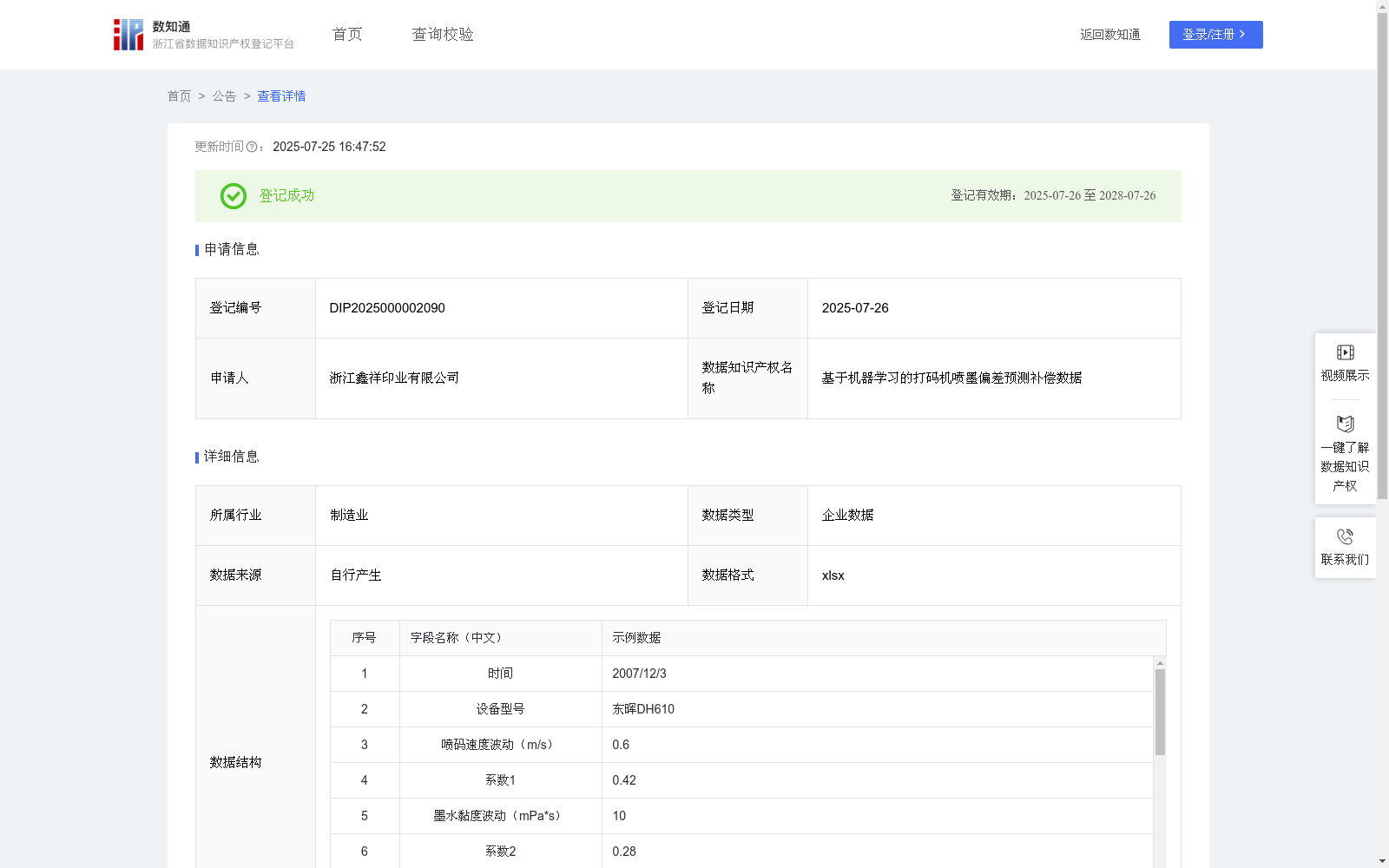
基于机器学习的打码机喷墨偏差预测补偿数据
收藏浙江省数据知识产权登记平台2025-07-25 更新2025-07-26 收录
下载链接:
https://www.zjip.org.cn/home/announce/trends/154992
下载链接
链接失效反馈官方服务:
资源简介:
打码机喷墨偏差指在喷码过程中,因机械振动(如传送带抖动)、喷头状态异常(如喷嘴堵塞、压电陶瓷老化)、墨水特性变化(粘度、温度敏感性)或基材表面特性(粗糙度、吸墨性不均)导致的喷印位置偏移、字符模糊或墨滴飞溅现象。本偏差预测补偿数据有以下应用场景:在企业内部,1.与生产线联动,动态调整喷码位置以适配不同包装尺寸(如罐装、袋装切换),减少人工标定时间。2.基于喷墨压力曲线与墨滴形态数据,构建喷头堵塞预警模型,通过压电陶瓷驱动信号异常识别喷嘴结晶风险,触发自动清洗程序。在企业外部,1.将喷墨补偿参数共享至上游印刷机,联动调整印刷图案位置,避免因套印误差导致的喷码区域重叠或错位。2.向墨水供应商反馈粘度-温度特性数据,推动开发宽温域稳定性墨水配方。3.预测模型可迁移至西林瓶激光打码机,通过基材粗糙度补偿,解决曲面反光干扰,提高字符识别率。1、数据收集:数据采集来源于编码器、黏度计、表面轮廓仪和生产日志,每日实时采集打码机喷码速度波动、墨水黏度波动和基材表面粗糙度等运行参数,对打码机设备采集到的数据进行降噪、清洗、加工后进行处理。 2、数据处理:、偏差预测公式:偏差预测值=喷码速度波动*系数1+墨水黏度波动*系数2+基材表面粗糙度*系数3+偏置项,3个系数值需通过机器学习训练确定,总和为1。补偿量=偏差预测值*比例系数+偏差变化率*动态响应系数,基于补偿后的残余偏差为偏差预测值与补偿量差值的绝对值。3、残余偏差越小,表明设备越健康。残余偏差大于等于1μm,这代表了设备补偿失效,应立即停机检修;补偿量小于等于0.7μm,这代表了设备补偿完全覆盖偏差,应维持当前补偿参数;补偿量在0.7μm至1μm范围内,这代表了设备补偿不足或过冲,应微调比例系数和动态响应系数。
Inkjet misalignment of coding machines refers to phenomena including printed position shift, blurry characters or ink droplet splashing during the inkjet coding process, caused by factors such as mechanical vibration (e.g., conveyor belt jitter), abnormal nozzle conditions (e.g., nozzle clogging, aging of piezoelectric ceramics), changes in ink properties (viscosity, temperature sensitivity), or uneven substrate surface characteristics (roughness, ink absorbency).
This deviation prediction and compensation dataset has the following application scenarios:
Internal enterprise scenarios:
1. Link with production lines to dynamically adjust coding positions to adapt to different packaging sizes (e.g., switching between cans and bags), reducing manual calibration time.
2. Construct a nozzle clogging early warning model based on inkjet pressure curves and droplet morphology data, identify nozzle crystallization risks via abnormal piezoelectric ceramic drive signals, and trigger automatic cleaning procedures.
External enterprise scenarios:
1. Share inkjet compensation parameters with upstream printing presses to coordinately adjust printed pattern positions, avoiding overlapping or misalignment of coding areas caused by registration errors.
2. Feed back viscosity-temperature characteristic data to ink suppliers to promote the development of wide-temperature-stable ink formulations.
3. The prediction model can be migrated to pharmaceutical vial laser coding machines, compensating for substrate roughness to mitigate curved surface reflection interference and improve character recognition rate.
1. Data Collection: Data is collected from encoders, viscometers, surface profilometers and production logs. Real-time collection of operating parameters such as coding speed fluctuations, ink viscosity fluctuations and substrate surface roughness of coding machines is conducted daily. The data collected by coding machines is processed through noise reduction, cleaning and preprocessing.
2. Data Processing:
Deviation prediction formula: Deviation prediction value = (coding speed fluctuation * coefficient 1) + (ink viscosity fluctuation * coefficient 2) + (substrate surface roughness * coefficient 3) + bias term. The three coefficient values need to be determined via machine learning training, with their sum equal to 1.
Compensation amount = (deviation prediction value * proportional coefficient) + (deviation change rate * dynamic response coefficient). The residual deviation after compensation is the absolute value of the difference between the deviation prediction value and the compensation amount.
3. Deviation and Compensation Judgment Rules: The smaller the residual deviation, the healthier the equipment. When the residual deviation is ≥1μm, it indicates that the equipment compensation has failed and immediate shutdown for maintenance is required. When the compensation amount is ≤0.7μm, it indicates that the equipment compensation fully covers the deviation and the current compensation parameters should be maintained. When the compensation amount is in the range of 0.7μm to 1μm, it indicates that the equipment compensation is insufficient or overshot, and the proportional coefficient and dynamic response coefficient should be fine-tuned.
提供机构:
浙江鑫祥印业有限公司
创建时间:
2025-04-08
搜集汇总
数据集介绍
背景与挑战
背景概述
该数据集是基于机器学习的打码机喷墨偏差预测补偿数据,包含喷码速度波动、墨水黏度波动、基材表面粗糙度等参数,通过算法预测偏差并进行补偿,应用于生产线联动、喷头堵塞预警等场景。
以上内容由遇见数据集搜集并总结生成



