
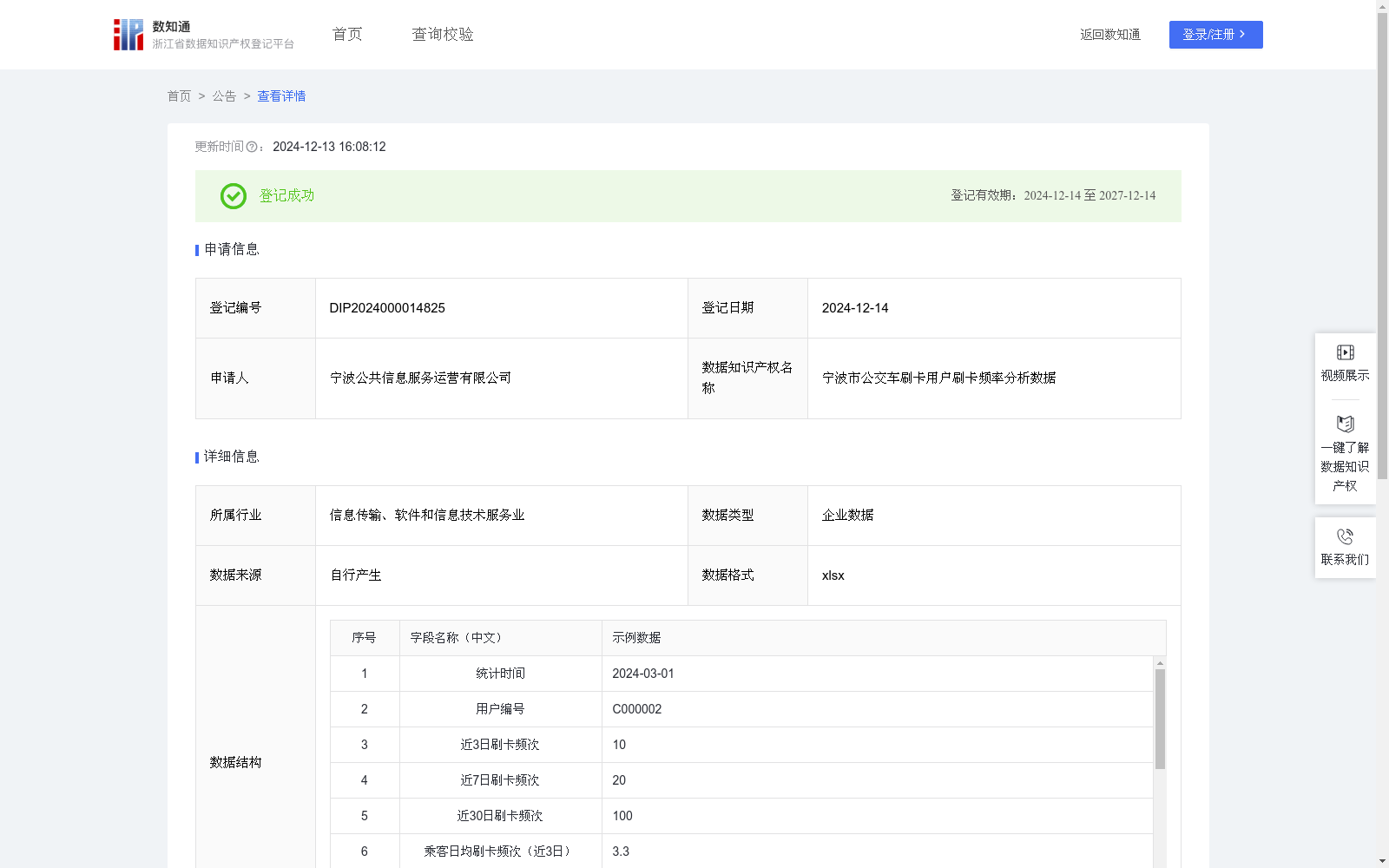
宁波市公交车刷卡用户刷卡频率分析数据
收藏浙江省数据知识产权登记平台2024-12-13 更新2024-12-14 收录
下载链接:
https://www.zjip.org.cn/home/announce/trends/103787
下载链接
链接失效反馈官方服务:
资源简介:
由于公交车刷卡用户刷卡频率数据能一定程度上反映刷卡用户的出行频率情况,因此:(1)本数据有助于公交车运营单位实现对刷卡用户的细分,定制个性化的营销策略,如为高频用户提供折扣或优惠,提高用户粘性和满意度。 (2)本数据有助于公交车运营单位通过进一步统计和分析趋势分析数据,基于用户刷卡频率变化预测刷卡用户出行需求量变化情况,为运力规划提供依据。(1)数据收集和预处理:从公司内部的设备运营平台收集宁波市公交车刷卡数据,包括统计时间、用户编号、近3日刷卡频次、近7日刷卡频次、近30日刷卡频次等数据。通过数据清洗去除无效或错误记录,确保数据质量。 (2)分别计算近3日、7日和30日的乘客日均刷卡频次(PDCF):PDCF(近3日)=近3日刷卡频次/3;PDCF(近7日)=近7日刷卡频次/7;PDCF(近30日)=近30日刷卡频次/30; (3)构建刷卡频率指数,公式为:刷卡频率指数=PDCF(近3日)×W1+PDCF(近7日)×W2+PDCF(近30日)×W3;W1、W2、W3是权重系数,根据实际数据分布和专家研讨确定; (4)刷卡频率指数归一化处理:利用Min-Max标准化统计方法,将所有刷卡用户的刷卡频率指数数据标准化为0到1范围,并输出刷卡频率指数归一化结果(CFIR); (5)刷卡用户细分:根据CFIR对客户进行细分。低频用户:CFIR≤ 0.3;中频用户:0.3 < CFIR≤ 0.6;高频用户:CFIR> 0.6; (6)趋势分析:采用移动平均统计方法分析刷卡频率指数归一化结果(CFIR)随时间的变化趋势。
Since the swipe frequency data of bus card users can reflect the travel frequency of such users to a certain extent, the data has the following two main applications:
(1) This data helps bus operation enterprises to segment card users and formulate personalized marketing strategies, such as providing discounts or preferential treatments for high-frequency users, so as to improve user stickiness and satisfaction.
(2) This data enables bus operation enterprises to predict changes in the travel demand of card users based on the changes in their swipe frequency by conducting further statistical and trend analysis, providing a basis for capacity planning.
The specific data processing steps are as follows:
(1) Data collection and preprocessing: Bus swipe card data of Ningbo City is collected from the company's internal equipment operation platform, including statistical time, user ID, swipe frequency in the past 3 days, swipe frequency in the past 7 days, swipe frequency in the past 30 days and other related statistics. Invalid or erroneous records are removed through data cleaning to ensure data quality.
(2) Calculate the Per Capita Daily Card Frequency (PDCF) for the past 3, 7 and 30 days respectively:
PDCF (past 3 days) = swipe frequency in the past 3 days / 3;
PDCF (past 7 days) = swipe frequency in the past 7 days / 7;
PDCF (past 30 days) = swipe frequency in the past 30 days / 30;
(3) Construct the swipe frequency index, with the formula:
Swipe Frequency Index = PDCF (past 3 days) × W1 + PDCF (past 7 days) × W2 + PDCF (past 30 days) × W3;
where W1, W2 and W3 are weight coefficients determined based on actual data distribution and expert discussions;
(4) Normalization of the swipe frequency index: Use the Min-Max normalization method to standardize the swipe frequency index data of all card users to the range of 0 to 1, and output the normalized swipe frequency index results (CFIR);
(5) Card user segmentation: Segment customers based on CFIR:
Low-frequency users: CFIR ≤ 0.3;
Medium-frequency users: 0.3 < CFIR ≤ 0.6;
High-frequency users: CFIR > 0.6;
(6) Trend analysis: Adopt the moving average statistical method to analyze the changing trend of the normalized swipe frequency index (CFIR) over time.
提供机构:
宁波公共信息服务运营有限公司
创建时间:
2024-11-06
搜集汇总
数据集介绍
以上内容由遇见数据集搜集并总结生成



