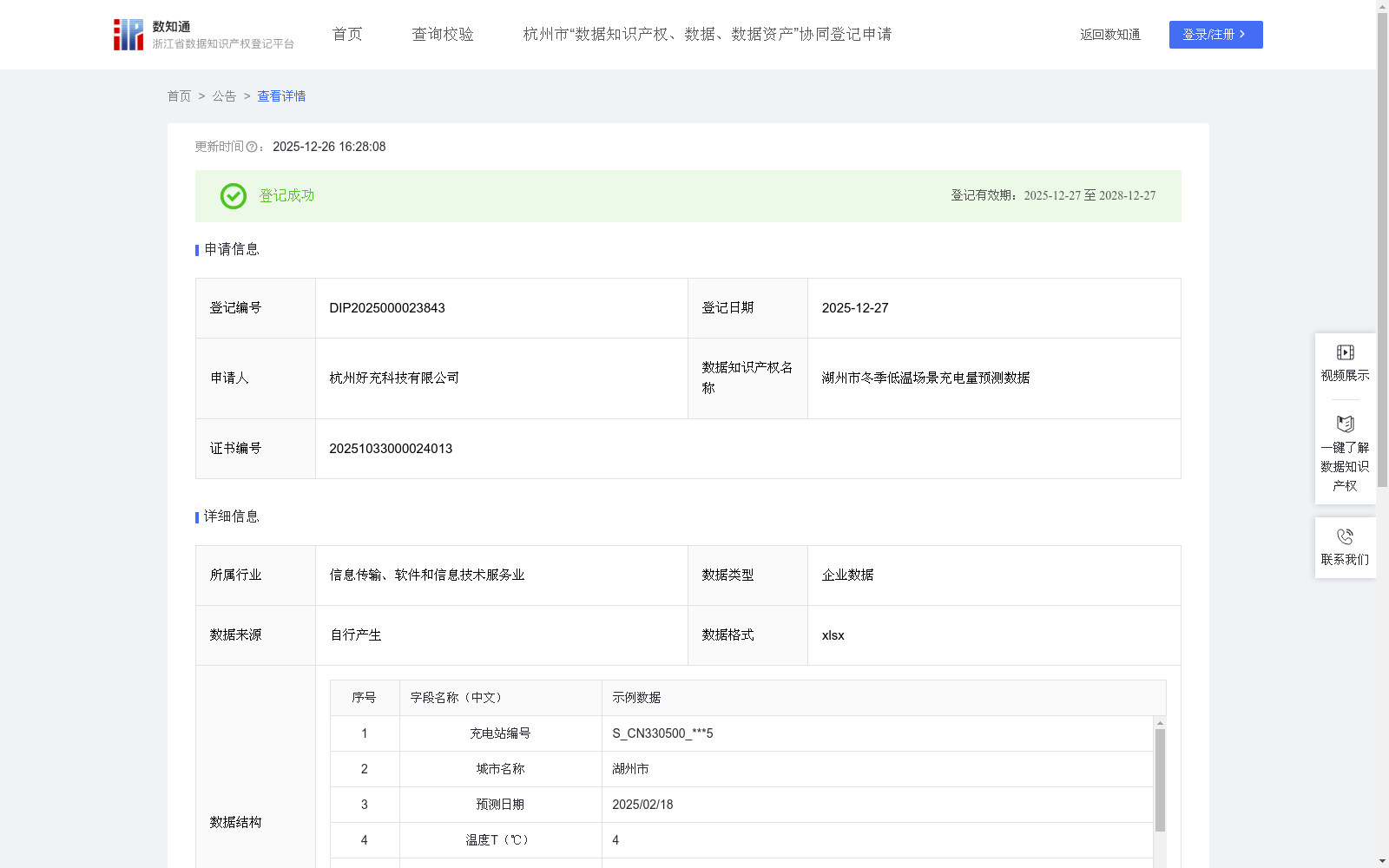
湖州市冬季低温场景充电量预测数据
收藏资源简介:
本数据通过分析湖州市冬季低温环境下不同类型动力电池的充电衰减特性,为充电运营管理提供决策支持提供充电量数据预测。主要应用于:指导运营商根据温度、湿度和风速等气象参数,结合三元锂电池和磷酸铁锂电池的衰减率特征,预测低温条件下的充电需求;在极端天气条件下保障充电服务稳定性;为电力调度部门提供负荷预测参考,确保电网在低温时段的稳定运行。同时可为新能源汽车用户提供准确的充电时长预估,提升低温环境下的充电体验。 "1.数据采集与处理 采集企业自有充电桩设备管理数据,包括充电站编号、城市名称、预测日期、温度T、湿度H、风速W、近30天日均充电量Q、近30天三元锂电池车辆订单占比P(三元)、近30天磷酸铁锂电池车辆订单占比P(铁锂)等数据。对采集的数据进行清洗,剔除温度>8℃的非低温场景记录。 2.核心计算 通过特征工程计算衰减率: ①三元锂电池衰减率α: 当T<5℃ 时:α=0.015×(5-T)+0.02H 当T≥5℃ 时:α=0(不衰减) ②磷酸铁锂电池衰减率β: 当T<3℃ 时:β=0.018×(3−T)+0.015H 当T≥3℃ 时:β=0(不衰减) ③综合衰减率γ: γ=[P(三元)×α+P(铁锂)×β]/(1+0.3H) 3.建立充电量预测模型 建立充电量预测模型:预测充电量Q(预测)=Q×(1+γ)×ε。其中ε为天气影响系数,根据风速W取值(当W≥7级时,ε=0.93;否则ε=1.0)。"
This dataset is developed to support decision-making for charging operation management and enable charging volume prediction by analyzing the charging decay characteristics of various power batteries under low-temperature winter environments in Huzhou City. Its main application scenarios are as follows: 1. Guiding charging operators to predict charging demand under low-temperature conditions based on meteorological parameters such as temperature, humidity and wind speed, combined with the decay rate features of ternary lithium batteries and lithium iron phosphate batteries; 2. Ensuring the stability of charging services under extreme weather conditions; 3. Providing load forecasting references for power dispatching departments to guarantee the stable operation of the power grid during low-temperature periods; 4. Offering accurate charging duration estimates for new energy vehicle users to enhance their charging experience in low-temperature environments. 1. Data Collection and Processing Collect data from the enterprise's self-owned charging pile equipment management system, including charging station ID, city name, prediction date, temperature T, humidity H, wind speed W, 30-day average daily charging volume Q, 30-day order proportion of ternary lithium battery vehicles P(ternary), and 30-day order proportion of lithium iron phosphate battery vehicles P(lithium iron phosphate). Clean the collected data by eliminating records of non-low-temperature scenarios where the temperature exceeds 8℃. 2. Core Calculations Calculate the decay rate via feature engineering: ① Ternary lithium battery decay rate α: When T < 5℃: α = 0.015×(5 - T) + 0.02H When T ≥ 5℃: α = 0 (no decay occurs) ② Lithium iron phosphate battery decay rate β: When T < 3℃: β = 0.018×(3 − T) + 0.015H When T ≥ 3℃: β = 0 (no decay occurs) ③ Comprehensive decay rate γ: γ = [P(ternary)×α + P(lithium iron phosphate)×β]/(1 + 0.3H) 3. Establishment of Charging Volume Prediction Model Establish the charging volume prediction model: Predicted charging volume Q(predicted) = Q×(1 + γ)×ε. Here, ε is the weather impact coefficient, which is valued according to wind speed W: ε = 0.93 when W ≥ Level 7; otherwise ε = 1.0.