
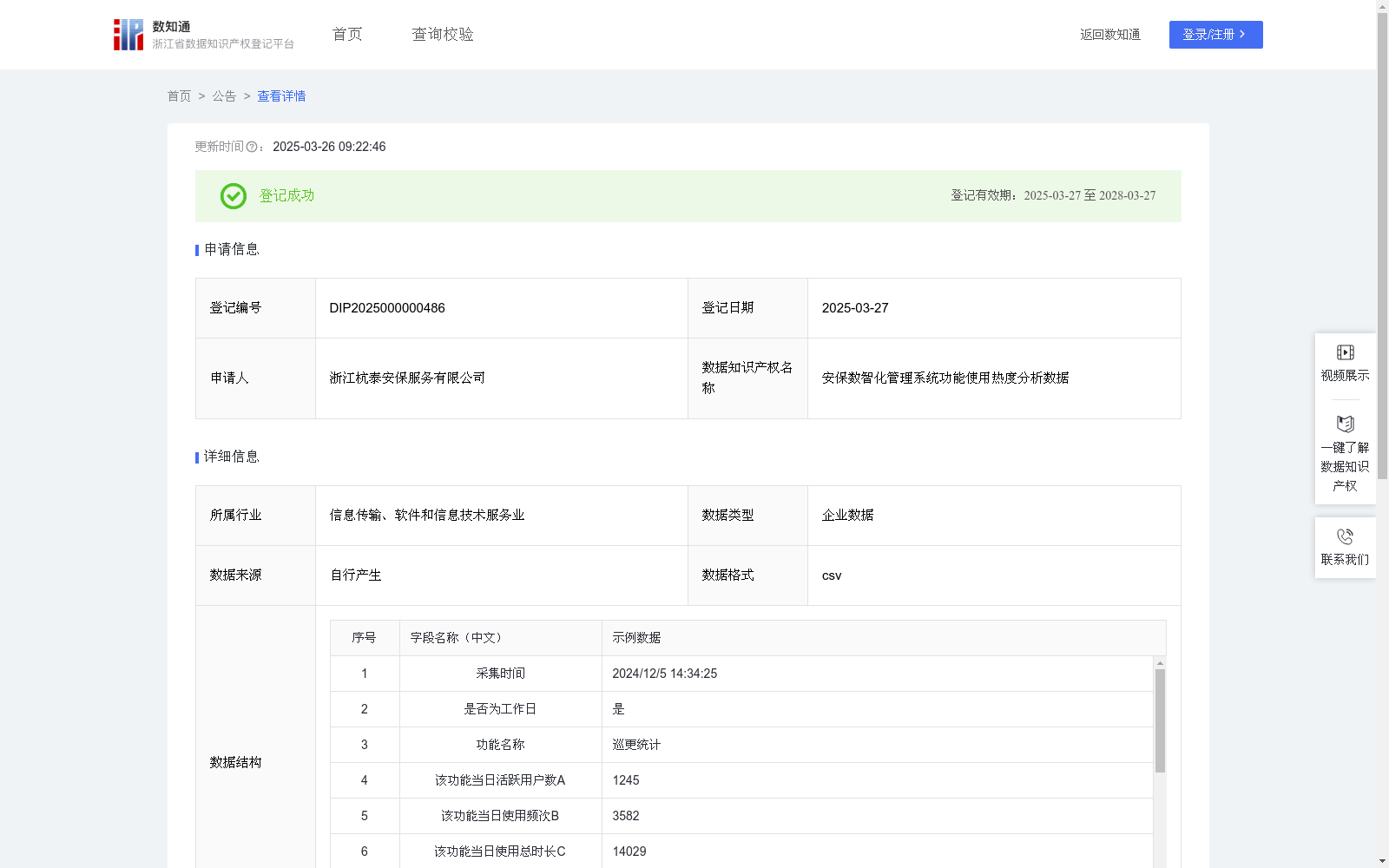
安保数智化管理系统功能使用热度分析数据
收藏浙江省数据知识产权登记平台2025-03-26 更新2025-03-27 收录
下载链接:
https://www.zjip.org.cn/home/announce/trends/119842
下载链接
链接失效反馈官方服务:
资源简介:
对软件系统不同功能的使用热度进行分析,有助于识别用户偏好,精准把握用户需求,指导软件系统优化,增强用户体验。本数据集的应用场景包括但不限于:(1)系统功能效果评估和改进:本数据集可反映用户与安保数智化管理系统相关功能的交互程度,通过对功能使用热度数值的长期跟踪,公司既可以评估相关功能的设置效果,又可以进一步对相关功能的未来使用趋势进行预测,为相关功能的后续改进提供依据。(2)售后服务资源优化:本数据集还能帮助公司在系统的售后服务的资源分配上做出更准确的决策,例如公司可以根据功能使用热度的数值大小,决定是否有必要围绕该功能对用户加强培训。(3)行业参考:本数据集可以帮助行业内相关单位客观准确地了解安保管理软件在不同功能上的受欢迎程度、用户依赖程度和普及度,为相关单位在类似软件中设置或改进相关功能提供参考依据,推动行业发展。1.数据收集和预处理:(1)数据收集:从公司建设运营的安保数智化管理系统日志中,提取反映用户对不同功能的每日使用情况数据,包括采集时间、是否为工作日、功能名称、该功能当日活跃用户数A、该功能当日使用频次B、该功能当日使用总时长C(min)、系统当日总活跃用户数D。(2)对采集的数据进行清洗,去除重复、错误或无关的信息。
2.建立功能使用热度计算模型:(1)计算功能当日使用率S:S=A/D*100%;(2)计算当日平均使用时长P:P=C/B:(3)引入时间加权因子q,以弱化工作日和非工作日的差异:若当天是工作日,则q为0.8,反之则q为1.2;(4)计算当日加权使用频次Bq和当日加权平均使用时长Pq:Bq=B*q,Pq=P*q;(5)计算当日用户活跃度指数H:H=√(A*Bq);(6)基于主成分分析法(PCA)计算功能使用热度W:W=H*0.6+Pq*0.2+S*0.2。
3.功能使用热度分析:若W≥500,则说明用户对该功能的使用热度较高;若300≤W<500,则说明用户对该功能的使用热度一般;若W<300,则说明用户对该功能的使用热度较低。
Analyzing the usage heat of different functions in a software system helps identify user preferences, accurately grasp user needs, guide software system optimization, and enhance user experience. The application scenarios of this dataset include but are not limited to: (1) System function effect evaluation and improvement: This dataset can reflect the degree of user interaction with the functions of the security digital-intelligent management system. By long-term tracking of the function usage heat values, the company can not only evaluate the setting effect of relevant functions, but also further predict the future usage trends of relevant functions, providing a basis for the subsequent improvement of relevant functions. (2) After-sales service resource optimization: This dataset can also help the company make more accurate decisions in the resource allocation of system after-sales service. For example, the company can decide whether it is necessary to provide enhanced training to users around this function based on the value of the function usage heat. (3) Industry reference: This dataset can help relevant units in the industry objectively and accurately understand the popularity, user dependency and penetration rate of security management software in different functions, providing a reference basis for relevant units to set or improve relevant functions in similar software, and promoting industry development. 1. Data Collection and Preprocessing: (1) Data Collection: Extract daily usage data reflecting users' usage of different functions from the logs of the security digital-intelligent management system built and operated by the company, including collection time, whether it is a working day, function name, the number of daily active users of this function (A), the daily usage frequency of this function (B), the total daily usage duration of this function (C, in minutes), and the total number of daily active users of the system (D). (2) Clean the collected data to remove duplicate, erroneous or irrelevant information. 2. Establishment of Function Usage Heat Calculation Model: (1) Calculate the daily usage rate S of the function: S = A/D * 100%; (2) Calculate the daily average usage duration P: P = C/B; (3) Introduce the time weighting factor q to weaken the difference between working days and non-working days: if the day is a working day, q is 0.8, otherwise q is 1.2; (4) Calculate the daily weighted usage frequency Bq and the daily weighted average usage duration Pq: Bq = B * q, Pq = P * q; (5) Calculate the daily user activity index H: H = √(A * Bq); (6) Calculate the function usage heat W based on Principal Component Analysis (PCA): W = H * 0.6 + Pq * 0.2 + S * 0.2. 3. Function Usage Heat Analysis: If W ≥ 500, it indicates that the user's usage heat of this function is high; if 300 ≤ W < 500, it indicates that the user's usage heat of this function is moderate; if W < 300, it indicates that the user's usage heat of this function is low.
提供机构:
浙江杭泰安保服务有限公司
创建时间:
2025-02-05
搜集汇总
数据集介绍
背景与挑战
背景概述
该数据集记录了安保数智化管理系统中各功能的使用热度数据,包含15个字段,每日更新,规模为583条。数据可用于评估功能效果、优化售后服务和提供行业参考。
以上内容由遇见数据集搜集并总结生成


