
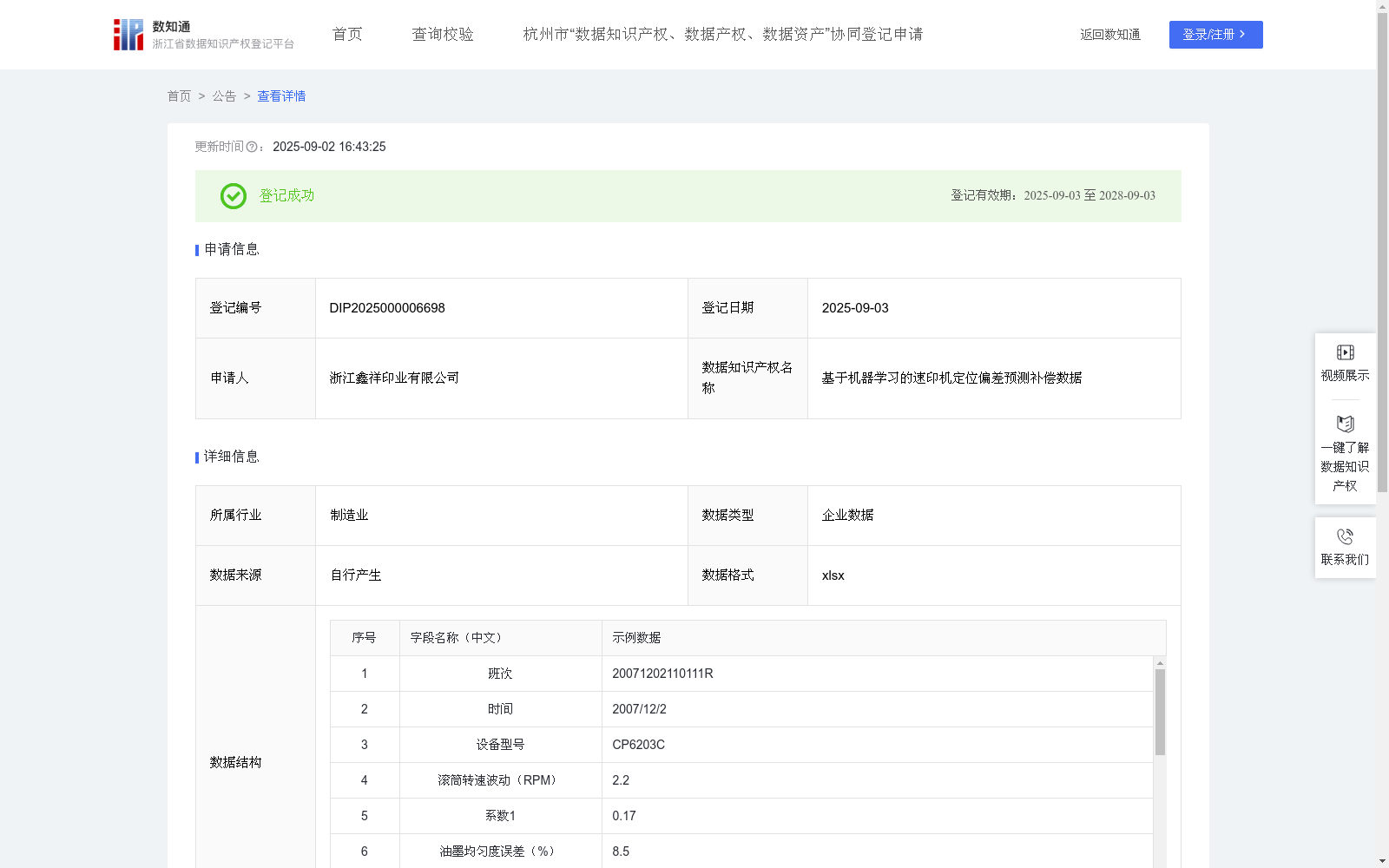
基于机器学习的速印机定位偏差预测补偿数据
收藏浙江省数据知识产权登记平台2025-09-02 更新2025-09-06 收录
下载链接:
https://www.zjip.org.cn/home/announce/trends/174070
下载链接
链接失效反馈官方服务:
资源简介:
速印机定位偏差指在高速连续印刷过程中,因进纸机构振动、滚筒同步误差、材料伸缩形变或环境温湿度波动导致的纸张定位偏移现象,表现为图像错位、套准失准或裁切偏差。基于机器学习的预测补偿技术通过实时采集设备运动参数、材料特性及环境数据,构建动态模型预测定位偏差趋势,并自动调整机械执行机构,实现高精度连续印刷定位。本预测补偿原理是通过传感器监测采集材料特性参数及环境数据,融合材料应力-应变特征与设备振动频谱,构建物理信息神经网络(PINN),建立多源数据与孔位偏差的非线性映射关系。本偏差预测补偿数据有以下应用场景:在标签连续印刷中实时补偿材料拉伸形变,减少套准误差,针对特种材料(如热敏纸)自动适配进纸压力,减少褶皱卡纸故障;将定位偏差数据接入印刷质量追溯系统,自动生成缺陷热力图并触发工艺参数自优化;向耗材供应商共享材料形变补偿系数,优化卷筒纸分切工艺参数。1、数据收集:数据采集来源于光学密度仪测、编码器、湿度传感器和生产日志,每日实时采集速印机滚筒转速波动、油墨均匀度误差和纸张湿度偏差等运行参数,对速印机设备采集到的数据进行降噪、清洗、加工后进行处理。 2、数据处理:、偏差预测公式:偏差预测值=滚筒转速波动*系数1+油墨均匀度误差*系数2+纸张湿度偏差*系数3+偏置项,3个系数值需通过机器学习训练确定,总和为1。补偿量=偏差预测值*比例系数+偏差变化率*动态响应系数,基于补偿后的残余偏差为偏差预测值与补偿量差值的绝对值。3、残余偏差越小,表明设备越健康。残余偏差大于等于1.2μm,这代表了设备补偿失效,应立即停机检修;补偿量小于等于0.7μm,这代表了设备补偿完全覆盖偏差,应维持当前补偿参数;补偿量在0.7μm至1.2μm范围内,这代表了设备补偿不足或过冲,应微调比例系数和动态响应系数。
Positioning deviation of high-speed printers refers to the phenomenon of paper positioning offset occurring during high-speed continuous printing, caused by vibration of the paper feeding mechanism, synchronization error of the printing cylinder, stretching and deformation of the printing substrate, or fluctuations in ambient temperature and humidity. This phenomenon manifests as image misalignment, printing misregister or cutting deviation.
Machine learning-based predictive compensation technology collects real-time equipment motion parameters, substrate properties and environmental data, constructs a dynamic model to predict the trend of positioning deviation, and automatically adjusts mechanical actuators to achieve high-precision continuous printing positioning.
The core principle of this predictive compensation method is to collect substrate characteristic parameters and environmental data via sensors, fuse the stress-strain characteristics of the substrate and the vibration spectrum of the equipment, construct a Physics-Informed Neural Network (PINN), and establish a nonlinear mapping relationship between multi-source data and hole position deviation.
The proposed deviation prediction and compensation data has the following application scenarios:
1. Real-time compensation of substrate stretching deformation during label continuous printing to reduce misregister; automatically adjust paper feeding pressure for special substrates such as thermal paper to reduce wrinkling and paper jam faults.
2. Integrate positioning deviation data into the printing quality traceability system to automatically generate defect heatmaps and trigger self-optimization of process parameters.
3. Share substrate deformation compensation coefficients with consumable suppliers to optimize the slitting process parameters of roll paper.
1. Data Collection: Data is collected from optical densitometers, encoders, humidity sensors and production logs. Real-time collection of operating parameters such as printing cylinder speed fluctuations, ink uniformity errors and paper humidity deviations of the high-speed printer is carried out daily. The data collected by the printing equipment is processed after noise reduction, cleaning and preprocessing.
2. Data Processing:
- Deviation prediction formula: Predicted deviation value = Cylinder speed fluctuation * Coefficient 1 + Ink uniformity error * Coefficient 2 + Paper humidity deviation * Coefficient 3 + Bias term. The three coefficients, whose sum equals 1, need to be determined via machine learning training.
- Compensation amount = Predicted deviation value * Proportional coefficient + Deviation change rate * Dynamic response coefficient. The residual deviation after compensation is defined as the absolute value of the difference between the predicted deviation value and the compensation amount.
3. The smaller the residual deviation, the healthier the equipment operates. When the residual deviation is ≥1.2μm, it indicates that the equipment compensation has failed, and the machine should be shut down immediately for maintenance; when the compensation amount is ≤0.7μm, it indicates that the equipment compensation fully covers the deviation, and the current compensation parameters should be maintained; when the compensation amount is between 0.7μm and 1.2μm, it indicates that the equipment compensation is insufficient or overshot, and the proportional coefficient and dynamic response coefficient should be fine-tuned.
提供机构:
浙江鑫祥印业有限公司
创建时间:
2025-05-30
搜集汇总
数据集介绍
背景与挑战
背景概述
该数据集由浙江鑫祥印业有限公司提供,包含22,436条每日更新的速印机运行参数,用于通过机器学习预测和补偿定位偏差,以提高印刷精度和设备维护效率。数据集涵盖滚筒转速、油墨均匀度、纸张湿度等关键指标,并定义了偏差计算和补偿规则,支持实时质量控制和工艺优化。
以上内容由遇见数据集搜集并总结生成



