
车位检测传感器需求量预测数据
收藏浙江省数据知识产权登记平台2025-09-03 更新2025-09-06 收录
下载链接:
https://www.zjip.org.cn/home/announce/trends/174525
下载链接
链接失效反馈官方服务:
资源简介:
本数据聚焦于预测车位检测传感器的市场需求量,为公司(制造商)及外部相关方提供了关键的决策依据,具有重要的应用价值。具体体现在以下方面:
1.优化生产计划:对制造商而言,通过预测不同地区车位检测传感器的需求量,科学制定生产排期,避免产能过剩或断货风险。动态调整原材料采购和包装供应计划,降低供应链成本并提升响应速度。
2.精准营销:经销商可以结合需求量预测数据,,制定差异化的销售策略。针对需求增长较快的地区,提前布局销售资源,抢占市场份额。1.数据采集:
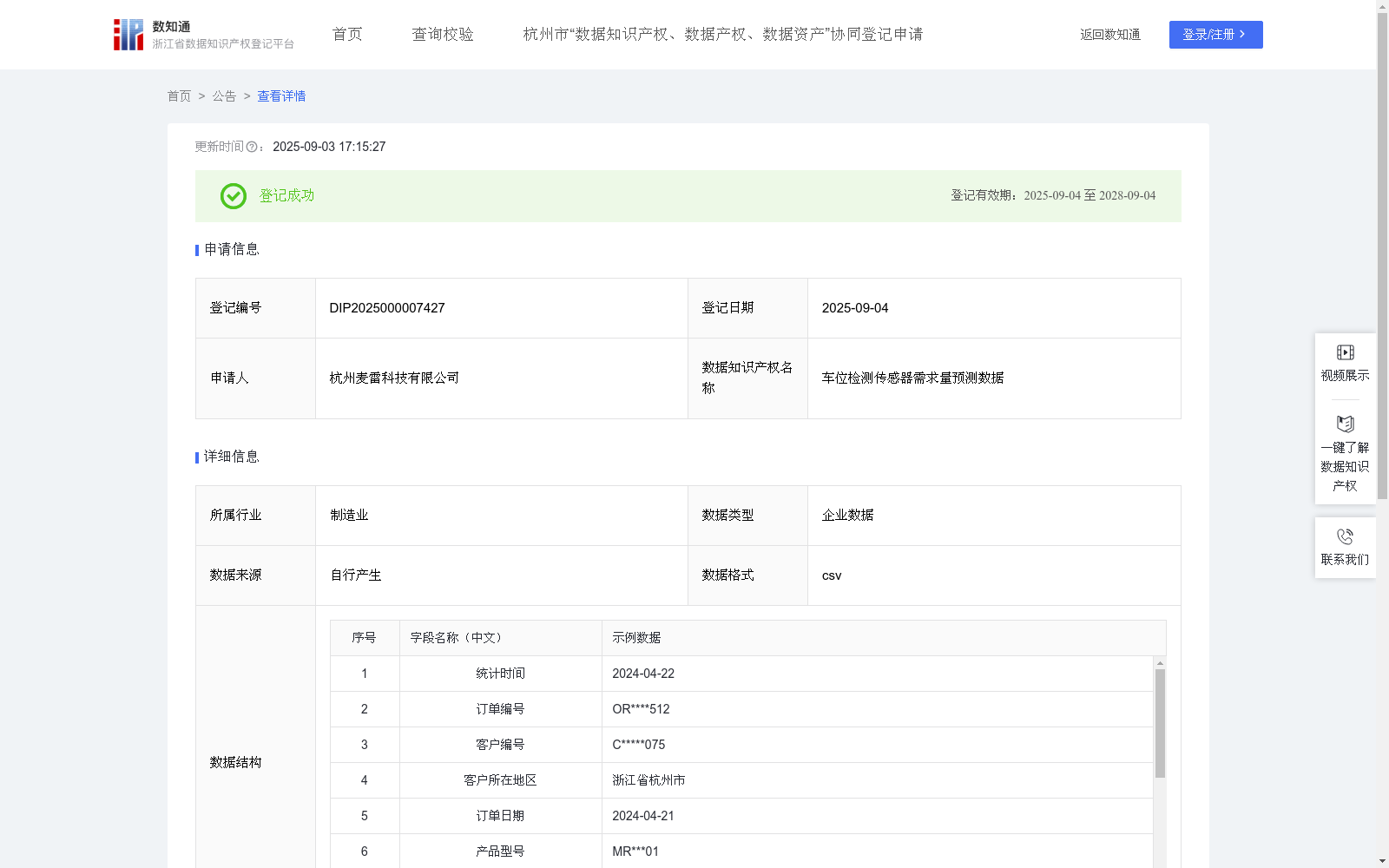
采集公司车位检测传感器的销售数据,包括统计时间、订单编号、客户编号、客户所在地区、订单日期、产品型号、订单数量(个)、订单金额(元)。
2.数据预处理:
对采集的数据进行清洗,去除重复记录,处理缺失值。
3.数据加工与分析:
(1)计算历史需求量:对于每种车位检测传感器型号,使用SUMIFS函数对订单数量进行累加,分别计算出其过去365天、90天和30天的总需求量。(2)建立需求量预测模型:未来30天需求量预测值=[(过去365天总需求量÷365*a)+(过去90天的总需求量÷90*b)+(过去30天的总需求量÷30*c)]*30*k;其中,系数a=0.5,b=0.3,c=0.2,调整因子k=1.1。系数a、b、c反映数值对未来30天需求量预测的影响程度,由于算法更注重长期需求趋势的影响,因此a被赋予了最高的权重。调整因子k是基于市场增长预期给出的修正值。
This dataset focuses on forecasting the market demand for parking space detection sensors, providing critical decision-making support for the company (manufacturer) and external stakeholders, and holds significant practical value, which is reflected in the following aspects:
1. Optimizing Production Planning: For manufacturers, forecasting the demand for parking space detection sensors across different regions enables them to develop scientifically sound production schedules, avoiding the risks of overcapacity or stockouts. It also allows for dynamic adjustment of raw material procurement and packaging supply plans, reducing supply chain costs and improving response speed.
2. Precision Marketing: Distributors can develop differentiated sales strategies based on demand forecast data. For regions with rapid demand growth, they can proactively allocate sales resources to seize market share.
1. Data Collection:
Collect the sales data of the company's parking space detection sensors, including statistical time, order number, customer ID, customer's region, order date, product model, order quantity (unit: piece), and order amount (unit: yuan).
2. Data Preprocessing:
Clean the collected data by removing duplicate records and handling missing values.
3. Data Processing and Analysis:
(1) Calculating Historical Demand: For each parking space detection sensor model, use the SUMIFS function to accumulate order quantities, and calculate the total demand over the past 365 days, 90 days, and 30 days respectively.
(2) Establishing Demand Forecasting Model: The 30-day future demand forecast value = [(Total demand over the past 365 days / 365 × a) + (Total demand over the past 90 days / 90 × b) + (Total demand over the past 30 days / 30 × c)] × 30 × k; where coefficients a=0.5, b=0.3, c=0.2, and adjustment factor k=1.1. The coefficients a, b, and c reflect the impact degree of the corresponding historical demand on the 30-day future demand forecast. Since the algorithm prioritizes long-term demand trends, a is assigned the highest weight. The adjustment factor k is a correction value based on market growth expectations.
提供机构:
杭州麦雷科技有限公司
创建时间:
2025-06-12
搜集汇总
数据集介绍
背景与挑战
背景概述
该数据集包含658条车位检测传感器订单记录,通过加权计算历史365/90/30天需求量的算法预测未来30天需求量,主要用于优化制造商生产计划和经销商精准营销策略。数据每日更新,采用CSV格式存储,包含订单编号、地区、产品型号等12个关键字段。
以上内容由遇见数据集搜集并总结生成



