
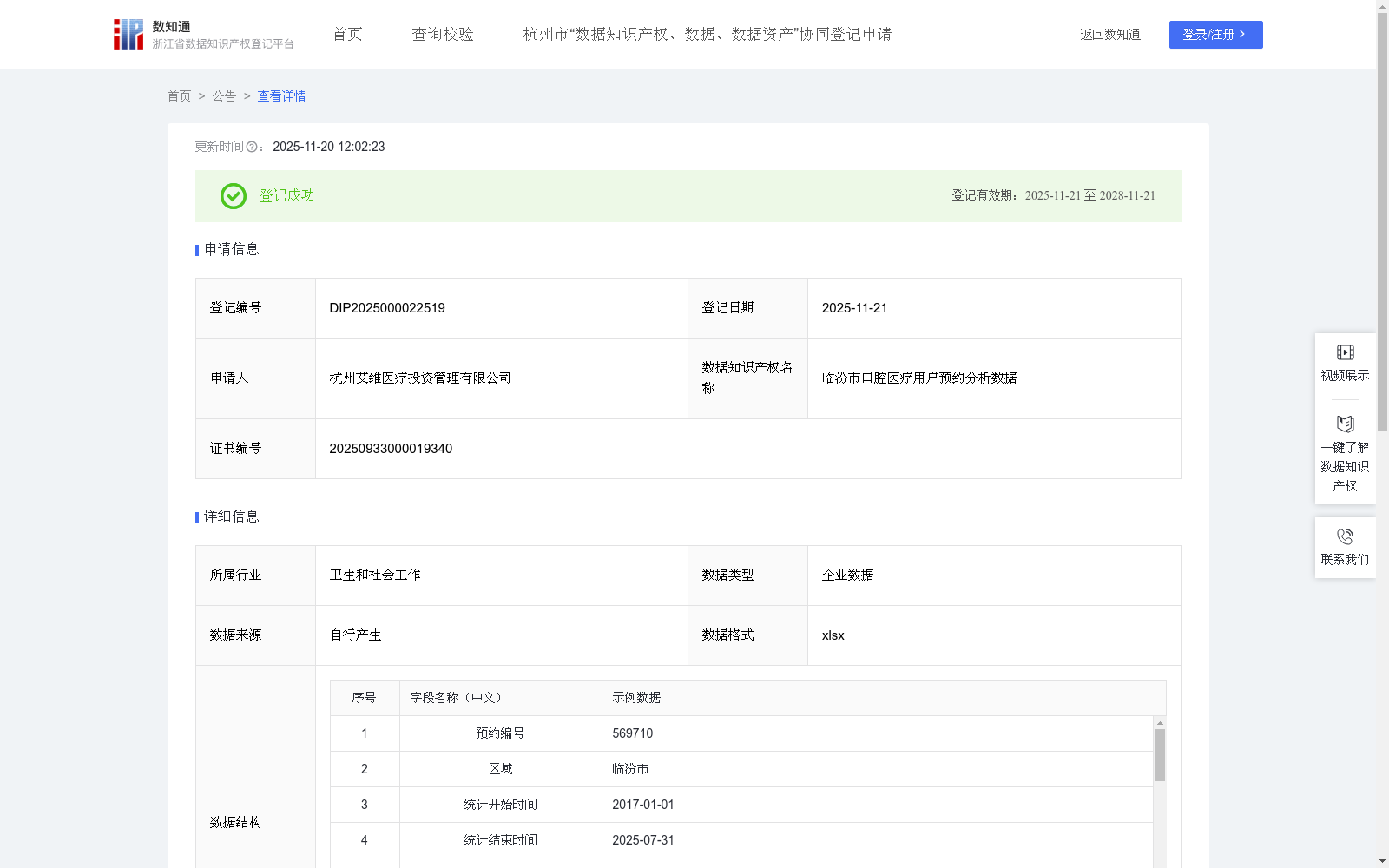
临汾市口腔医疗用户预约分析数据
收藏浙江省数据知识产权登记平台2025-11-20 更新2025-11-21 收录
下载链接:
https://www.zjip.org.cn/home/announce/trends/8403317
下载链接
链接失效反馈官方服务:
资源简介:
一、医院端核心价值:提升资源利用率:通过监测预约未到率,结合用户等级推送提醒(D级用户双提醒,A/B级用户保权益),降低未到率,减少医生/设备闲置。优化排班服务:按科室履约率、取消预约率调整排班(如种植科留弹性时段),减少冲突,降低投诉。联动营收:将履约率、失约率纳入医生考核,提升整体履约率,增加复购和营收。二、分用户等级运营方案(聚焦服务与优先级):A级(90-100分):①预约优先——优先锁定旺季热门医生/时段,支持1次/季度7天内临时调时段;②服务优先——到店免排队登记,享专属客服对接,年度1次免费口腔检查。B级(80-89分):①预约优先——可约15天内热门时段,每月1次提前24小时调约免记录;②服务优先——到店优先叫号(比普通用户快15分钟),诊疗后赠洗牙9折券。C级(70-79分):①预约服务——可约非高峰时段,预约前分3次推送提醒(避免失约);D级(≤69分):①预约服务——可约7天后非热门时段,预约后电话确认(确保有效);三、行业价值:帮中小机构建标准化用户标签,替代人工记忆,降低未到率。履约率等指标成行业参考标准,助机构对标改进,释放诊疗产能。推动行业分层服务,留存优质用户、转化待改进用户,实现体验与效益双提升。1.数据收集和预处理:(1)数据收集:收集医院预约管理系统中的预约相关数据,具体包括统计、总预约次数、预约未到数、履约数、取消预约数、失约数。(2)数据预处理:对采集到的原始数据进行处理,去除医院主动取消预约、用户提交未确认预约、测试订单等无效数据,同时排除用户因突发疾病等特殊情况并提供证明的豁免数据。2. 核心率类指标计算:(1)计算预约未到率:预约未到率=(预约未到数÷总预约次数)×100%;(2)计算履约率:履约率=(履约数÷总预约次数)×100%;(3)计算取消预约率:取消预约率=(取消预约数÷总预约次数)×100%;(4)计算失约率:失约率=(失约数÷总预约次数)×100%。3.计算各率类指标评分(四舍五入保留两位小数):(1)履约评分=履约率x40(满分为40分)、(2)预约未到评分=(100%-预约未到率)x20(满分20分)、(3)取消预约评分=(100%-取消预约率)x20(满分20分)、(4)失约评分=(100%-失约率)x20(满分为20分);4. 建立综合评分与用户等级判定模型:(1)计算综合评分=履约评分+预约未到评分+取消预约评分+失约评分。(2)用户评级:基于医院运营需求及用户管理目标,确定当综合评分 90-100 分,则用户等级为 “A 级(优质)”;当综合评分 80-89 分,则用户等级为 “B 级(良好)”;当综合评分 70-79 分,则用户等级为 “C 级(一般)”;当综合评分 69 分及以下,则用户等级为 “D 级(限制)”。
I. Hospital-side Core Values
1. Improve Resource Utilization: Monitor the appointment no-show rate, and push targeted reminders based on user tiers (double reminders for Tier D users, retain original rights for Tier A/B users) to reduce no-shows and cut idle time of medical staff and equipment.
2. Optimize Scheduling Services: Adjust scheduling plans based on departmental fulfillment rate and cancellation rate (e.g., reserve flexible time slots for the Implantology Department) to reduce scheduling conflicts and patient complaints.
3. Link to Revenue Growth: Incorporate fulfillment rate and no-show rate into doctor performance assessments, improve overall fulfillment rate, and boost repeat customer purchases and total revenue.
II. Tiered User Operation Plan (Focus on Service and Priority)
- Tier A (90-100 points):
① Priority Appointment Booking: Secure hot-demand doctors and time slots during peak seasons first; allow 1 temporary time adjustment within 7 days per quarter.
② Priority Service: Skip in-store check-in queue, enjoy dedicated customer service support, and 1 free oral examination per year.
- Tier B (80-89 points):
① Priority Appointment Booking: Book hot-demand time slots within 15 days; enjoy 1 free appointment adjustment 24 hours in advance per month without negative records.
② Priority Service: Be called ahead in the queue (15 minutes faster than regular users), and receive a 10% discount coupon for dental prophylaxis after treatment.
- Tier C (70-79 points):
① Appointment Service: Book non-peak time slots; send 3 reminder pushes before the appointment to prevent no-shows.
- Tier D (≤69 points):
① Appointment Service: Book non-popular time slots 7 days in advance; confirm the appointment via phone call after booking to ensure validity.
III. Industry Value
Help small and medium-sized medical institutions build standardized user tags instead of relying on manual memory, effectively reducing appointment no-show rates. Make indicators such as fulfillment rate become industry reference standards, enabling institutions to benchmark and optimize their operations, and release clinical capacity. Promote tiered medical services in the industry, retain high-quality users, convert users with room for improvement, and achieve dual improvements in patient experience and institutional benefits.
1. Data Collection and Preprocessing
(1) Data Collection: Collect appointment-related data from the hospital appointment management system, including total appointment count, number of no-shows, number of fulfilled appointments, number of canceled appointments, and number of missed appointments.
(2) Data Preprocessing: Process the collected raw data by removing invalid entries such as hospital-initiated canceled appointments, unconfirmed user-submitted appointments, and test orders. Additionally, exclude exempted cases where users provide proof of special circumstances such as sudden illness.
2. Core Rate Indicator Calculation
(1) Appointment No-show Rate = (Number of No-shows ÷ Total Appointment Count) × 100%
(2) Fulfillment Rate = (Number of Fulfilled Appointments ÷ Total Appointment Count) × 100%
(3) Cancellation Rate = (Number of Canceled Appointments ÷ Total Appointment Count) × 100%
(4) Missed Appointment Rate = (Number of Missed Appointments ÷ Total Appointment Count) × 100%
3. Tiered Score Calculation for Rate Indicators (rounded to two decimal places)
(1) Fulfillment Score = Fulfillment Rate × 40 (full score: 40 points)
(2) No-show Score = (100% - Appointment No-show Rate) × 20 (full score: 20 points)
(3) Cancellation Score = (100% - Cancellation Rate) × 20 (full score: 20 points)
(4) Missed Appointment Score = (100% - Missed Appointment Rate) × 20 (full score: 20 points)
4. Comprehensive Score and User Tier Judgment Model
(1) Comprehensive Score = Fulfillment Score + No-show Score + Cancellation Score + Missed Appointment Score
(2) User Rating: Based on hospital operation needs and user management objectives, the user tier is determined as follows:
- Tier A (High-quality): Comprehensive score 90-100 points
- Tier B (Good): Comprehensive score 80-89 points
- Tier C (Average): Comprehensive score 70-79 points
- Tier D (Restricted): Comprehensive score ≤ 69 points
提供机构:
杭州艾维医疗投资管理有限公司
创建时间:
2025-09-22
搜集汇总
数据集介绍
背景与挑战
背景概述
该数据集聚焦于临汾市口腔医疗用户的预约行为分析,包含525条记录,涵盖预约状态、履约率和用户等级等关键指标,用于优化医院资源分配和提升服务效率。数据通过算法计算综合评分,支持用户分层运营,帮助医疗机构降低未到率并改善患者体验。
以上内容由遇见数据集搜集并总结生成



