
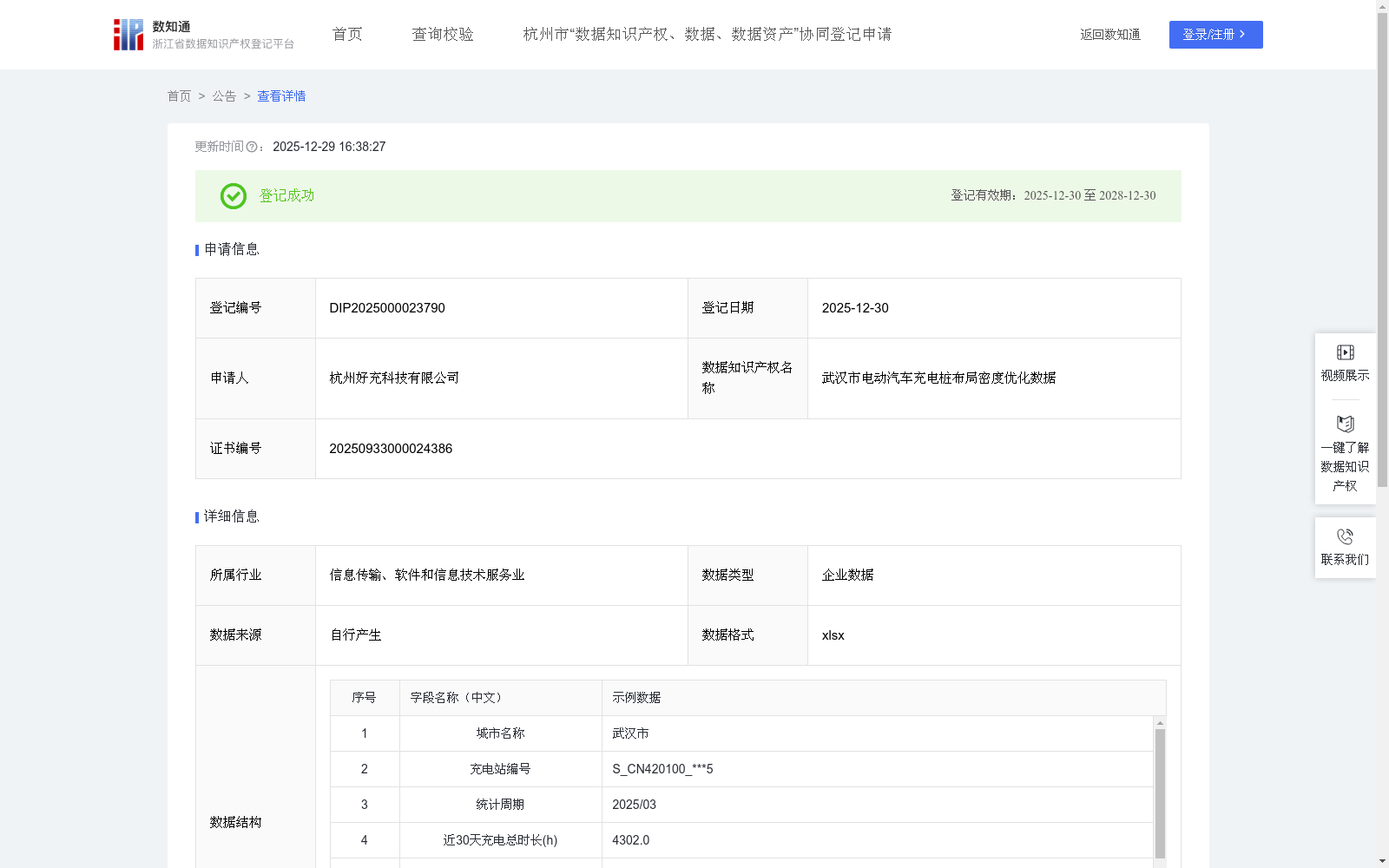
武汉市电动汽车充电桩布局密度优化数据
收藏浙江省数据知识产权登记平台2025-12-29 更新2025-12-30 收录
下载链接:
https://www.zjip.org.cn/home/announce/trends/8420577
下载链接
链接失效反馈官方服务:
资源简介:
本数据通过分析武汉市内充电桩使用情况,为充电基础设施优化提供决策支持。主要应用于:指导运营商优化充电桩布局,识别高负荷站点优先扩容,发现闲置设备可迁移区域,优化运维资源分配,合理配置公共资源,提升整体运营效率。同时可为城市规划部门提供充电设施使用热力图参考,助力实现充电资源的高效利用。
"1.数据采集
采集企业自有充电桩设备管理数据,包括城市名称、充电站编号、统计周期、近30天充电总时长、充电桩数量等数据。
2.数据处理与加工计算
通过数据清洗剔除不足5分钟的充电记录等其他异常值与无效记录,计算需求指数=近30天充电总时长/充电桩数量,使用Python scipy.spatial.ConvexHull包(一种Python中用于计算覆盖范围的工具)计算服务半径R,得出服务面积=πR^2。计算密度指数=充电桩数量/服务面积。计算匹配度=需求指数/密度指数。
3.优化策略
进行匹配度分类并给出优化策略:
匹配度>220:匹配度分类为""供给不足"",优化策略为""建议新建""。
90≤匹配度≤220:匹配度分类为""供需平衡"",优化策略为""建议保持现状""。
匹配度<90:匹配度分类为""供给过剩"",优化策略为""建议迁移""。"
This dataset provides decision support for the optimization of charging infrastructure by analyzing the usage of charging piles in Wuhan City. Its main applications include: guiding operators to optimize the layout of charging piles, identifying high-load stations for priority expansion, discovering areas where idle equipment can be relocated, optimizing the allocation of operation and maintenance resources, rationally configuring public resources, and improving overall operational efficiency. It can also provide reference charging facility usage heatmaps for urban planning departments, helping to achieve efficient utilization of charging resources.
1. Data Collection
Collect enterprise-owned charging pile equipment management data, including city name, charging station ID, statistical cycle, total charging duration in the past 30 days, number of charging piles and other relevant data.
2. Data Processing and Calculation
First, perform data cleaning to remove outliers and invalid records such as charging records shorter than 5 minutes. Calculate the Demand Index as total charging duration in the past 30 days / number of charging piles. Use the Python scipy.spatial.ConvexHull package (a Python tool for calculating coverage ranges) to calculate the service radius R, and derive the service area as πR². Calculate the Density Index as number of charging piles / service area. Calculate the Matching Degree as Demand Index / Density Index.
3. Optimization Strategies
Classify based on the Matching Degree and provide corresponding optimization strategies:
- Matching Degree > 220: Classified as "Insufficient Supply", with the optimization strategy of "Recommended to build new".
- 90 ≤ Matching Degree ≤ 220: Classified as "Supply and Demand Balance", with the optimization strategy of "Recommended to maintain status quo".
- Matching Degree < 90: Classified as "Excessive Supply", with the optimization strategy of "Recommended to relocate".
提供机构:
杭州好充科技有限公司
创建时间:
2025-09-30
搜集汇总
数据集介绍
背景与挑战
背景概述
该数据集提供了武汉市电动汽车充电桩的布局密度优化分析数据,包含500条记录,每月更新,涵盖充电站编号、统计周期、充电总时长、充电桩数量、需求指数、服务面积、匹配度等关键指标。通过计算匹配度并进行分类(如供给过剩或不足),数据集为充电运营商和城市规划部门提供决策支持,帮助优化充电桩布局、识别高负荷站点并指导设备迁移,以提升充电资源利用效率和运营效果。
以上内容由遇见数据集搜集并总结生成


