
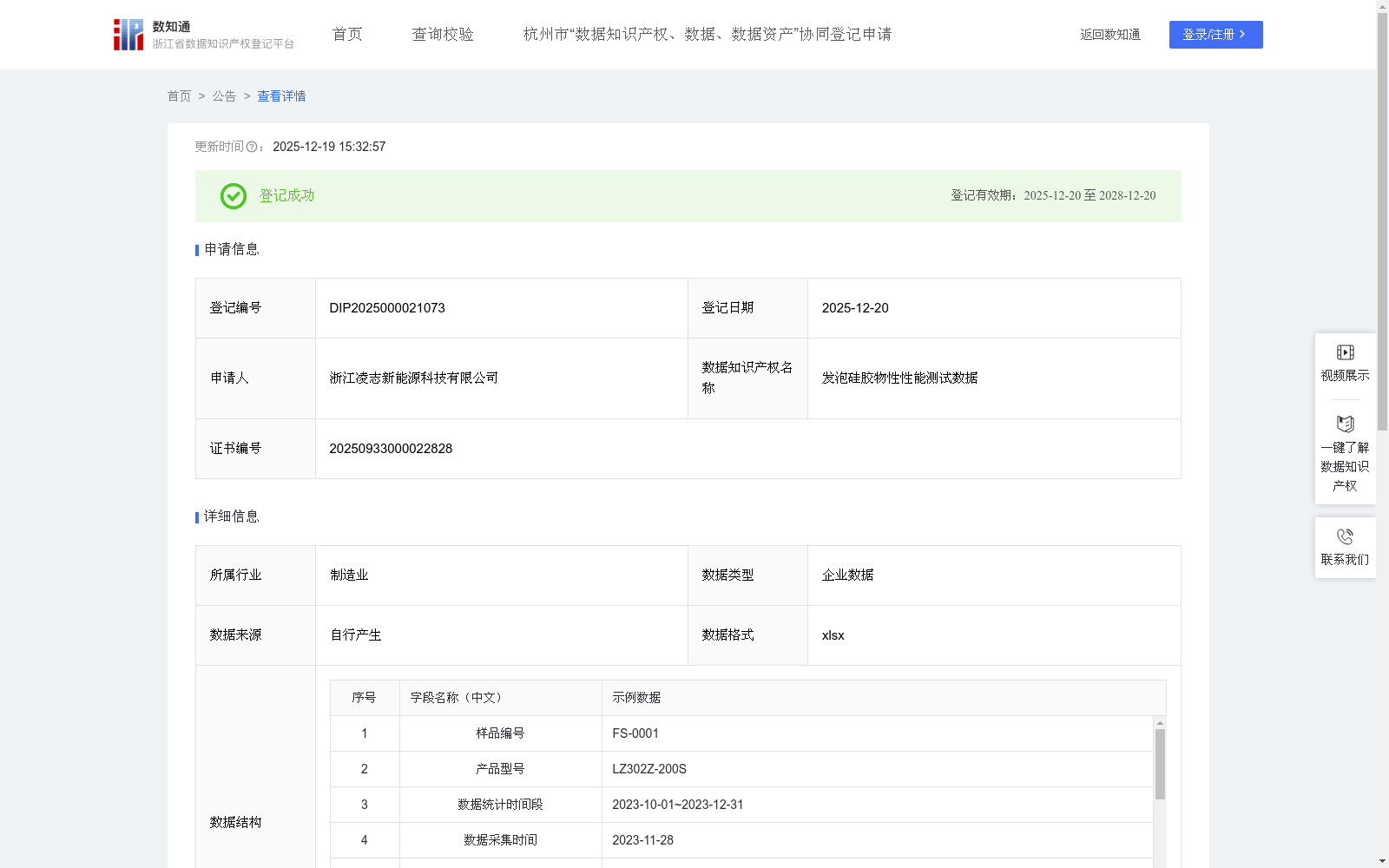
发泡硅胶物性性能测试数据
收藏浙江省数据知识产权登记平台2025-12-19 更新2025-12-20 收录
下载链接:
https://www.zjip.org.cn/home/announce/trends/8416701
下载链接
链接失效反馈官方服务:
资源简介:
发泡硅胶物性性能测试数据集可广泛应用于材料研发、生产控制及应用验证等环节,在研发阶段,研究人员可利用密度、压缩应力、拉伸强度、断裂伸长率等核心指标,对不同型号样品进行性能对比与趋势分析,并结合性能综合评分、结构稳定性系数等衍生字段,为新材料设计和配方优化提供数据支撑。在生产过程中,测试环境参数及批量检测结果可用于质量监控,通过压缩永久变形率、吸水率、硬度等指标的一致性分析,帮助发现潜在偏差并及时调整工艺,确保产品性能稳定可靠。在应用场景中,结合绝缘可靠性指数、导热率及阻燃性能等级,可对材料在密封垫片、绝缘隔热、汽车减震、电子缓冲、家电部件等典型领域的适配性进行量化评估,综合等级能够为客户快速选型提供参考。此外,该数据集还能支撑性能预测与智能分析,帮助企业开展材料可靠性研究和未来型号仿真验证,提升研发效率和服务水平。数据统计时间段字段使得用户能够按时间维度进行历史数据回溯与趋势对比,数据采集时间字段进一步增强了数据的时效性分析与动态监测能力。1.数据预处理:清洗原始检测数据,剔除缺失值和异常值;各项参数按照公司标准约束,保证数据符合质量要求;必要时对少量数据进行扰动或抽样,使整体分布符合实际,又避免泄露单次实验记录。2.性能综合评分:(1)标准化处理:对拉伸强度、断裂伸长率、介电强度、压缩永久变形率标准化,其中压缩永久变形率按越小越优采用反向标准化。(2)权重设定:拉伸强度30%,断裂伸长率20%,介电强度30%,压缩永久变形率20%。(3)结果映射:加权求和后线性映射至0-100分区间并四舍五入取整,作为样品整体性能评分。3.结构稳定性系数:(1)稳定因子计算:以压缩永久变形率反向计算,公式:稳定因子=1-(压缩永久变形率÷5.0),数值越小材料越稳定。(2)应力保持因子计算:25%压缩应力与型号标准上限归一化,公式:应力保持因子=25%压缩应力÷上限值。(3)综合计算:稳定因子*应力保持因子,得结构稳定性系数,限定0-1保留三位小数,用于反映长期受力下抵抗永久形变的能力。4.绝缘可靠性指数:(1)介电得分:介电强度按2-5kV/mm标准化,转换为0-100分。(2)体积电阻率得分:≥1.0×10¹⁴Ω•cm为满分,否则按比例折减。(3)加权综合:介电得分60%,体积电阻率40%,加权平均后映射至0-100并取整,,作为电气绝缘可靠性量化指标。5.综合等级判定:性能综合评分≥80、结构稳定性系数≥0.70、绝缘可靠性指数≥80时为A级;性能综合评分≥60且其他两项中至少一项达标为B级;性能综合评分<60或三项指标均未达标时为C级。
Foamed silica gel physical property test dataset can be widely applied in material R&D, production control, application verification and other links. During the R&D stage, researchers can use core indicators such as density, compressive stress, tensile strength, elongation at break to conduct performance comparison and trend analysis on samples of different models. Combined with derived fields such as comprehensive performance score and structural stability coefficient, it can provide data support for new material design and formula optimization. In the production process, test environment parameters and batch test results can be used for quality monitoring. Through consistency analysis of indicators such as compression set, water absorption, and hardness, potential deviations can be identified and processes adjusted timely to ensure stable and reliable product performance. In application scenarios, combined with insulation reliability index, thermal conductivity and flame retardant performance grade, the adaptability of the material in typical fields such as sealing gaskets, insulation and heat insulation, automobile shock absorption, electronic buffering, and home appliance parts can be quantitatively evaluated. The comprehensive grade can provide reference for customers to quickly select models. In addition, this dataset can also support performance prediction and intelligent analysis, helping enterprises carry out material reliability research and future model simulation verification, and improve R&D efficiency and service level. The data statistics time period field enables users to conduct historical data review and trend comparison from the time dimension, and the data collection time field further enhances the timeliness analysis and dynamic monitoring capabilities of the data.
1. Data preprocessing: Clean the original test data, eliminate missing values and outliers; Standardize various parameters in accordance with company standards to ensure data meets quality requirements; Perform perturbation or sampling on a small amount of data when necessary to make the overall distribution conform to reality while avoiding leakage of single experiment records.
2. Comprehensive performance score: (1) Standardization treatment: Standardize tensile strength, elongation at break, dielectric strength, and compression set, among which compression set adopts reverse standardization as the smaller the value, the better. (2) Weight setting: Tensile strength 30%, elongation at break 20%, dielectric strength 30%, compression set 20%. (3) Result mapping: Perform weighted summation, then linearly map to the 0-100 score interval and round to the nearest integer as the overall performance score of the sample.
3. Structural stability coefficient: (1) Stability factor calculation: Calculate reversely based on compression set, formula: Stability factor = 1 - (compression set ÷ 5.0), the smaller the value, the more stable the material. (2) Stress retention factor calculation: Normalize 25% compressive stress with the model's standard upper limit, formula: Stress retention factor = 25% compressive stress ÷ upper limit value. (3) Comprehensive calculation: Multiply stability factor by stress retention factor to obtain the structural stability coefficient, which is limited to 0-1 with three decimal places, used to reflect the ability to resist permanent deformation under long-term stress.
4. Insulation reliability index: (1) Dielectric score: Standardize dielectric strength from 2 to 5 kV/mm and convert it to 0-100 points. (2) Volume resistivity score: Full score when ≥1.0×10¹⁴ Ω•cm, otherwise reduce proportionally. (3) Weighted comprehensive: Dielectric score accounts for 60%, volume resistivity accounts for 40%, after weighted average, map to 0-100 and round to the nearest integer as the quantitative indicator of electrical insulation reliability.
5. Comprehensive grade determination: Grade A when comprehensive performance score ≥80, structural stability coefficient ≥0.70, and insulation reliability index ≥80; Grade B when comprehensive performance score ≥60 and at least one of the other two indicators meets the standard; Grade C when comprehensive performance score <60 or none of the three indicators meet the standard.
提供机构:
浙江凌志新能源科技有限公司
创建时间:
2025-09-17
搜集汇总
数据集介绍
背景与挑战
背景概述
该数据集是浙江凌志新能源科技有限公司登记的发泡硅胶物理性能测试数据,包含2009条记录,每季度更新,数据格式为xlsx。它详细记录了发泡硅胶的密度、压缩应力、拉伸强度等关键物性指标,并通过算法计算了性能综合评分、结构稳定性系数和绝缘可靠性指数,用于材料研发、生产质量控制和产品应用评估。数据集适用于制造业中的材料分析和优化场景。
以上内容由遇见数据集搜集并总结生成


