
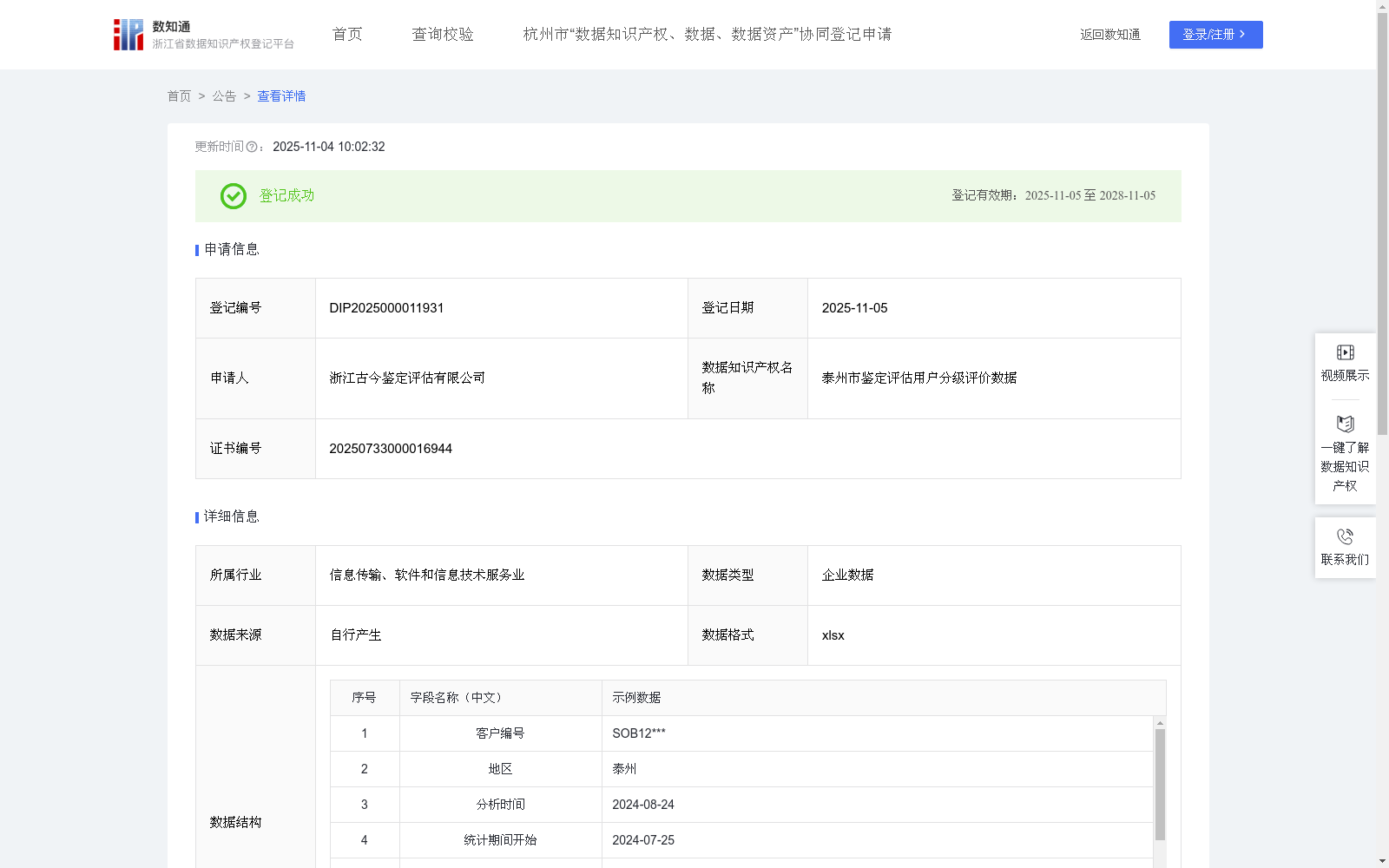
泰州市鉴定评估用户分级评价数据
收藏浙江省数据知识产权登记平台2025-11-04 更新2025-11-13 收录
下载链接:
https://www.zjip.org.cn/home/announce/trends/8386793
下载链接
链接失效反馈官方服务:
资源简介:
本数据聚焦于对泰州市地区客户鉴定评估的价值度分级评价,揭示了客户的价值层次及其特点,为鉴定评估中心及鉴定行业提供了重要的决策依据,具有显著的应用价值。具体体现在以下方面: 1.精准客户管理:通过客户价值度分级,本鉴定中心可以识别泰州市地区鉴定评估的高等级客户,并制定差异化的营销策略和服务方案。针对高等级客户提供专属技术专家支持、优先进行鉴定评估及上门服务,优化资源配置,提升客户满意度和长期合作黏性,实现客户价值的最大化。 2.资源动态调配与成本管控:依据客户价值等级,可对鉴定中心的人力、设备、物料等资源进行动态分配。例如,为高价值客户预留先进检测设备的使用时段,避免资源闲置;对低价值且需求分散的客户,可采用集中化鉴定流程或套餐服务,降低单位服务成本。通过这种精准调配,既能保障高价值客户的服务效率,又能减少无效资源消耗,提升整体运营效益。3.风险预警与合作稳定性维护:通过持续跟踪客户价值等级的波动,能及时发现合作风险。当某高价值客户的评估需求频率骤降或项目复杂度降低时,可能预示其合作意愿变化或转向竞争对手,此时可启动预警机制,由专属客户经理主动沟通,排查问题并提供增值服务(如免费鉴定评估咨询),预防客户流失。对于低价值但风险较高(如历史鉴定纠纷率高)的客户,可强化前期资质审核,降低合作风险。1.数据采集:采集在泰州市地区的鉴定评估情况数据,包括客户编号、地区、分析时间、统计期间、上次服务时间、距离上一次购买的天数R(天)、最近一段时间购买频次F(次)、最近一段时间购买金额M(元)等数据字段。其中,最近一段时间指最近30天。 2.数据预处理:对采集到的数据进行清洗,去除重复记录,处理缺失值。 3.数据加工:运用RFM模型并结合该客户的R、F、M的排名,分别得出该客户的R、F、M的得分。赋分规则如下:提取所有客户的距离上一次购买的天数R(天),距离上一次购买的天数R(天)最短的客户排在最上面,按照从1-5评分,前20%的客户的R得分获得5分,接下来的20%客户的R得分获得4分,再下来20%的客户的R得分为3分,再下来20%的客户的R得分为2分,最后20%的客户为1分;提取所有客户的最近一段时间购买频次F(次),F得分=最近一段时间购买频次F(次);提取所有客户的最近一段时间购买金额M(元),前20%的客户的M得分为5,以此类推。 4.数据处理:(1)RFM得分计算:RFM得分=R得分+F得分+M得分。(2)客户等级划分:RFM得分≥4分为A级客户,3≤RFM得分<4为B级客户,2≤RFM得分<3为C级客户,RFM得分<2为D级客户。
This dataset focuses on the value grading evaluation of customer appraisal and assessment in Taizhou, reveals the value hierarchy and characteristics of customers, and provides important decision-making basis for appraisal centers and the appraisal industry, with significant application value. It is specifically reflected in the following aspects:
1. Precise Customer Management: Through customer value grading, the appraisal center can identify high-value customers for appraisal and assessment in Taizhou, and formulate differentiated marketing strategies and service plans. Exclusive technical expert support, priority appraisal and assessment, and on-site services are provided for high-value customers, optimizing resource allocation, improving customer satisfaction and long-term cooperation stickiness, and maximizing customer value.
2. Dynamic Resource Allocation and Cost Control: According to the customer value level, dynamic allocation of human resources, equipment, materials and other resources of the appraisal center can be carried out. For example, reserve usage time slots of advanced testing equipment for high-value customers to avoid resource idleness; for low-value customers with scattered demands, centralized appraisal processes or package services can be adopted to reduce unit service costs. Through such precise allocation, the service efficiency of high-value customers can be guaranteed, while reducing invalid resource consumption and improving overall operational efficiency.
3. Risk Early Warning and Maintenance of Cooperation Stability: By continuously tracking the fluctuations of customer value levels, cooperation risks can be identified in a timely manner. When the frequency of assessment demands of a high-value customer drops sharply or the project complexity decreases, it may indicate a change in their willingness to cooperate or a shift to competitors. At this time, an early warning mechanism can be activated, and the dedicated account manager will take the initiative to communicate, investigate problems and provide value-added services (such as free appraisal and assessment consultation) to prevent customer churn. For low-value customers with high risks (such as high historical appraisal dispute rate), pre-qualification review can be strengthened to reduce cooperation risks.
1. Data Collection: Collect appraisal and assessment data in Taizhou, including data fields such as customer ID, region, analysis time, statistical period, last service time, number of days R (days) since the last purchase, purchase frequency F (times) in the recent period, and recent purchase amount M (yuan). The recent period refers to the last 30 days.
2. Data Preprocessing: Clean the collected data, remove duplicate records, and handle missing values.
3. Data Processing: Use the RFM model combined with the rankings of the customer's R, F, and M to obtain the scores of R, F, and M respectively. The scoring rules are as follows: Extract the number of days R (days) since the last purchase of all customers. Customers with the shortest R days are ranked first, and scored from 1 to 5. Customers in the top 20% get 5 points for their R score, the next 20% get 4 points, the next 20% get 3 points, the next 20% get 2 points, and the last 20% get 1 point; Extract the purchase frequency F (times) in the recent period of all customers, and the F score is equal to the purchase frequency F (times); Extract the recent purchase amount M (yuan) of all customers, customers in the top 20% get 5 points for their M score, and so on.
4. Data Calculation: (1) RFM Score Calculation: RFM Score = R Score + F Score + M Score. (2) Customer Level Division: Customers with RFM Score ≥ 4 are classified as Level A customers, 3 ≤ RFM Score < 4 as Level B customers, 2 ≤ RFM Score < 3 as Level C customers, and RFM Score < 2 as Level D customers.
提供机构:
浙江古今鉴定评估有限公司
创建时间:
2025-07-22
搜集汇总
数据集介绍
背景与挑战
背景概述
该数据集是泰州市鉴定评估行业的客户分级评价数据,包含681条记录,每月更新,采用RFM模型对客户进行价值度分级(分为A、B、C、D四个等级)。数据集旨在通过分析客户购买行为(如最近购买天数、频次和金额),支持精准客户管理、资源动态调配和风险预警,为鉴定评估中心提供决策依据。
以上内容由遇见数据集搜集并总结生成



