
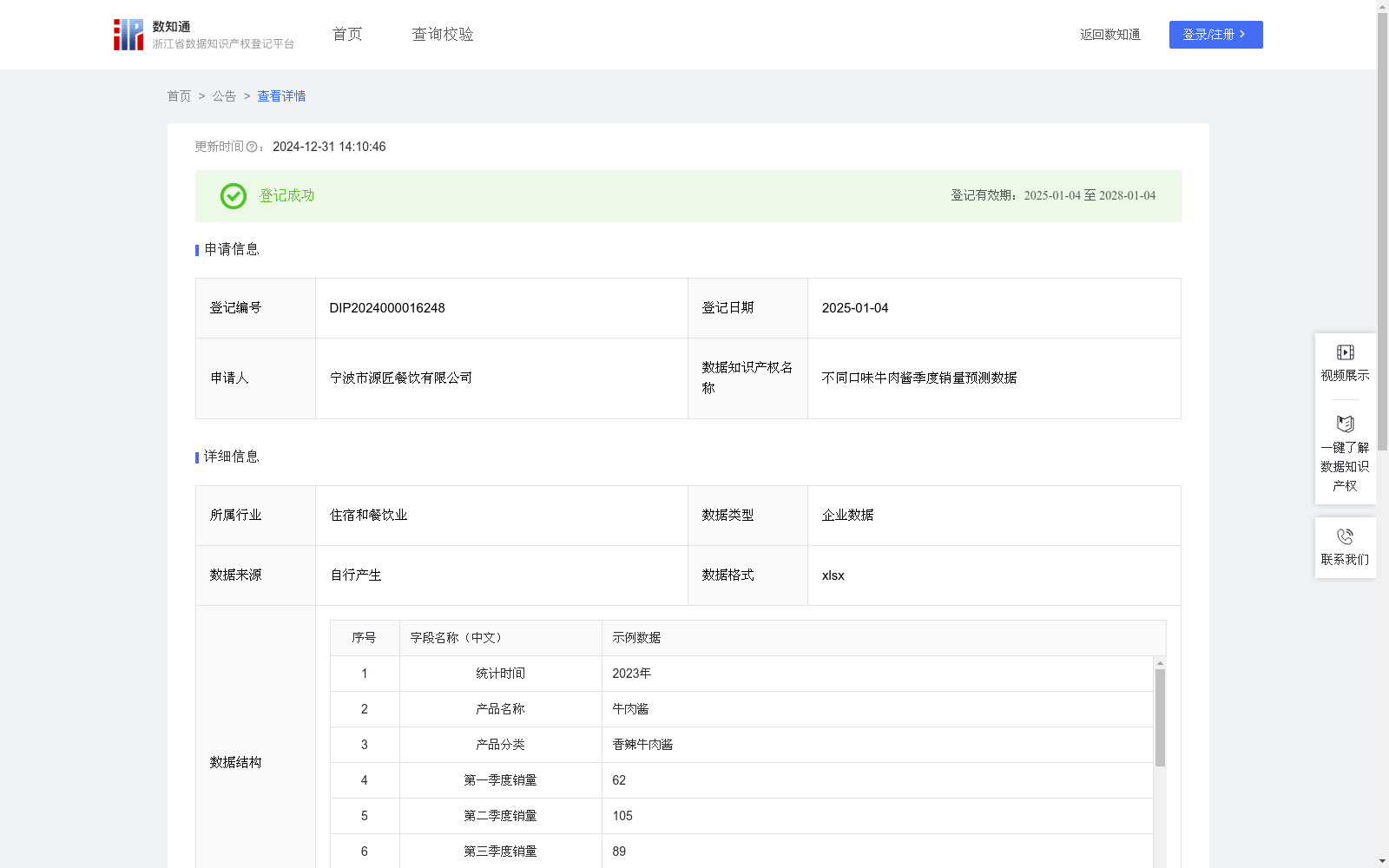
不同口味牛肉酱季度销量预测数据
收藏浙江省数据知识产权登记平台2024-12-31 更新2025-01-01 收录
下载链接:
https://www.zjip.org.cn/home/announce/trends/109518
下载链接
链接失效反馈官方服务:
资源简介:
1.本公司可以利用预测的不同口味牛肉酱季度销量数据更好地识别销售风险,如周期性波动可能导致的库存和资源分配问题。 2.本数据可供其他牛肉酱销售商、与牛肉酱相关的产业链上下游厂商参考了解不同口味牛肉酱的市场需求趋势,为牛肉酱的口味开发、市场营销等经营活动决策提供辅助依据。 3.本数据可为行业分析师分析不同口味牛肉酱市场销售趋势提供数据支持,为投资者和其他利益相关者提供洞察。1.数据收集和预处理:(1)数据收集:收集公司内部销售管理平台对于不同口味牛肉酱的销售统计信息,包括统计时间、产品名称、产品分类、第一季度销量、第二季度销量、第三季度销量、第四季度销量、全年总销量。(2)数据预处理:对采集到的原始数据进行处理,去除缺失和异常数据。 2.计算全年季度平均销量:全年季度平均销量=全年总销量/4 3.计算季度销售指数:季度销售指数 = (该季度总销量 / 全年季度平均销量)× 100%,季度销售指数大于100%表示该季度销售量高于平均,小于100%表示低于平均。 4.使用ARIMA(自回归积分滑动平均)模型预测销量: (1)时间序列分解:使用季度性时间序列分解方法,来识别和分离出趋势、周期性和随机成分;(2)ARIMA模型参数拟合:①模型识别:根据ACF和PACF图来识别ARIMA模型的参数(p, d, q);②参数估计:确定自回归项(p)、差分阶数(d)和移动平均项(q)的值。③模型拟合:使用不同口味牛肉酱的历史季度销量数据拟合ARIMA模型; (3)预测销量:使用拟合好的ARIMA模型预测不同口味牛肉酱未来指定季度的销量。并为应对季度性的销量变化,将季度销售指数作为调整因子,调整ARIMA模型的预测结果,以反映每个季度相对于全年平均销量的波动,使预测结果更为准确。(4)模型验证迭代:根据验证结果调整模型参数以提高预测的准确性。
1. This enterprise can leverage the predicted quarterly sales data of beef sauces with distinct flavors to better identify sales risks, including inventory and resource allocation problems arising from cyclical fluctuations.
2. This dataset can be referenced by other beef sauce sellers and upstream/downstream manufacturers in the beef sauce-related industrial chain to understand the market demand trends of beef sauces with different flavors, providing auxiliary support for business decision-making such as flavor development and marketing of beef sauces.
3. This dataset can offer data support for industry analysts to study the market sales trends of beef sauces with various flavors, and deliver insights for investors and other stakeholders.
1. Data Collection and Preprocessing:
(1) Data Collection: Gather sales statistics of beef sauces with different flavors from the company's internal sales management platform, including statistical time, product name, product category, Q1 sales, Q2 sales, Q3 sales, Q4 sales, and annual total sales.
(2) Data Preprocessing: Process the collected raw data by eliminating missing and abnormal records.
2. Calculate Average Quarterly Sales for the Full Year: Average Quarterly Sales for the Full Year = Annual Total Sales / 4
3. Calculate Quarterly Sales Index: Quarterly Sales Index = (Total Quarterly Sales / Average Quarterly Sales for the Full Year) × 100%. A Quarterly Sales Index greater than 100% means the quarterly sales volume exceeds the average level, while a value less than 100% indicates below-average sales.
4. Sales Forecasting via ARIMA (AutoRegressive Integrated Moving Average) Model:
(1) Time Series Decomposition: Apply seasonal time series decomposition methods to identify and separate trend, cyclical and random components.
(2) ARIMA Model Parameter Fitting:
① Model Identification: Determine the parameters (p, d, q) of the ARIMA model based on ACF (Autocorrelation Function) and PACF (Partial Autocorrelation Function) plots;
② Parameter Estimation: Confirm the values of the autoregressive term (p), difference order (d) and moving average term (q);
③ Model Fitting: Fit the ARIMA model using historical quarterly sales data of beef sauces with different flavors.
(3) Sales Forecasting: Use the fitted ARIMA model to predict the sales of beef sauces with distinct flavors in specified future quarters. To cope with seasonal sales fluctuations, the Quarterly Sales Index will be taken as an adjustment factor to revise the prediction results of the ARIMA model, reflecting the gap between each quarter's sales and the full-year average sales, thus enhancing the accuracy of the forecasting outcomes.
(4) Model Validation and Iteration: Adjust model parameters based on validation results to improve forecasting accuracy.
提供机构:
宁波市源匠餐饮有限公司
创建时间:
2024-11-20
搜集汇总
数据集介绍
特点
该数据集提供了不同口味牛肉酱的季度销量数据及其预测信息,包含历史销量、季度销售指数和预测销量等关键指标。数据由宁波市源匠餐饮有限公司自行产生,采用ARIMA模型进行销量预测,适用于销售风险管理、市场需求趋势分析及行业分析等场景。
以上内容由遇见数据集搜集并总结生成



