
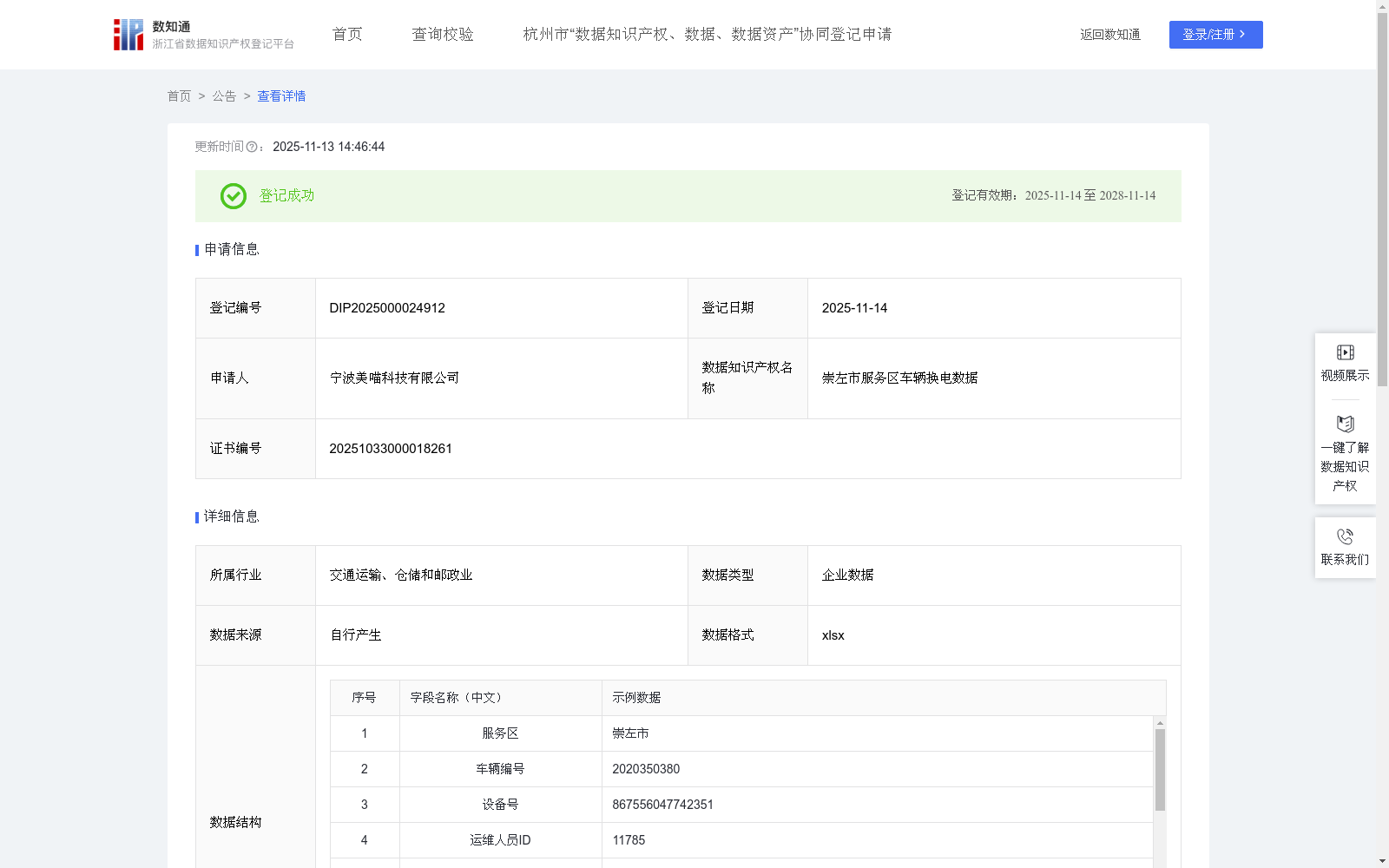
崇左市服务区车辆换电数据
收藏浙江省数据知识产权登记平台2025-11-13 更新2025-11-14 收录
下载链接:
https://www.zjip.org.cn/home/announce/trends/8398567
下载链接
链接失效反馈官方服务:
资源简介:
换电服务质量评分数据适用于本公司具备完整操作记录的换电业务场景,涵盖共享电单车、运营车辆等采用换电模式的运营体系,服务对象包括运维管理团队、区域负责人及设备维护部门。通过量化评分,可对每一次换电操作进行精准评估,支持运维人员绩效考核、低效行为预警、设备故障识别和区域服务优化,推动运维管理从“经验驱动”向“数据驱动”转型,全面提升服务规范性与运营效率。对外,该评分数据为第三方运维公司提供了统一、可信的服务质量评价标准,有效解决外包服务验收难、结算易产生纠纷等问题,实现“按分计费、达标结算”的自动化对账;电池管理方可依据“达标”记录核验换电真实性,用于电池使用强度分析与残值评估;在跨企业车辆交接或区域运营协作中,接收方可通过评分快速判断车辆服务状态,避免重复检查;政府或园区管理者可将其作为企业运营能力的量化监管指标。通过输出标准化评分,推动各方建立以数据为基础的信任机制,实现高效协同与规范化合作。数据采集:记录每次换电服务的操作信息,包括:服务区、车辆编号、设备号、运维人员ID、换电前电量百分比(%)、换电后电量百分比(%)、电量增长百分比(%)、打开电池仓时间、关闭电池仓时间、换电完成时间(秒)、换电前行驶里程(米)。 数据处理:对采集的原始数据进行清洗,剔除关键字段缺失或格式错误的记录,如打开电池仓时间、关闭电池仓时间、电量数据为空或非数值类型的数据项。基于换电过程中的操作行为与结果表现,计算换电服务质量的综合得分。换电服务质量评分=电量提升效果得分+换电后电量水平得分+换电操作效率得分+时间逻辑规范性得分+行驶里程合理性得分+电量增长真实性。 电量增长百分比<20%:电量提升效果得分得0分;20%≤电量增长百分比<40%:电量提升效果得分得10分;40%≤电量增长百分比<60%:电量提升效果得分得20分;电量增长百分比≥60%:电量提升效果得分得30分。 换电后电量百分比<50%:换电后电量水平得分得0分;50%≤换电后电量百分比<70%:换电后电量水平得分得10分;70%≤换电后电量百分比<90%:换电后电量水平得分得15分;换电后电量百分比≥90%:换电后电量水平得分得20分。 换电时长>300秒(5分钟):换电操作效率得分得0分;180秒≤换电时长≤300秒:换电操作效率得分得10分;90秒≤换电时长<180秒(1.5–3分钟):换电操作效率得分得20分;换电时长<90秒(<1.5分钟):换电操作效率得分得25分。 若关闭电池仓时间≤打开电池仓时间,或换电完成时间<关闭电池仓时间,则视为流程异常,时间逻辑规范性得分得0分;否则,所有时间顺序合理,时间逻辑规范性得分得10分。 换电前行驶里程>800,000米(800公里):行驶里程合理性得分得0分;500,000米≤换电前行驶里程≤800,000米(500–800公里):行驶里程合理性得分得5分;换电前行驶里程<500,000米(<500公里):行驶里程合理性得分得10分。 若换电前电量百分比>80%且电量增长百分比>15%,则视为不合理增长,电量增长真实性得0分;其他情况均视为合理,电量增长真实性得5分。
This battery swap service quality scoring data is applicable to the battery swap business scenarios of the company with complete operation records, covering operation systems adopting battery swap mode such as shared electric bicycles and operating vehicles. The service targets include operation and maintenance (O&M) management teams, regional managers, and equipment maintenance departments.
Through quantitative scoring, accurate evaluation can be conducted for each battery swap operation, supporting O&M personnel performance appraisal, inefficient behavior early warning, equipment fault identification and regional service optimization, promoting the transformation of O&M management from 'experience-driven' to 'data-driven', and comprehensively improving service standardization and operational efficiency.
Externally, this scoring data provides a unified and credible service quality evaluation standard for third-party O&M companies, effectively solving problems such as difficult acceptance of outsourcing services and disputes easily arising in settlement, realizing automated reconciliation of 'billing by score, settlement upon standard achievement'. The battery management party can verify the authenticity of battery swap based on 'standard achievement' records, which is used for battery usage intensity analysis and residual value evaluation. In cross-enterprise vehicle handover or regional operation collaboration, the receiving party can quickly judge the vehicle service status through the scores, avoiding repeated inspections. Government or park managers can use it as a quantitative supervision indicator for enterprise operation capabilities. By outputting standardized scores, all parties are promoted to establish a data-based trust mechanism, achieving efficient collaboration and standardized cooperation.
### Data Collection
The operation information of each battery swap service is recorded, including: service area, vehicle number, equipment number, O&M personnel ID, battery percentage before swap (%), battery percentage after swap (%), battery percentage growth (%), battery compartment opening time, battery compartment closing time, battery swap completion time (seconds), driving mileage before swap (meters).
### Data Processing
Clean the collected raw data, eliminate records with missing key fields or format errors, such as data items where battery compartment opening time, battery compartment closing time, and power data are empty or of non-numeric types. Calculate the comprehensive score of battery swap service quality based on the operational behaviors and result performance during the battery swap process. The formula of battery swap service quality scoring is:
Battery Swap Service Quality Score = Power Improvement Effect Score + Post-swap Power Level Score + Swap Operation Efficiency Score + Time Logic Normativity Score + Driving Mileage Rationality Score + Power Growth Authenticity Score
#### Power Improvement Effect Score
- If battery percentage growth < 20%: Power Improvement Effect Score = 0
- If 20% ≤ battery percentage growth < 40%: Power Improvement Effect Score = 10
- If 40% ≤ battery percentage growth < 60%: Power Improvement Effect Score = 20
- If battery percentage growth ≥ 60%: Power Improvement Effect Score = 30
#### Post-swap Power Level Score
- If battery percentage after swap < 50%: Post-swap Power Level Score = 0
- If 50% ≤ battery percentage after swap < 70%: Post-swap Power Level Score = 10
- If 70% ≤ battery percentage after swap < 90%: Post-swap Power Level Score = 15
- If battery percentage after swap ≥ 90%: Post-swap Power Level Score = 20
#### Swap Operation Efficiency Score
- If swap duration > 300 seconds (5 minutes): Swap Operation Efficiency Score = 0
- If 180 seconds ≤ swap duration ≤ 300 seconds: Swap Operation Efficiency Score = 10
- If 90 seconds ≤ swap duration < 180 seconds (1.5–3 minutes): Swap Operation Efficiency Score = 20
- If swap duration < 90 seconds (<1.5 minutes): Swap Operation Efficiency Score = 25
#### Time Logic Normativity Score
- If battery compartment closing time ≤ battery compartment opening time, or battery swap completion time < battery compartment closing time, it is regarded as process abnormality, and Time Logic Normativity Score = 0; otherwise, if all time sequences are reasonable, Time Logic Normativity Score = 10
#### Driving Mileage Rationality Score
- If driving mileage before swap > 800,000 meters (800 km): Driving Mileage Rationality Score = 0
- If 500,000 meters ≤ driving mileage before swap ≤ 800,000 meters (500–800 km): Driving Mileage Rationality Score = 5
- If driving mileage before swap < 500,000 meters (<500 km): Driving Mileage Rationality Score = 10
#### Power Growth Authenticity Score
- If battery percentage before swap > 80% and battery percentage growth > 15%, it is regarded as unreasonable growth, and Power Growth Authenticity Score = 0; otherwise, it is regarded as reasonable, and Power Growth Authenticity Score = 5
提供机构:
宁波美喵科技有限公司
创建时间:
2025-10-10
搜集汇总
数据集介绍
背景与挑战
背景概述
该数据集记录了崇左市服务区车辆换电操作的详细信息,包含516条数据,涵盖服务区、车辆编号、电量变化和时间等19个字段。它通过算法规则对换电服务质量进行量化评分,支持运维管理、绩效考核和区域服务优化,适用于共享电单车和运营车辆等换电业务场景,促进数据驱动的运营效率提升。
以上内容由遇见数据集搜集并总结生成



