MIRIAD
收藏资源简介:
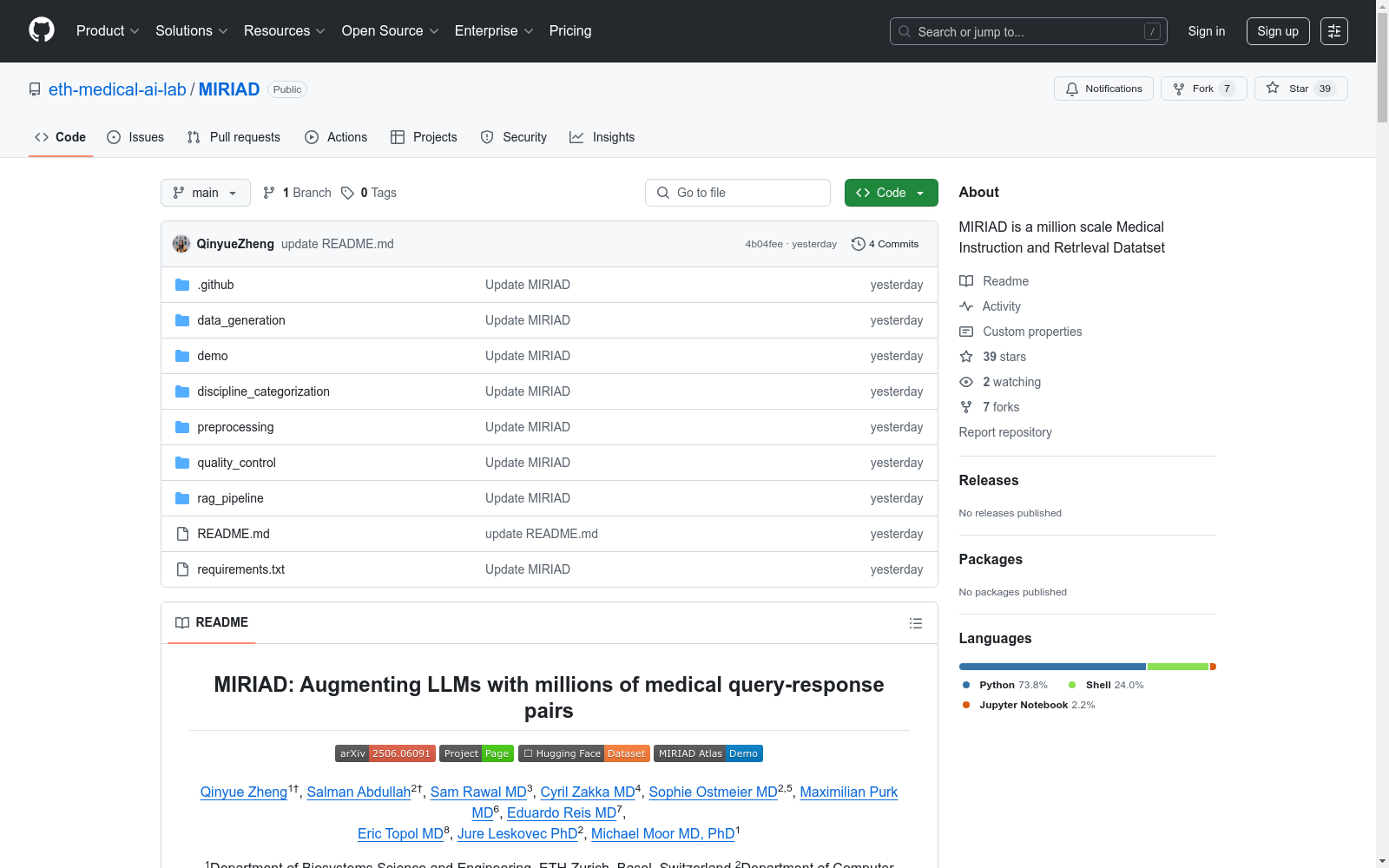
MIRIAD是一个大规模、经过筛选的医学指令-响应对语料库,包含5,821,948对基于同行评审文献的医学指令-响应对。通过结合LLM重写、基础、过滤和专家注释的半自动化流程生成,MIRIAD以LLM可以可靠使用的形式操作医学知识。MIRIAD提高了医学问答的准确性,能够检测医学幻觉,并可以通过MIRIAD-Atlas支持临床用户,这是一个用于语义组织浏览和知识检索的可视化界面。MIRIAD为临床护理和生物医学研究中更安全、更基础的医学AI奠定了基础。
MIRIAD is a large-scale, curated medical instruction-response corpus containing 5,821,948 pairs of medical instruction-response based on peer-reviewed literature. Generated through a semi-automated process that combines LLM rewriting, foundational, filtering, and expert annotations, MIRIAD operates medical knowledge in a form that is reliably usable by LLMs. MIRIAD enhances the accuracy of medical question-answering, can detect medical illusions, and supports clinical users through MIRIAD-Atlas, a visual interface for semantic organization browsing and knowledge retrieval. MIRIAD lays the foundation for safer, more robust medical AI in clinical care and biomedical research.
MIRIAD数据集概述
数据集基本信息
- 名称: MIRIAD (Million-scale medical query-response pairs)
- 规模: 5,821,948条医学指令-响应对
- 特点: 每条数据均基于同行评审的生物医学文献
- 用途: 增强大型语言模型(LLM)在医学领域的知识可靠性,支持多样化的下游任务
核心特性
-
数据生成方式:
- 半自动化流程生成
- 包含LLM重写、基础验证、过滤和专家标注环节
-
主要功能:
- 提升医学问答准确性
- 支持医学幻觉检测
- 提供可视化浏览界面(MIRIAD-Atlas)
数据集内容
- 数据格式: 指令-响应对
- 学科分类: 包含56个医学学科
- 数据子集: 提供30万条数据的可视化子集(MIRIAD Atlas)
技术规格
-
硬件要求:
- 推荐使用GPU系统(如NVIDIA A100 40GB)
- 最低要求: 1个GPU(用于完整流程)
-
软件要求:
- 推荐系统: Ubuntu 22.04
- Python版本: 3.10.12
- 依赖管理: 通过requirements.txt文件
获取方式
-
主要来源:
- Hugging Face: https://huggingface.co/miriad
- 备用下载: Google Drive
-
加载方式: python from datasets import load_dataset ds = load_dataset(miriad/miriad-5.8M, split=train)
应用示例
-
检索增强生成(RAG):
- 支持在医学问答基准测试中的应用
- 包含端到端实现流程
-
演示案例:
- MedMCQA数据集500题解答演示
- 轻量级RAG管道实现
相关资源
- 项目主页: https://med-miriad.github.io/
- 论文链接: https://arxiv.org/abs/2506.06091
- 可视化演示: https://med-miriad.github.io/demo/
引用格式
bibtex @misc{zheng2025miriadaugmentingllmsmillions, title={MIRIAD: Augmenting LLMs with millions of medical query-response pairs}, author={Qinyue Zheng and Salman Abdullah and Sam Rawal and Cyril Zakka and Sophie Ostmeier and Maximilian Purk and Eduardo Reis and Eric J. Topol and Jure Leskovec and Michael Moor}, year={2025}, eprint={2506.06091}, archivePrefix={arXiv}, primaryClass={cs.CL}, url={https://arxiv.org/abs/2506.06091}, }