
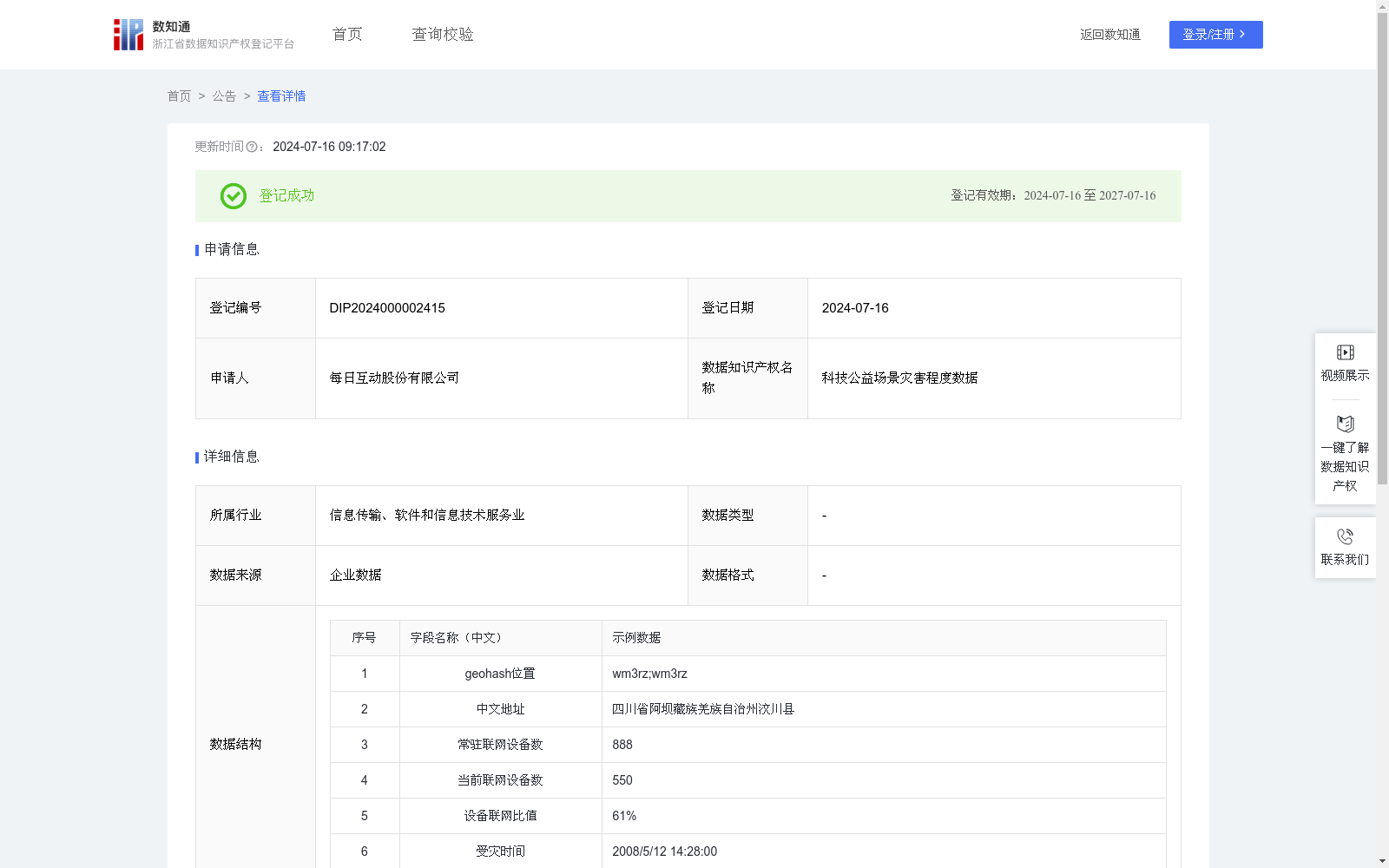
科技公益场景灾害程度数据
收藏浙江省数据知识产权登记平台2024-07-16 更新2024-07-17 收录
下载链接:
https://www.zjip.org.cn/home/announce/trends/38337
下载链接
链接失效反馈官方服务:
资源简介:
a. 灾害预警:灾害程度数据可以帮助预测灾害的规模和影响范围,从而提前进行预警。
b. 应急响应决策:在灾害发生时,灾害程度数据对于制定应急响应策略至关重要。
c. 灾后恢复与重建:灾害程度数据在灾后恢复和重建过程中也发挥着重要作用。
d. 防灾减灾规划:灾害程度数据对于制定长期防灾减灾规划具有重要意义。在自研的每日治数平台上,结合受灾地区用户设备联网行为,通过机器学习预测得到灾害程度数据。
一、数据抽取
从数据库中抽取用户的设备联网及LBS类相关数据。
灾害相关数据抽取:获取与灾害相关的数据,如受灾时间,区域位置(geohash及地址)等。
二、数据清理和处理
数据清洗:去除重复、无效或错误的数据,确保数据的准确性和一致性。
数据标准化:
时间对齐:确保用户LBS数据与灾害发生时间、地点相匹配,以便准确分析受灾情况。
三、数据仓库层建设
1.数据模型设计
2.ETL过程
3.数据仓库优化
四、机器学习建模
特征提取:从用户LBS类和设备联网数据中提取关键特征,如受灾地区常驻联网设备数,不同时间点、设备联网设备数。
模型选择:根据业务需求和数据特点,选择合适的机器学习模型,如时间序列模型(AR、MA、ARMA、ARIMA)。
模型训练与评估:使用历史数据对模型进行训练,并通过交叉验证等方法评估模型的性能。根据评估结果调整模型参数和结构,优化模型的预测能力。
将训练好的模型应用于评估当下及未来时刻设备联网比率,进一步绘制受灾热力图,辅助评估和预测当前受灾地区灾害程度。
a. Disaster Early Warning: Disaster severity data can help predict the scale and impact scope of disasters, enabling early warning.
b. Emergency Response Decision-Making: When a disaster occurs, disaster severity data is crucial for formulating emergency response strategies.
c. Post-Disaster Recovery and Reconstruction: Disaster severity data also plays an important role in the post-disaster recovery and reconstruction process.
d. Disaster Prevention and Mitigation Planning: Disaster severity data is of great significance for formulating long-term disaster prevention and mitigation planning. On the self-developed daily data governance platform, disaster severity data is predicted via machine learning by combining the device networking behaviors of users in affected areas.
1. Data Extraction
Extract user device networking and Location-Based Services (LBS)-related data from the database.
Disaster-related data extraction: Obtain data related to disasters, such as disaster occurrence time, regional location (geohash and address), etc.
2. Data Cleaning and Processing
Data cleaning: Remove duplicate, invalid or erroneous data to ensure data accuracy and consistency.
Data standardization:
Time alignment: Ensure that user LBS data matches the disaster occurrence time and location to accurately analyze the disaster situation.
3. Data Warehouse Layer Construction
1. Data model design
2. ETL (Extract-Transform-Load) process
3. Data warehouse optimization
4. Machine Learning Modeling
Feature extraction: Extract key features from user LBS and device networking data, such as the number of resident networking devices in affected areas, and the number of networking devices at different time points.
Model selection: Select appropriate machine learning models based on business requirements and data characteristics, such as time series models (AR, MA, ARMA, ARIMA).
Model training and evaluation: Train the model using historical data, and evaluate its performance through methods such as cross-validation. Adjust model parameters and structure based on evaluation results to optimize the model's predictive capability.
Apply the trained model to evaluate the device networking ratio at current and future moments, further generate disaster heatmaps to assist in evaluating and predicting the disaster severity of currently affected areas.
提供机构:
每日互动股份有限公司
创建时间:
2024-06-28
搜集汇总
数据集介绍
特点
该数据集名为'科技公益场景灾害程度数据',包含501条记录,每日更新,主要应用于灾害预警、应急响应决策、灾后恢复与重建以及防灾减灾规划。数据通过机器学习预测受灾地区的灾害程度,已在浙江省知识产权区块链公共存证平台存证。
以上内容由遇见数据集搜集并总结生成



