
Mandarin Affective Speech
收藏Mendeley Data2024-01-31 更新2024-06-27 收录
下载链接:
https://catalog.ldc.upenn.edu/LDC2007S09
下载链接
链接失效反馈官方服务:
资源简介:
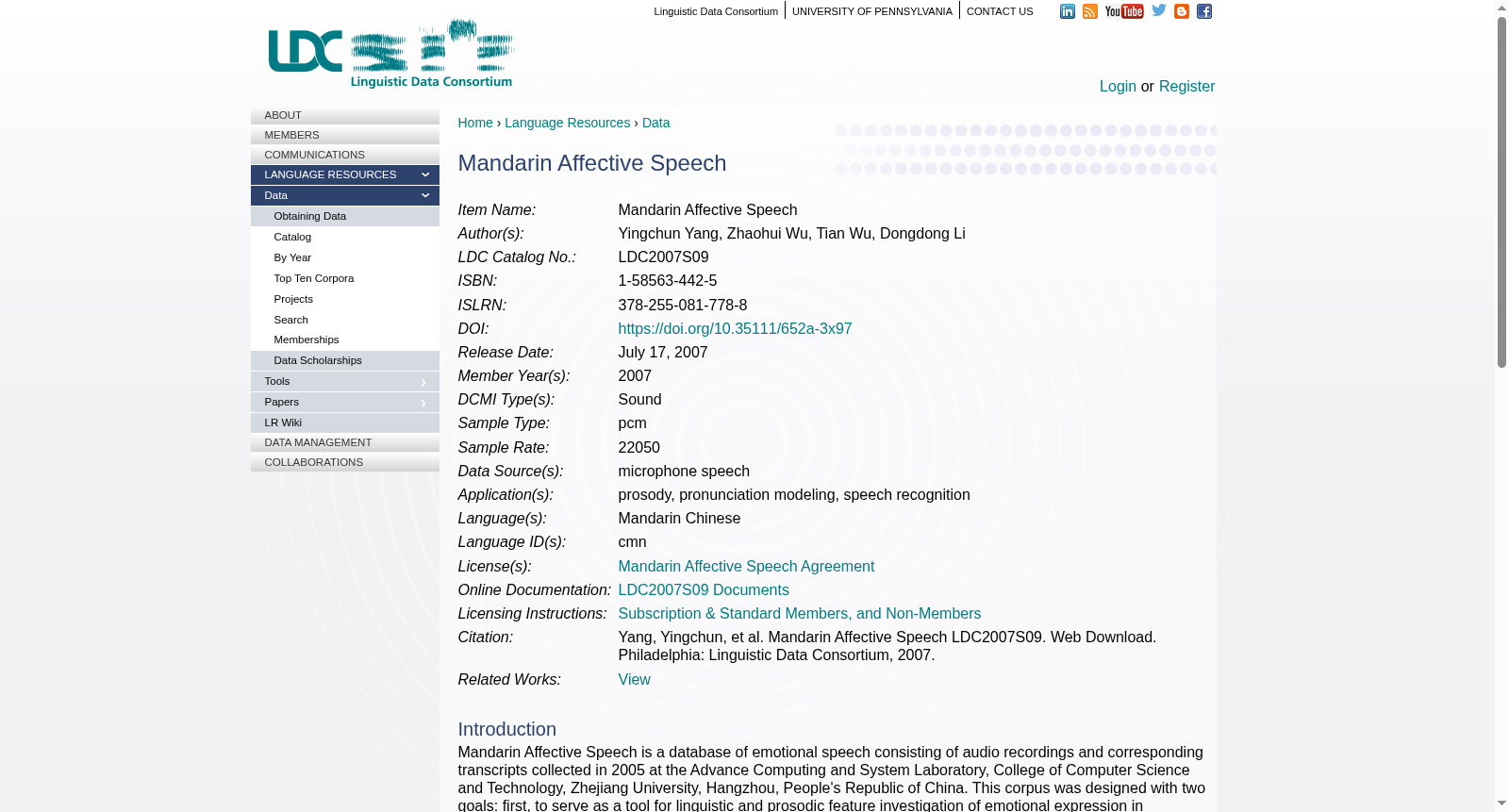
Introduction Mandarin Affective Speech is a database of emotional speech consisting of audio recordings and corresponding transcripts collected in 2005 at the Advance Computing and System Laboratory, College of Computer Science and Technology, Zhejiang University, Hangzhou, People's Republic of China. This corpus was designed with two goals: first, to serve as a tool for linguistic and prosodic feature investigation of emotional expression in Mandarin Chinese; and second, to provide a source of training and test data essential to support research in speaker recognition with affective speech. The speech database was recorded by eliciting speakers to express different emotional states in response to stimuli. The speakers read scenarios designed to elicite an emotional response such as a colleague's mistake for anger, a pleasant trip for elation, a hurry-up scene for panic and a puppy's death for sadness. The five emotional states recorded are characterized as follows: Neutral - Simple statements without any emotion. Anger - A strong feeling of displeasure or hostility. Elation - Be glad or happy because of praise. Panic - A sudden, overpowering terror, often affecting many people at once. Sadness - Affected or characterized by sorrow or unhappiness Data Over 100 speakers participated in the data collection. After screening, recordings from 68 speakers (23 females, 45 males) were used in this corpus. Most of the speakers were in their twenties at the time of collection. Information about the speakers is contained in "SpeakerInfo.doc." Subjects were given a text to read that consisted of five phrases, fifteen sentences and two paragraphs designed to generate the emotional speech. The material included all the phonemes in Mandarin. Each subject read the phrases, paragraphs, and sentences portraying the five emotional states: neutral (unemotional), anger, elation, panic and sadness. Altogether this database contains 25,636 utterances. The read material was constructed as follows: 5 phrases - "yes", "no" and three nouns as "apple", "train", "tennis ball". In Chinese, these words contain many different basic vowels and consonants. 20 sentences - These sentences include all the phonemes and most common consonant clusters in Mandarin. The types of sentences are: simple statements, a declarative sentence with an enumeration, general questions (yes/no question), alternative questions, imperative sentences, exclamatory sentences, special questions (whquestions). 2 paragraphs - Two readings, one selected from a famous Chinese novel, and the other stating a normal fact. All the data were recorded in a quiet office on an OLYMPUS DM-20 digital voice recorder with a sampling rate of 22050Hz. Afterwards, the recorded voice files were transferred to a personal computer by USB (Universal Serial Bus). The recordings were then converted into monophonic Windows PCM format at 8 kHz sampling frequency and 16 bits resolution. Further information about the data and methodology in this corpus is contained in the authors' paper, "MASC: A Speech Corpus in Mandarin for Emotional Analysis and Affective Speaker Recognition," in "MASC.pdf." Samples For an example of the data in this corpus, please listen the following examples: Neutral Anger Elation Portions © 2005-2007, Zhejiang University, Advance Computing and System Laboratory, © 2007 Trustees of the University of Pennsylvania
# 普通话情感语音语料库(Mandarin Affective Speech)简介
本语料库为情感语音数据库,由2005年于中国杭州浙江大学计算机科学与技术学院先进计算与系统实验室采集的语音录音及对应转写文本构成。该语料库的构建兼具两大目标:其一,作为研究汉语普通话情感表达的语言学与韵律特征的工具;其二,提供训练与测试数据来源,为情感语音场景下的说话人识别研究提供必要支撑。
本语音数据库通过设置刺激情境,诱导说话人表达不同情绪状态的方式录制。研究人员设计了可诱发特定情绪的情境脚本:以同事失误场景诱发愤怒情绪、以愉快旅途场景诱发愉悦情绪、以紧急赶路场景诱发恐慌情绪,以及以幼犬死亡场景诱发悲伤情绪。本次录制涵盖五种情绪状态,具体特征如下:
- 中性(Neutral):无情感倾向的简单陈述语句;
- 愤怒(Anger):强烈的不悦或敌意情绪;
- 愉悦(Elation):因获得称赞而感到欣喜;
- 恐慌(Panic):突发且难以克制的恐惧,常同时影响多人;
- 悲伤(Sadness):以忧愁或不快为特征的情绪状态。
## 数据概况
数据采集阶段共有100余名说话人参与,经筛选后,最终采用68名说话人的录音数据(其中女性23名,男性45名)。多数参与采集的说话人时年二十余岁。说话人的详细信息收录于“SpeakerInfo.doc”文件中。
受试人员需朗读一套预设文本,该文本包含5个短语、15个句子与2个段落,用于生成情感语音。该材料覆盖了普通话的全部音素。每位受试人员需分别以中性、愤怒、愉悦、恐慌与悲伤五种情绪状态朗读上述短语、段落与句子。本数据库总计包含25636条语音片段。
朗读素材的具体构成如下:
1. 5个短语:“是”“否”以及“苹果”“火车”“网球”三个名词。在汉语中,这些词汇涵盖了多种基础元音与辅音。
2. 20个句子:覆盖普通话全部音素与绝大多数常见辅音连缀。句子类型包括:简单陈述句、带枚举的陈述句、一般疑问句(是非问句)、选择疑问句、祈使句、感叹句、特殊疑问句(wh问句)。
3. 2个段落:一段选自中国经典小说,另一段为普通事实陈述。
所有数据均于安静办公室内使用奥林巴斯(OLYMPUS)DM-20数字语音记录仪录制,采样率为22050Hz。录制完成后,语音文件通过USB(通用串行总线,Universal Serial Bus)传输至个人计算机,并转换为单声道Windows PCM格式,采样频率为8kHz,采样精度为16比特。
有关该语料库的数据与采集方法的更多细节,可参阅作者发表的论文《MASC:用于情感分析与情感说话人识别的普通话语音语料库》(收录于“MASC.pdf”)。
## 数据示例
如需查看本语料库的数据示例,请收听以下样例:中性、愤怒、愉悦。
### 版权声明
本语料库部分内容版权归2005-2007年浙江大学先进计算与系统实验室、2007年宾夕法尼亚大学校董会所有。
创建时间:
2024-01-31
搜集汇总
数据集介绍
背景与挑战
背景概述
Mandarin Affective Speech 是一个普通话情感语音数据库,包含音频录音和对应文本,旨在研究情感表达的语言特征和支持说话人识别研究。数据集采集自68名说话者,涵盖中性、愤怒、兴奋、恐慌和悲伤五种情感状态,共25,636个话语,适用于韵律分析和语音识别等应用。
以上内容由遇见数据集搜集并总结生成


