
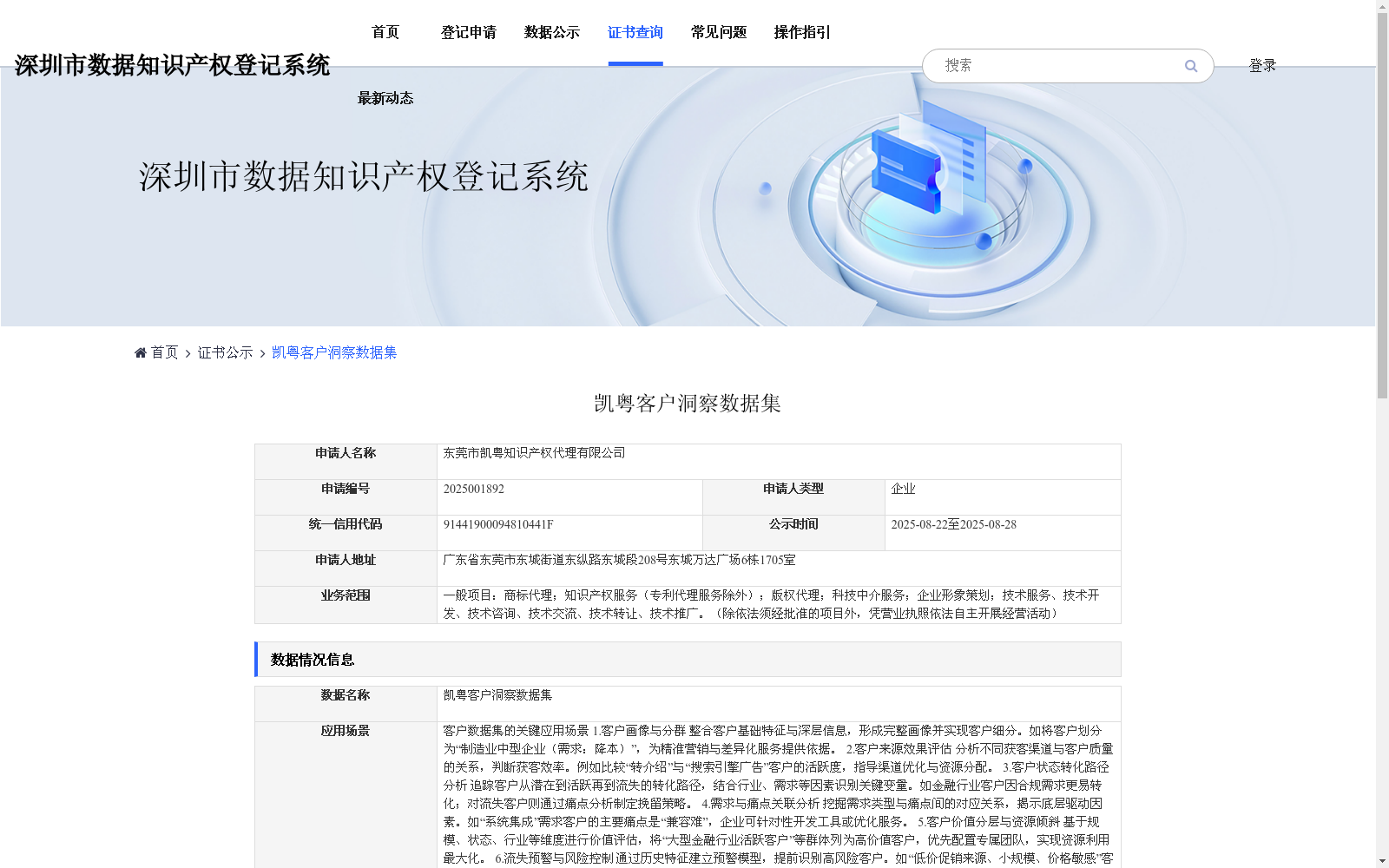
凯粤客户洞察数据集
收藏深圳市数据知识产权登记系统2025-08-29 更新2025-08-29 收录
下载链接:
https://sjdj.sist.org.cn/cqdjCms/detail/certdetail.html?id=39e34933-9794-41ad-88a9-90f44c41a3ce
下载链接
链接失效反馈官方服务:
资源简介:
客户数据集的关键应用场景 1.客户画像与分群 整合客户基础特征与深层信息,形成完整画像并实现客户细分。如将客户划分为“制造业中型企业(需求:降本)”,为精准营销与差异化服务提供依据。 2.客户来源效果评估 分析不同获客渠道与客户质量的关系,判断获客效率。例如比较“转介绍”与“搜索引擎广告”客户的活跃度,指导渠道优化与资源分配。 3.客户状态转化路径分析 追踪客户从潜在到活跃再到流失的转化路径,结合行业、需求等因素识别关键变量。如金融行业客户因合规需求更易转化;对流失客户则通过痛点分析制定挽留策略。 4.需求与痛点关联分析 挖掘需求类型与痛点间的对应关系,揭示底层驱动因素。如“系统集成”需求客户的主要痛点是“兼容难”,企业可针对性开发工具或优化服务。 5.客户价值分层与资源倾斜 基于规模、状态、行业等维度进行价值评估,将“大型金融行业活跃客户”等群体列为高价值客户,优先配置专属团队,实现资源利用最大化。 6.流失预警与风险控制 通过历史特征建立预警模型,提前识别高风险客户。如“低价促销来源、小规模、价格敏感”客户流失率高,可用增值服务提升粘性。
Key Application Scenarios of the Customer Dataset
1. Customer Profiling and Segmentation: Integrate basic customer characteristics and in-depth information to form a complete customer profile and achieve customer segmentation. For example, classify customers into "Medium-sized Manufacturing Enterprises (Demand: Cost Reduction)" to provide a basis for precise marketing and differentiated services.
2. Customer Source Effect Evaluation: Analyze the relationship between different customer acquisition channels and customer quality to judge customer acquisition efficiency. For example, compare the activity levels of customers acquired through "referrals" and "search engine advertisements" to guide channel optimization and resource allocation.
3. Analysis of Customer State Transformation Paths: Track the transformation paths of customers from potential to active to churned, and identify key variables by combining factors such as industry and demand. For example, financial industry customers are more likely to convert due to compliance requirements; for churned customers, retention strategies can be formulated through pain point analysis.
4. Demand and Pain Point Correlation Analysis: Mine the corresponding relationship between demand types and pain points to reveal underlying driving factors. For example, the main pain point of customers with "system integration" demands is "difficulty in compatibility", and enterprises can develop targeted tools or optimize services.
5. Customer Value Stratification and Resource Prioritization: Conduct value evaluation based on dimensions such as scale, state, and industry, classify groups such as "Large Financial Industry Active Customers" as high-value customers, and prioritize the allocation of exclusive teams to maximize resource utilization.
6. Churn Warning and Risk Control: Establish early warning models based on historical features to identify high-risk customers in advance. For example, customers acquired through "low-price promotions" who are "small-scale and price-sensitive" have a high churn rate, and value-added services can be used to enhance customer stickiness.
提供机构:
东莞市凯粤知识产权代理有限公司
创建时间:
2025-08-29
搜集汇总
数据集介绍
以上内容由遇见数据集搜集并总结生成



