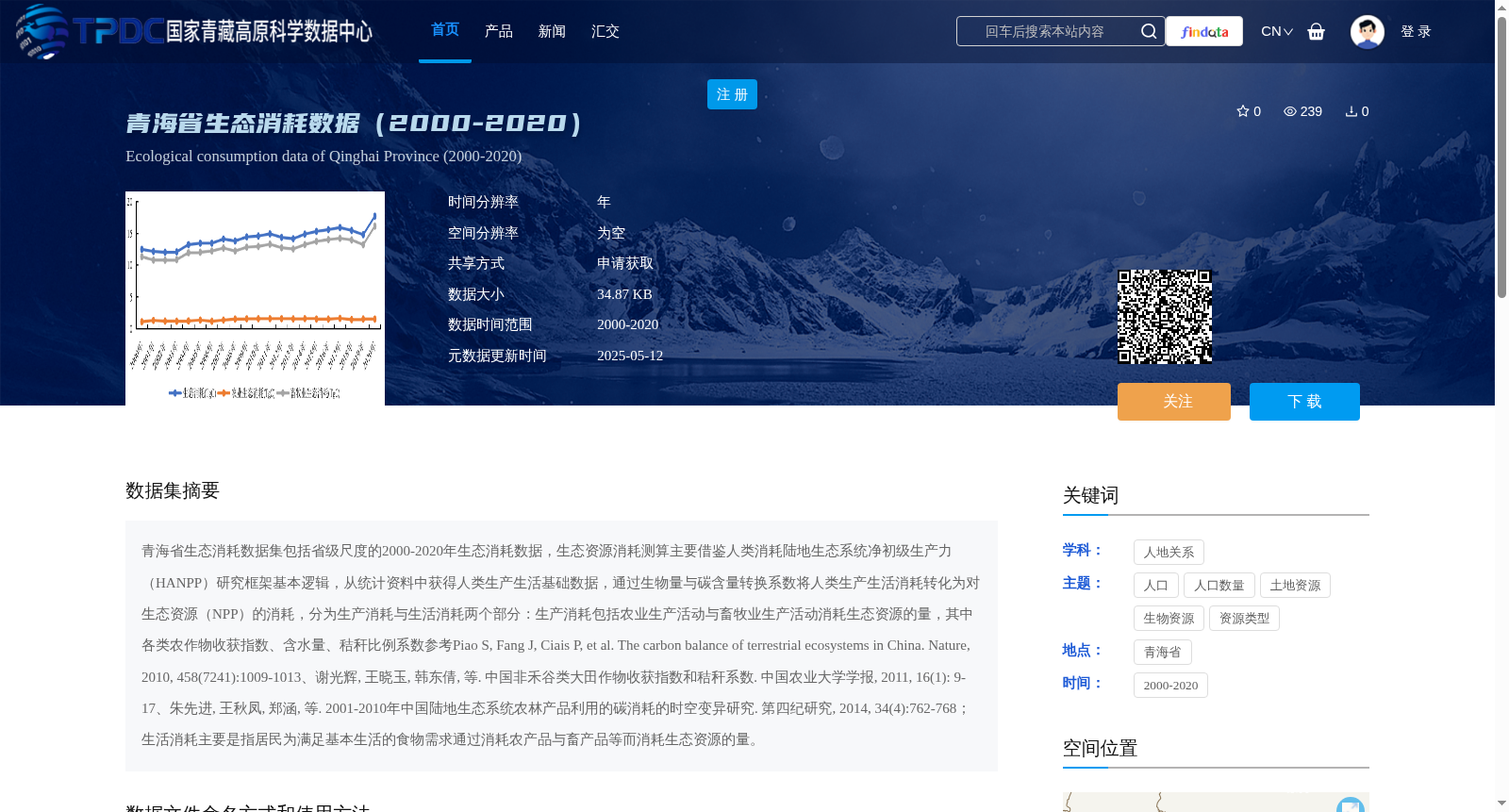
青海省生态消耗数据(2000-2020)
收藏资源简介:
青海省生态消耗数据集包括省级尺度的2000-2020年生态消耗数据,生态资源消耗测算主要借鉴人类消耗陆地生态系统净初级生产力(HANPP)研究框架基本逻辑,从统计资料中获得人类生产生活基础数据,通过生物量与碳含量转换系数将人类生产生活消耗转化为对生态资源(NPP)的消耗,分为生产消耗与生活消耗两个部分:生产消耗包括农业生产活动与畜牧业生产活动消耗生态资源的量,其中各类农作物收获指数、含水量、秸秆比例系数参考Piao S, Fang J, Ciais P, et al. The carbon balance of terrestrial ecosystems in China. Nature, 2010, 458(7241):1009-1013、谢光辉, 王晓玉, 韩东倩, 等. 中国非禾谷类大田作物收获指数和秸秆系数. 中国农业大学学报, 2011, 16(1): 9-17、朱先进, 王秋凤, 郑涵, 等. 2001-2010年中国陆地生态系统农林产品利用的碳消耗的时空变异研究. 第四纪研究, 2014, 34(4):762-768;生活消耗主要是指居民为满足基本生活的食物需求通过消耗农产品与畜产品等而消耗生态资源的量。
The Qinghai Province Ecological Consumption Dataset contains provincial-scale ecological consumption data from 2000 to 2020. The methodology for calculating ecological resource consumption draws primarily on the core logic of the Human Appropriation of Net Primary Production (HANPP) research framework. Basic data on human production and daily living activities are sourced from official statistical materials, and the consumption generated by these activities is converted into the consumption of ecological resources (Net Primary Productivity, NPP) using conversion coefficients between biomass and carbon content. This dataset is divided into two categories: production consumption and domestic consumption. Production consumption refers to the quantity of ecological resources consumed by agricultural and livestock production activities. The harvest index, moisture content and straw ratio coefficients for various crop types are referenced from the following scholarly works: 1. Piao S, Fang J, Ciais P, et al. The carbon balance of terrestrial ecosystems in China. *Nature*, 2010, 458(7241): 1009-1013. 2. Xie G H, Wang X Y, Han D Q, et al. Harvest index and straw coefficient of non-cereal field crops in China. *Journal of China Agricultural University*, 2011, 16(1): 9-17. 3. Zhu X J, Wang Q F, Zheng H, et al. Spatiotemporal variation of carbon consumption from terrestrial ecosystem agroforestry product utilization in China (2001-2010). *Quaternary Sciences*, 2014, 34(4): 762-768. Domestic consumption mainly refers to the volume of ecological resources consumed by residents through the utilization of agricultural and livestock products to meet their basic daily food needs.