loka
收藏资源简介:
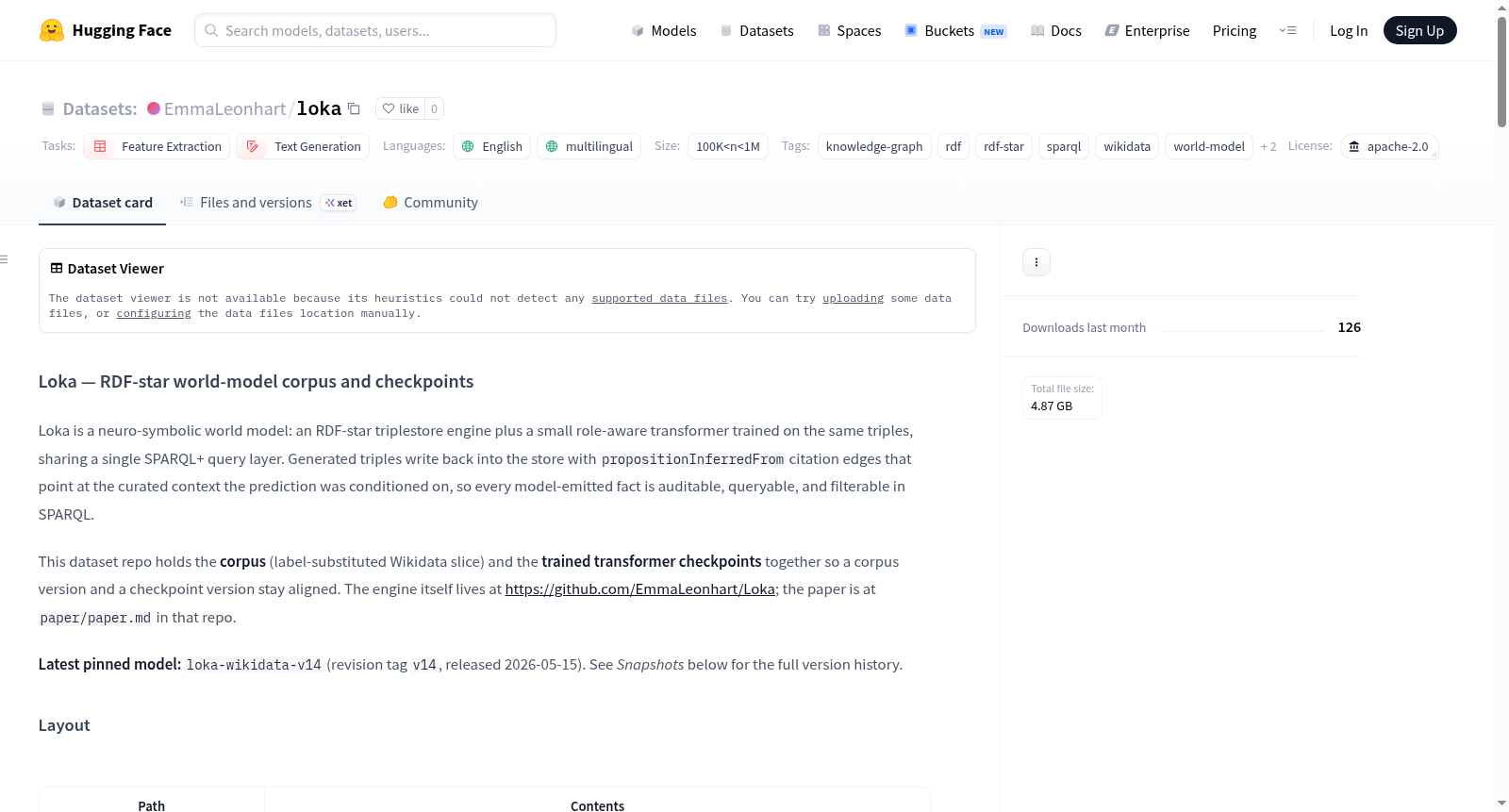
Loka数据集是一个用于神经符号世界模型训练和评估的综合资源,包含一个经过处理的Wikidata知识图谱子集以及预训练的Transformer模型检查点。其核心是一个RDF-star三元组语料库,其中Wikidata的实体ID和属性ID已被替换为英文标签,字面量中的语言标签和数据类型后缀被剥离,形成纯文本格式的三元组(主语、谓语、宾语)。语料库构建时筛选保留了具有语义内容的实体链接、字符串、数值、日期和单语文本,而丢弃了外部标识符、URL、地理坐标等可能引入噪声的数据类型。数据集规模在10万到100万之间。此外,数据集提供了多个版本的预训练模型检查点,这些模型采用统一的44.5M参数角色感知掩码Transformer架构,使用50K大小的BPE词汇表。每个模型版本还输出生成的推理三元组文件,这些文件采用RDF-star格式,并附带了详细的溯源元数据,包括生成标志、模型版本、置信度以及推理所依据的上下文三元组引用,确保了模型输出的可审计性。该数据集适用于知识图谱补全、神经符号推理、可控文本生成等任务,旨在支持可解释、可查询的生成式人工智能研究。
The Loka dataset is a comprehensive resource for training and evaluating neuro-symbolic world models, consisting of a processed subset of the Wikidata knowledge graph along with pre-trained Transformer model checkpoints. Its core is an RDF-star triple corpus where Wikidata entity and property IDs have been replaced with English labels, and language tags and datatype suffixes from literals have been stripped, resulting in plain-text triples (subject, predicate, object) stored in `corpus/triples.txt`. The corpus construction follows a strict data type filtering strategy: it retains semantically meaningful entity links, strings, numbers, dates, and monolingual texts (all languages), while discarding data types like external identifiers, URLs, and geographic coordinates that may introduce noise or cause format hallucinations. The dataset size ranges from 100,000 to 1,000,000 triples. Additionally, the dataset provides multiple versions of pre-trained model checkpoints (`checkpoints/wikidata_v*.pt`), which use a uniform 44.5M-parameter role-aware masked Transformer architecture with a 50K BPE vocabulary. Each model version also outputs generated inference triple files (`corpus/generated_v*.nt`) in RDF-star format, accompanied by detailed provenance metadata including generation flags, model version, confidence scores, and references to contextual triples used for inference, ensuring auditability of model outputs. This dataset is suitable for tasks such as knowledge graph completion, neuro-symbolic reasoning, and controlled text generation, aiming to support interpretable and queryable generative AI research.