
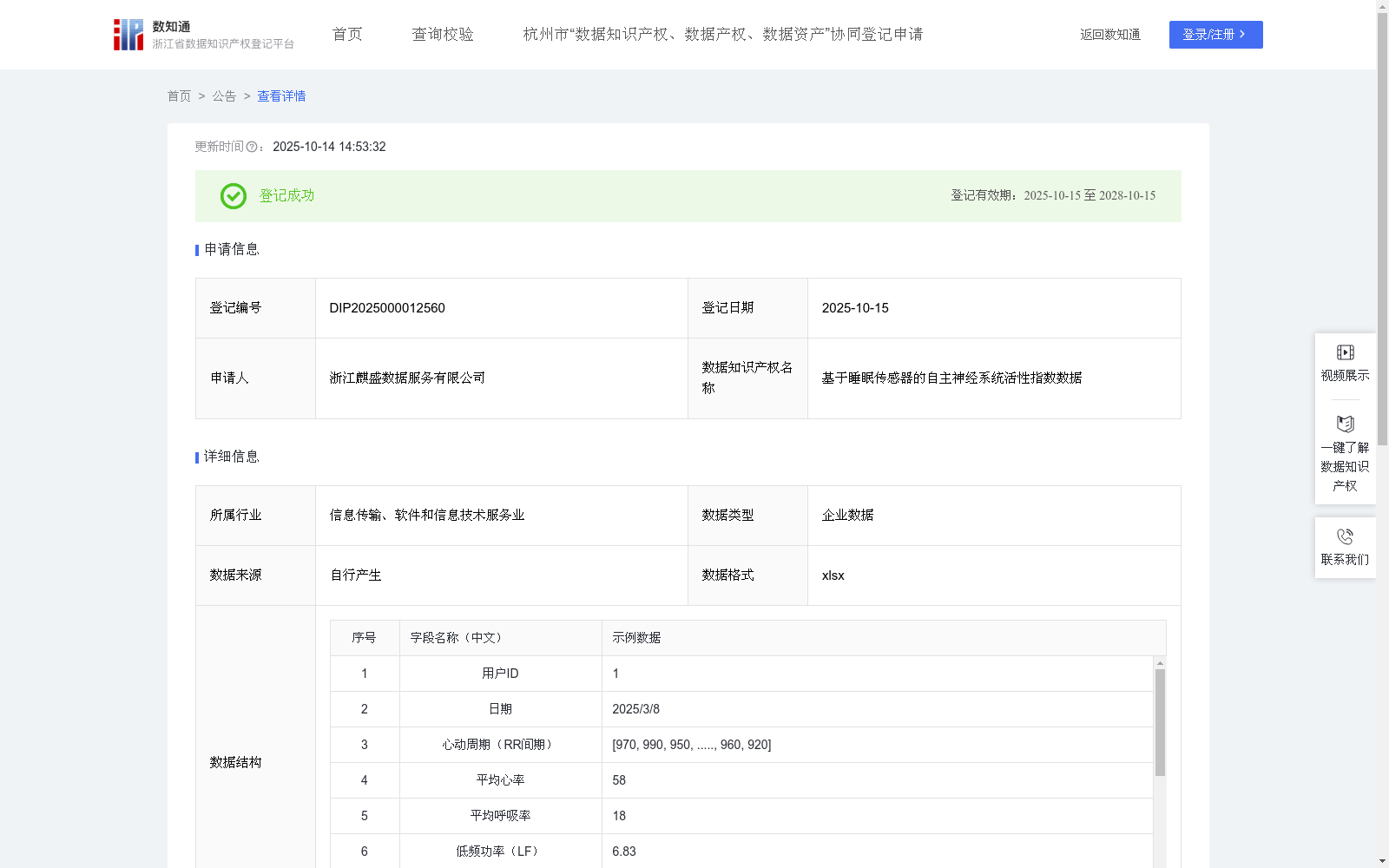
基于睡眠传感器的自主神经系统活性指数数据
收藏浙江省数据知识产权登记平台2025-10-14 更新2025-10-15 收录
下载链接:
https://www.zjip.org.cn/home/announce/trends/2056522
下载链接
链接失效反馈官方服务:
资源简介:
以智能床采集的心率变异性、心率与呼吸频率等数据为基础,推算出的“自主神经系统活性”指标具备广泛的应用价值:1)通过算法推算的自主神经系统活性指数,用户可以了解夜间交感与副交感神经的动态平衡状态。持续高交感活性可能暗示慢性压力或睡眠质量不佳,持续副交感活性占优则可能指向良好恢复状态。2)慢性病风险预警与康复监测:自主神经系统的异常活动与多种慢性疾病密切相关(如高血压、糖尿病、心律失常)。研究表明,交感神经长期过度活跃可能是代谢综合征与心血管疾病的前驱信号。在临床康复中,该指标也可用于评估药物干预效果(如交感抑制药物)或手术后患者的神经功能恢复过程。智能床传感器采集夜间原始数据,包括RR间期序列(单位:毫秒)、平均心率与平均呼吸率。对RR序列进行异常值剔除(<300ms或>1200ms,及相邻差值超过平均值20%的突变点),并采用线性插值填补短时间缺失数据。将清洗后的数据按5分钟非重叠滑窗进行分段处理。每个窗口中计算以下时域与频域心率变异性指标:相邻 RR 间期变化的均方根,即RMSSD(短期变异性),随后,对 RR 间期序列进行插值与功率谱分析,提取低频(LF, 0.04–0.15Hz)与高频(HF, 0.15–0.40Hz)功率成分,分别对应交感与副交感神经活性。最后计算 LF/HF 比值,同时提取该窗口内的平均心率和平均呼吸频率。基于医学研究定义如下两类神经活性分量:副交感活性(PNS_index) = RMSSD 标准化值 + HF 标准化值 − HR 标准化值,交感活性(SNS_index) = LF 标准化值 + LF/HF比值 + HR 标准化值 + RR(呼吸频率)标准化值。最终,自主神经系统活性指数按如下方式输出:ANS_Activity = γ1 * PNS_index - γ2 * SNS_index,γ1、γ2 为平衡系数,可调节模型偏向,正值表示副交感占优,负值表示交感占优。为提升用户感知性,系统将内部标准化指数结果通过线性缩放方式映射至 0–150 的整数分值区间。本算法引入特征归一化及动态加权融合机制,使不同睡眠结构、年龄层或心率基准水平的用户均可适配。同时,通过对原始信号的异常检测与窗口级稳定性过滤,提升算法在家庭非干预环境中的稳定性与泛化能力。
The 'Autonomic Nervous System (ANS) Activity' index, derived from data including heart rate variability (HRV), heart rate, and respiratory rate collected by smart beds, has broad application prospects:
1) Users can learn about the dynamic balance of sympathetic and parasympathetic nerves during sleep through the algorithm-derived ANS activity index. Sustained high sympathetic activity may indicate chronic stress or poor sleep quality, while sustained dominant parasympathetic activity may suggest a favorable recovery status.
2) Chronic disease risk early warning and rehabilitation monitoring: Abnormal autonomic nervous system activity is closely associated with a variety of chronic diseases, including hypertension, diabetes mellitus, and arrhythmia. Studies have demonstrated that long-term overactivation of sympathetic nerves may serve as a precursor signal for metabolic syndrome and cardiovascular diseases. In clinical rehabilitation, this index can also be used to evaluate the efficacy of drug interventions (such as sympathetic inhibitory drugs) or the neurological recovery process of post-operative patients.
Smart bed sensors collect nighttime raw data, including RR interval sequences (unit: milliseconds), average heart rate, and average respiratory rate. Outliers are removed from the RR sequences: mutated points with values <300 ms or >1200 ms, and adjacent differences exceeding 20% of the average value. Short-term missing data are then filled using linear interpolation. The cleaned data are segmented using 5-minute non-overlapping sliding windows.
The following time-domain and frequency-domain HRV indicators are calculated for each window: First, the root mean square of successive differences between adjacent RR intervals, referred to as RMSSD (short-term variability). Subsequently, interpolation and power spectrum analysis are performed on the RR interval sequences to extract low-frequency (LF, 0.04–0.15 Hz) and high-frequency (HF, 0.15–0.40 Hz) power components, which correspond to sympathetic and parasympathetic nerve activity, respectively. Finally, the LF/HF ratio is calculated, and the average heart rate and average respiratory frequency within the window are also extracted.
Based on medical research, the following two types of nerve activity components are defined:
Parasympathetic activity (PNS_index) = standardized RMSSD value + standardized HF value − standardized HR value,
Sympathetic activity (SNS_index) = standardized LF value + LF/HF ratio + standardized HR value + standardized RR (respiratory rate) value.
Finally, the autonomic nervous system activity index is output as follows: ANS_Activity = γ1 * PNS_index - γ2 * SNS_index, where γ1 and γ2 are balance coefficients that can adjust the model's bias. A positive value indicates dominant parasympathetic activity, while a negative value indicates dominant sympathetic activity.
To enhance user perception, the internal standardized index results are mapped to an integer score range of 0–150 via linear scaling. This algorithm introduces feature normalization and dynamic weighted fusion mechanisms, enabling adaptation for users with different sleep structures, age groups, or baseline heart rate levels. Additionally, through anomaly detection of the original signal and window-level stability filtering, the stability and generalization ability of the algorithm in non-interventional home environments are improved.
提供机构:
浙江麒盛数据服务有限公司
创建时间:
2025-07-28
搜集汇总
数据集介绍
背景与挑战
背景概述
该数据集包含1001条基于智能床传感器采集的自主神经系统活性指数数据,每日更新,涵盖心率变异性、交感和副交感神经活性等关键指标,用于评估睡眠质量和慢性病风险预警;数据通过标准化算法处理,确保在家庭环境中的稳定性和适用性,并已通过区块链存证验证。
以上内容由遇见数据集搜集并总结生成


