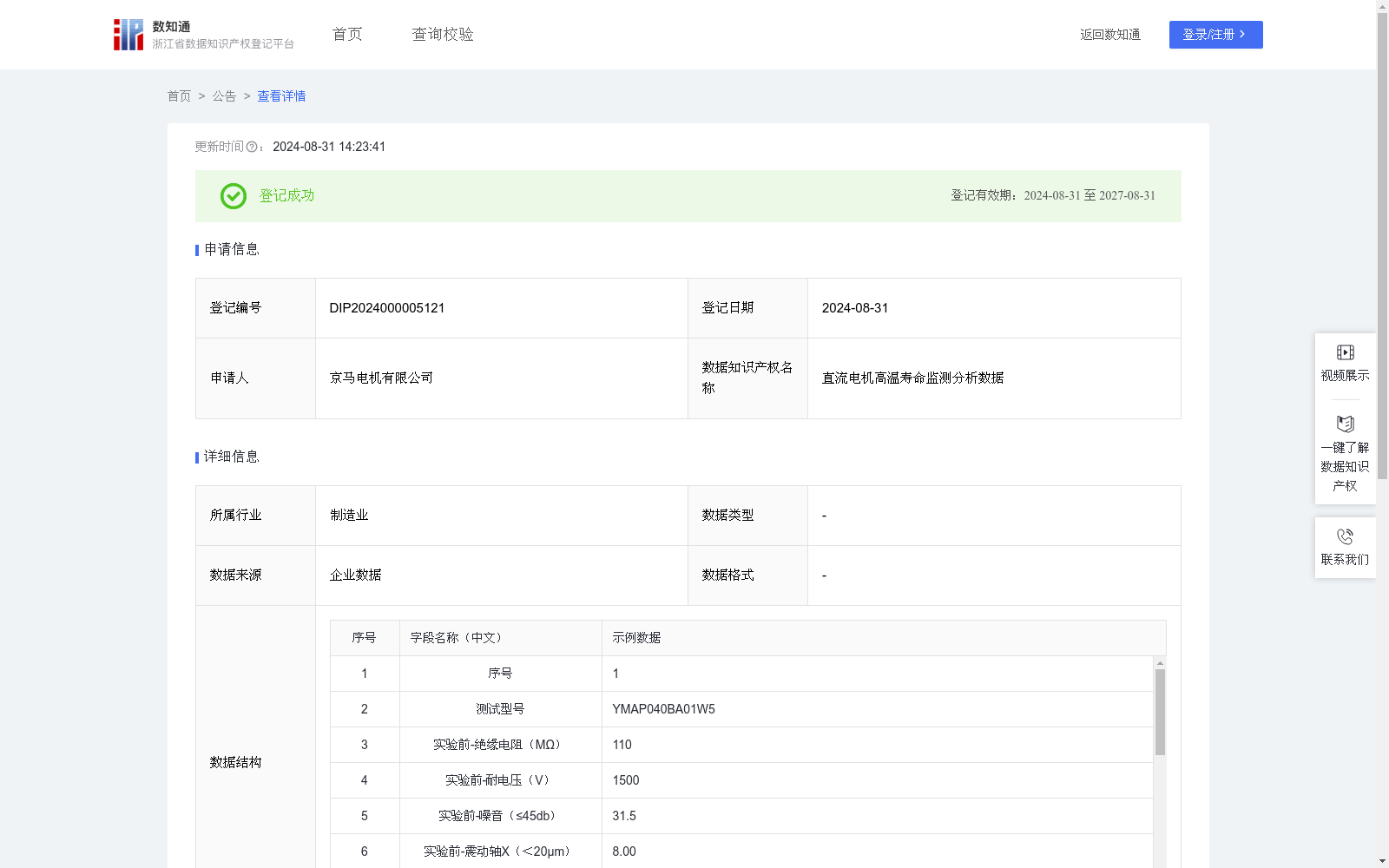
直流电机高温寿命监测分析数据
收藏资源简介:
通过模拟高温工作环境,根据电机移动的稳定率来预测高温寿命,并对试验结果进行分级,试验结果可以作为电机耐高温、电机在高温中的使用寿命等级的评价依据,为监管部门监管、采购商采购提供技术支撑。试验过程中,对电机的性能参数进行监测和记录,有助于发现设计和制造中的潜在问题,及时进行改进,提高产品质量。通过了解电机在高温环境下的性能变化,可以优化维护策略,提高维护效率,降低维护成本。经过高温寿命试验的电机,其可靠性和稳定性得到验证,有助于提升产品的整体可靠性和市场竞争力。 1.数据采集:对直流电机进行高温寿命试验,控制绝缘电阻保持为110MΩ,耐电压1500V。得到实验前后的噪音数据、实验前后震动轴X的数据、实验前后震动轴Y的数据、实验前后震动轴Z的数据。2.偏差值计算:将实验前后各震动轴的数据相减,得到震动轴偏差(X、Y、Z)。3.偏差总值计算:利用ABS函数,将值全都改为正数并进行相加,则偏差总值=ABS(震动轴偏差X+震动轴偏差Y+震动轴偏差Z)。4.稳定率计算,由于设备需要通过高温试验,所以偏差总值5μm为标准值,值越小则性能越好,超过5μm则需要进行检修。稳定率=ABS((偏差总值-5)/5)*100%。5.分级:试验分类运用ABCDEF分类法,稳定率越高证明移动距离越少,移动距离越少则使用寿命越长,稳定率在5%以内的,给予“F类寿命”分层;稳定率在5%到10%区间的,则给予“E类寿命“分层;稳定率在10%到15%区间,则给予“D类寿命”分层;稳定率在15%到20%区间,则给予“C类寿命”分层;稳定率在20%到30%区间,则给予“B类寿命”分层;稳定率在30%以上,则给予“A类寿命”分层。
This dataset predicts the high-temperature service life of motors based on their movement stability rate by simulating high-temperature operating environments, and classifies the test results. The test results can serve as the evaluation basis for the high-temperature resistance and high-temperature service life grade of the motor, providing technical support for supervision by regulatory authorities and procurement by purchasers. During the test, performance parameters of the motor are monitored and recorded, which helps detect potential problems in design and manufacturing, enable timely improvements, and enhance product quality. By understanding the performance changes of the motor in high-temperature environments, maintenance strategies can be optimized, maintenance efficiency improved, and maintenance costs reduced. Motors that have undergone high-temperature life tests have their reliability and stability verified, which helps improve the overall reliability and market competitiveness of the products. 1. Data Collection: Conduct high-temperature life tests on DC motors, control the insulation resistance to maintain 110 MΩ and withstand voltage to 1500 V. Obtain noise data before and after the test, as well as vibration axis X, Y, Z data before and after the test. 2. Deviation Value Calculation: Subtract the data of each vibration axis before and after the test to obtain the vibration axis deviations (X, Y, Z). 3. Total Deviation Calculation: Use the ABS (absolute value) function to convert all values to positive numbers and sum them up. The total deviation = ABS(vibration axis deviation X + vibration axis deviation Y + vibration axis deviation Z). 4. Stability Rate Calculation: Since the equipment needs to pass the high-temperature test, the total deviation of 5 μm is taken as the standard value. The smaller the value, the better the performance; if the value exceeds 5 μm, maintenance is required. The stability rate = ABS((total deviation - 5)/5) * 100%. 5. Classification: The ABCDEF classification method is adopted for test classification. A higher stability rate indicates less movement distance, and less movement distance corresponds to a longer service life. The lifetime layers are assigned as follows: "F-type lifetime" for stability rate within 5%; "E-type lifetime" for stability rate between 5% and 10%; "D-type lifetime" for stability rate between 10% and 15%; "C-type lifetime" for stability rate between 15% and 20%; "B-type lifetime" for stability rate between 20% and 30%; and "A-type lifetime" for stability rate above 30%.