
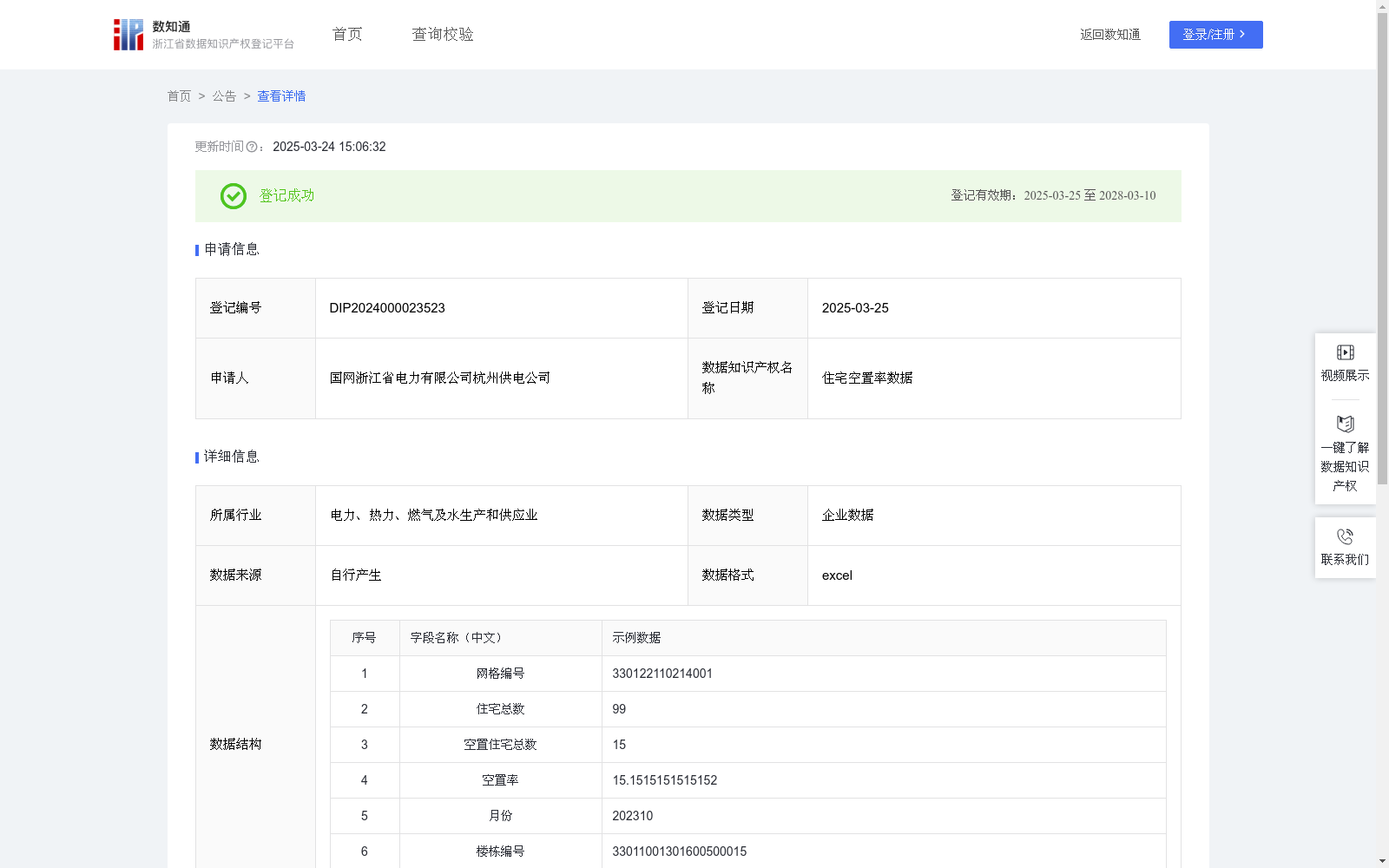
住宅空置率数据
收藏浙江省数据知识产权登记平台2025-03-24 更新2025-03-25 收录
下载链接:
https://www.zjip.org.cn/home/announce/trends/119547
下载链接
链接失效反馈官方服务:
资源简介:
1.数据适用范围:杭州市及下属十三个区县
2.数据内容:基于数据中台,利用一户一表记录的住宅用电数据,分析房住宅住状态,再结合统一地址库编码统计住宅的空置率。
3.数据应用场景:通过住宅的用电数据,打造房住宅住状态分析模型。结合统一地址库编码,量化杭州市各区域、各版块的住宅空置率,为政府在城市规划、土地供应、房地产刺激政策制定等方面提供支持。
4.数据简介:通过对电力开户时间一年及以上的住宅前一年用电量的统计来判断住宅的居住状态。前1年累计用电量超过规定阈值的认为是有人居住,低于阈值的认为的无人居住。根据统一地址库编码的编码规则统计市、区县、街道、网格和楼栋的住宅空置率。1.数据关联:将电力地址和统一地址库编码进行关联。
2.数据清洗:对数据集进行清洗,包括去除异常数据、处理缺失值。
3.算法模型
(1)住宅居住状态分析模型:统计对象 电力开户时间一年及以上的住宅。 完成电力地址匹配,拥有统一地址编码的住宅 判定规则 过去一年累计用电量 < 20 kWh,空置。 过去一年累计用电量 ≥ 20 kWh,非空置。
(2)网格空置率计算模型:统一地址编码规则 统一地址编码前6位表示杭州市、7-9位表示区县、10-12位表示街道、13-15位表示网格。 将住宅状态按照前15位数(网格编码)一致的情况进行统计分类,统计住宅总数和空置住宅总数,进而计算出该网格范围内的空置率=空置住宅总数/住宅总数。
(3)楼栋空置率计算模型:根据楼栋编号计算各个楼栋的空置率,考虑到很多农村自建房、别墅类住宅等一幢楼只有少量用电户号,而将这类楼栋的空置率情况拿出来对外服务会存在用户隐私暴露等安全问题,故楼栋空置率仅展示含6个户号及以上的楼栋空置率。 将统一地址编码前20位一致且数量大于等于6的楼栋统计这栋楼含有的住宅总数和空置住宅总数。
1. Data Application Scope: Hangzhou City and its 13 subordinate districts and counties.
2. Data Content: Based on the data middle platform, residential electricity consumption data recorded via the one-household one-meter system is used to analyze the residential status of houses, and then combined with the unified address library coding to count the residential vacancy rate.
3. Data Application Scenarios: Develop a residential status analysis model using residential electricity consumption data. By combining with the unified address library coding, quantify the residential vacancy rates of various regions and blocks in Hangzhou, and provide decision support for the government in aspects such as urban planning, land supply, and formulation of real estate stimulus policies.
4. Data Introduction: The residential status of houses is judged by counting the electricity consumption of houses with electricity account opening time of one year or more in the previous year. Houses with cumulative electricity consumption in the previous year exceeding the specified threshold are considered occupied, while those with cumulative electricity consumption lower than the threshold are considered vacant. The residential vacancy rate at the city, district and county, street, grid and building levels is counted according to the coding rules of the unified address library.
1. Data Association: Associate the electricity address with the unified address library coding.
2. Data Cleaning: Clean the dataset, including removing abnormal data and handling missing values.
3. Algorithm Models
(1) Residential Status Analysis Model:
- Statistical Target: Houses with electricity account opening time of one year or more, with completed electricity address matching and possessing unified address coding.
- Judgment Rules: If the cumulative electricity consumption in the previous year < 20 kWh, the house is considered vacant; if ≥ 20 kWh, the house is considered occupied.
(2) Grid Vacancy Rate Calculation Model:
- Unified Address Coding Rules: The first 6 digits of the unified address code represent Hangzhou City, digits 7–9 represent districts and counties, digits 10–12 represent sub-districts (streets), and digits 13–15 represent grids.
- Calculation Method: Classify residential status according to the consistency of the first 15 digits (grid code). Count the total number of residences and the total number of vacant residences, then calculate the vacancy rate of this grid as: Vacancy Rate = Total Number of Vacant Residences / Total Number of Residences.
(3) Building Vacancy Rate Calculation Model:
- Privacy Protection Consideration: Considering that many rural self-built houses, villas and other buildings only have a small number of electricity account numbers, and releasing the vacancy rate of such buildings may pose security risks such as user privacy disclosure, the building vacancy rate is only displayed for buildings with 6 or more electricity account numbers.
- Statistical Method: For buildings with the first 20 digits of the unified address code being consistent and having a number of electricity accounts ≥6, count the total number of residences and the total number of vacant residences in this building.
提供机构:
国网浙江省电力有限公司杭州供电公司
创建时间:
2024-12-18
搜集汇总
数据集介绍
背景与挑战
背景概述
住宅空置率数据集包含500条记录,每月更新,基于电力数据统计杭州市住宅空置率,适用于城市规划等政府决策。
以上内容由遇见数据集搜集并总结生成



