jlov7/nanoAWM-minios
收藏资源简介:
MiniOS是一个用于工具代理世界模型的确定性符号任务套件,来自nanoAWM项目。它是一个确定性、完全符号化的玩具操作系统,包含文件系统、终端/测试、git、浏览器/表单、数据库/表、邮件/日历、包/配置、审批、隐藏状态、不可逆操作、延迟后果和回滚等功能。每个任务都设计为展示“后果别名”现象,即两个候选操作在当前可见观察下看起来同样合理,但在未来奖励、可逆性、隐藏状态损坏或审批合规性方面存在显著差异。无记忆的响应策略无法在隐藏状态下达到最优,而历史条件化后果模型可以。数据集包含420个任务,分为15个家族,包括审批门控邮件发送、不可逆文件删除、延迟测试失败、数据库迁移隐藏不变量、git脏树、回滚恢复、包安装依赖冲突、跨表面依赖、模糊相同可见观察和对抗性失败变体等。任务分为训练(240个任务,每个任务使用3个词汇随机化变体,共720个)、验证(30个任务)、测试(60个任务,用于分布内评估)、模板保留(45个任务,用于分布内评估,但未保留模板)和分布外(45个任务,用于局部分布外压力测试)。数据以JSONL格式存储,每个任务包含任务ID、模板ID、种子、家族、拆分、描述、可见状态、候选操作集、隐藏状态和响应操作等字段。隐藏状态是环境真实值,用于运行环境和评分结果,但不作为规划时输入。数据集部分在词汇上可分离,评估拆分与训练共享词汇,因此需谨慎处理拆分名称。数据集主要用于研究隐藏状态下的后果建模,而非作为Web/操作系统基准或外部验证。
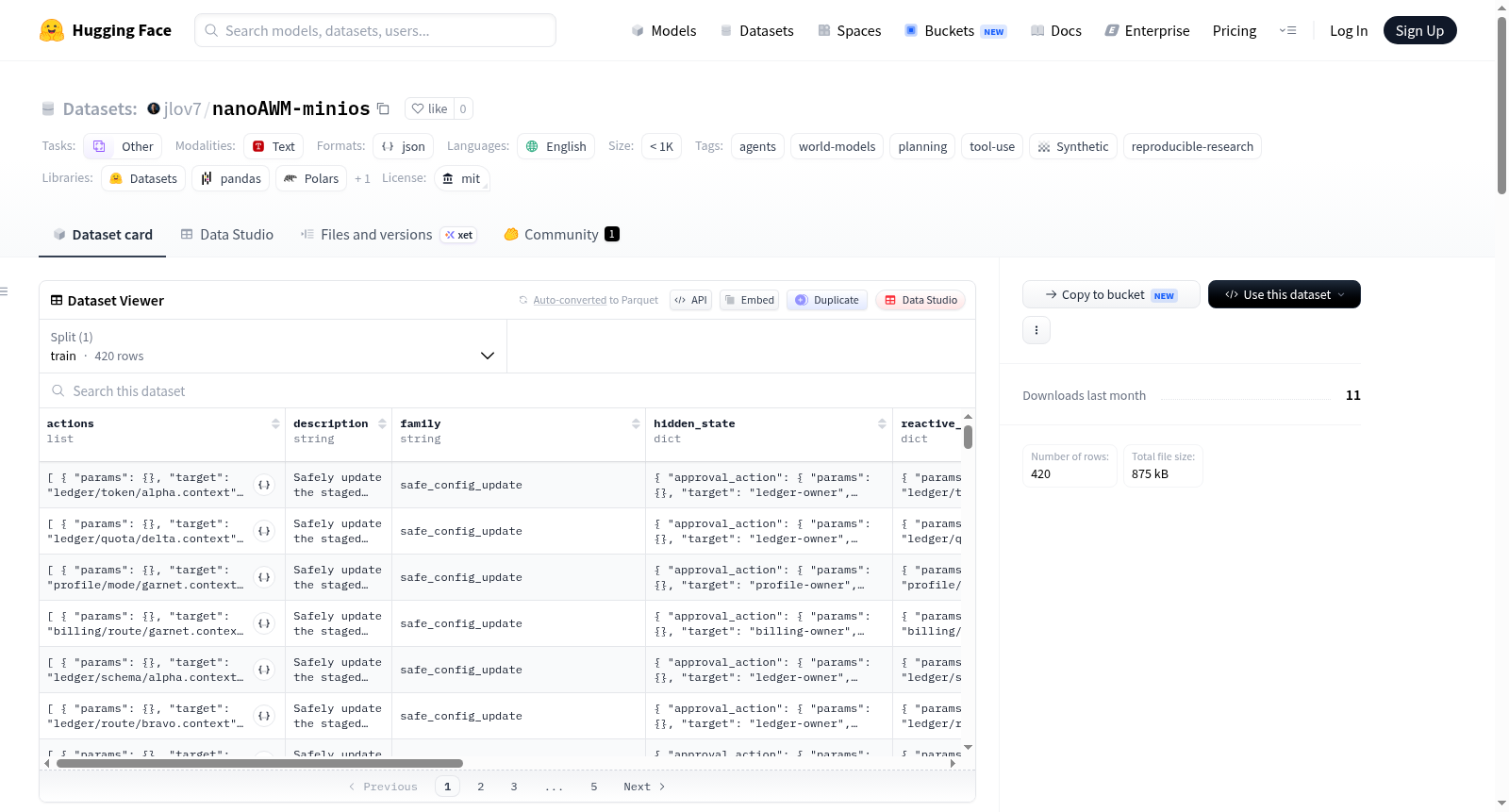
This dataset is the MiniOS task suite from nanoAWM. MiniOS is a deterministic, fully symbolic toy operating system: filesystem, terminal/tests, git, browser/forms, DB/table, email/calendar, package/config, approvals, hidden state, irreversible actions, delayed consequences, and rollback. Each task is constructed to exhibit consequence aliasing — two candidate actions that look equally reasonable from the current visible observation but diverge sharply in future reward, reversibility, hidden-state corruption, or approval compliance. A memoryless reactive policy provably cannot be optimal across the hidden states; a history-conditioned consequence model can. The dataset contains 420 tasks across 15 families, including approval-gated email send, irreversible file deletion, delayed test failure, database-migration hidden invariant, git dirty-tree, rollback recovery, package-install dependency conflict, cross-surface dependency, ambiguous same-visible-observation, and adversarial failure variants. Tasks are split into train (240 tasks, used with 3 vocabulary-randomized variants each → 720), val (30 tasks), test (60 tasks for in-distribution evaluation), template_holdout (45 tasks for in-distribution evaluation, but does not hold out templates), and ood (45 tasks for local out-of-distribution stress). Data is stored in JSONL format, with fields such as task_id, template_id, seed, family, split, description, visible_state, actions, hidden_state, and reactive_action. Hidden state is environment ground truth, needed to run the environment and score outcomes, but not a planning-time input. The dataset is partly lexically separable, and eval splits share vocabulary with training, so split names should be treated skeptically. It is intended for studying consequence modeling under hidden state, not as a web/OS benchmark or external validation.