
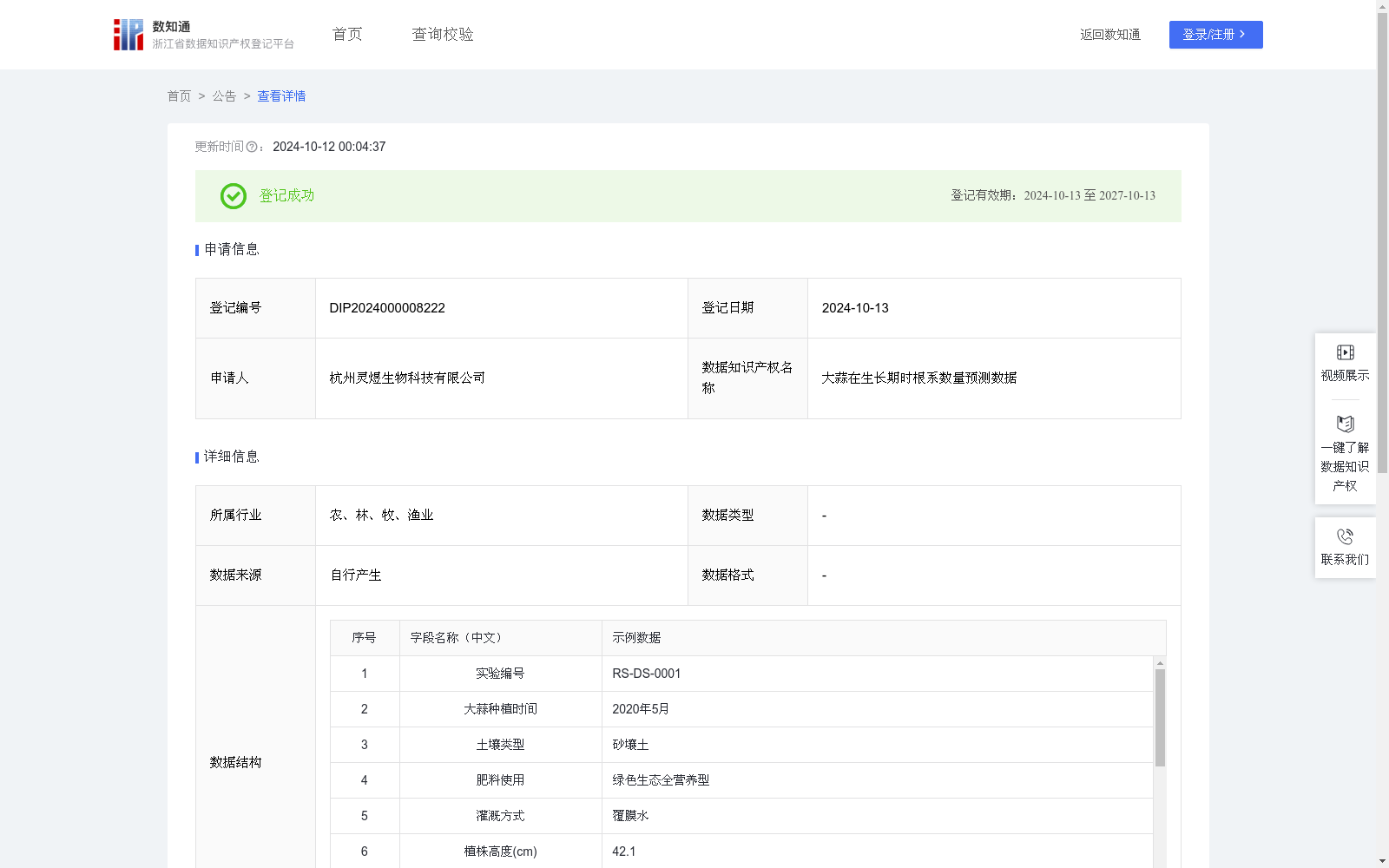
大蒜在生长期时根系数量预测数据
收藏浙江省数据知识产权登记平台2024-10-12 更新2024-10-12 收录
下载链接:
https://www.zjip.org.cn/home/announce/trends/70117
下载链接
链接失效反馈官方服务:
资源简介:
可以用于大蒜根系数量预测,输入为土壤类型、肥料使用、灌溉方式、植株高度(cm)、大蒜茎粗(cm)、叶面积指数、根系长度(cm)、大蒜产量(亩产量)、根系主要分布范围(cm)、根茎长(cm)、叶绿素含量(mg/g)、叶片数量。输出为大蒜根系数量预测值。该模型帮助解决了大蒜根系数量和大蒜状况的关系建模的问题。大蒜植株的根系数量对大蒜根的生长有着重要的影响,根系的健康状况(包括有根系数量)还能影响其对养分的吸收效率,从而影响作物的最终产量。因此,通过预测大蒜根系的数量,可以初步判断作物的生长状况。通过调查采集大蒜数据,并使用传统算法和多元线性回归算法预测大蒜根系数量。该模型的输入为土壤类型、肥料使用、灌溉方式、植株高度(cm),大蒜茎粗(cm),叶面积指数,根系长度(cm),大蒜产量(亩产量),根系主要分布范围(cm),大蒜根系数量,根茎长(cm),叶绿素含量(mg/g)。多元线性回归算法通过分析这些输入变量与大蒜根系预测数量之间的线性关系,确定每个变量的权重系数,使用深度学习框架构建模型F=ω1 * U1 + ω2* U2+…ω13 * U13,其中,ω1至ω13分别是土壤类型、肥料使用、灌溉方式、植株高度、大蒜茎粗、叶面积指数、根系长度、大蒜产量、根系主要分布范围、根茎长、叶绿素含量、叶片数量的权重系数,同样的 U1至 U13分别是上述13个输入量的参数值,F是大蒜根系数量预测值。在模型训练过程中,算法会利用大蒜根系数量实际值进行优化,调整权重系数以最小化预测误差,因此上述权重系数(ω1至ω13)是会动态变化。模型通过最小二乘法等技术,根据输入的数据计算大蒜根系数量预测值,从而得出最终结果。通过这样的过程,模型能够将多个输入变量综合考虑,准确预测大蒜根系数量。
This dataset is designed for garlic root quantity prediction. Its inputs include soil type, fertilizer application, irrigation method, plant height (cm), garlic stem diameter (cm), leaf area index, root length (cm), garlic yield per mu, main root distribution range (cm), rhizome length (cm), chlorophyll content (mg/g), and leaf count, while the output is the predicted garlic root quantity.
This model addresses the challenge of modeling the relationship between garlic root quantity and the overall status of garlic plants. The root quantity and health status of garlic plants significantly affect root growth and nutrient uptake efficiency, which in turn influence the final crop yield. Therefore, predicting garlic root quantity allows for preliminary assessment of crop growth conditions.
Garlic data were collected through field surveys, and traditional algorithms and multiple linear regression were used to predict garlic root quantity. The multiple linear regression algorithm analyzes the linear relationship between these input variables and the predicted garlic root quantity to determine the weight coefficients for each variable. The model is constructed using a deep learning framework with the formula: $F = omega_1 imes U_1 + omega_2 imes U_2 + dots + omega_{13} imes U_{13}$, where $omega_1$ to $omega_{13}$ are the weight coefficients corresponding to soil type, fertilizer application, irrigation method, plant height, garlic stem diameter, leaf area index, root length, garlic yield per mu, main root distribution range, actual garlic root quantity, rhizome length, chlorophyll content, and leaf count, respectively; $U_1$ to $U_{13}$ represent the parameter values of the 13 aforementioned input variables, and $F$ is the predicted garlic root quantity.
During model training, the algorithm utilizes the actual values of garlic root quantity for optimization, adjusting the weight coefficients to minimize prediction errors, so the weight coefficients $omega_1$ to $omega_{13}$ are dynamically variable. The model calculates the predicted garlic root quantity using techniques such as the method of least squares based on the input data, thereby generating the final result. Through this process, the model comprehensively considers multiple input variables to achieve accurate prediction of garlic root quantity.
提供机构:
杭州灵煜生物科技有限公司
创建时间:
2024-09-10
搜集汇总
数据集介绍
特点
该数据集提供了大蒜生长期的根系数量预测数据,包含4164条记录,每月更新。数据涵盖多种生长因素,如土壤类型、肥料使用等,通过多元线性回归算法预测根系数量,帮助评估大蒜生长状况和产量。
以上内容由遇见数据集搜集并总结生成



