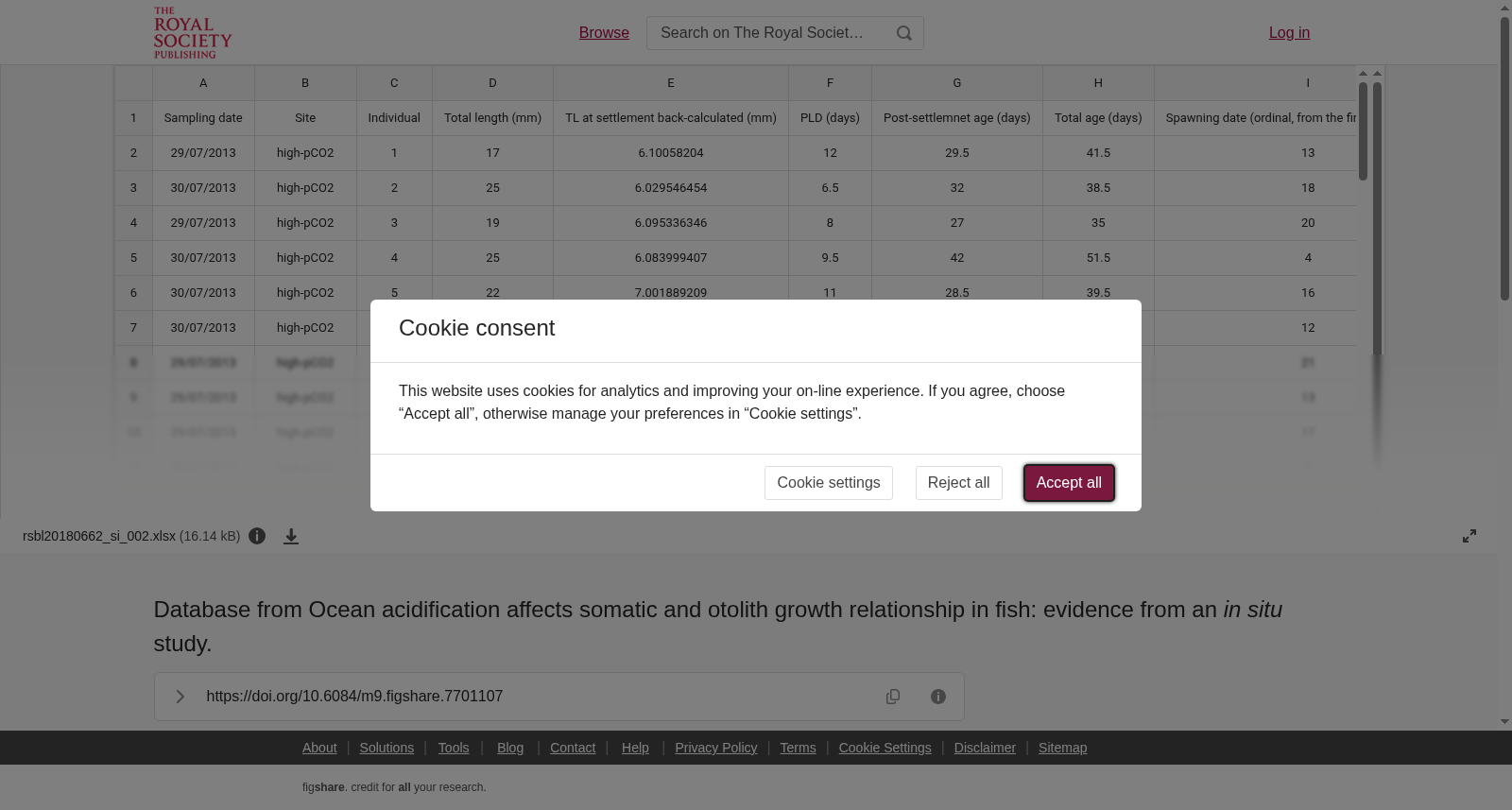
Database from Ocean acidification affects somatic and otolith growth relationship in fish: evidence from an <i>in situ</i> study.
收藏资源简介:
Ocean acidification (OA) may have varied effects on fish eco-physiological responses. Most OA studies have been carried out in laboratory conditions without considering the <i>in situ p</i>CO<sub>2</sub>/pH variability documented for many marine coastal ecosystems. Using a standard otolith ageing technique, we assessed how <i>in situ</i> ocean acidification (ambient, versus end-of-century CO<sub>2</sub> levels) can affect somatic and otolith growth, and their relationship in a coastal fish. Somatic and otolith growth rates of juveniles of the ocellated wrasse <i>Symphodus ocellatus</i> living off a Mediterranean CO<sub>2</sub> seep increased at the high-<i>p</i>CO<sub>2</sub> site. Also, we detected that slower-growing individuals living at ambient <i>p</i>CO<sub>2</sub> levels tend to have larger otoliths at the same somatic length (i.e. higher relative size of otoliths to fish body length) than faster-growing conspecifics living under high <i>p</i>CO<sub>2 </sub>conditions, with this being attributable to the so-called ‘growth effect’. Our findings suggest the possibility of contrasting OA effects on fish fitness, with higher somatic growth rate and possibly higher survival associated with smaller relative size of otoliths that could impair fish auditory and vestibular sensitivity.
海洋酸化(Ocean acidification, OA)对鱼类的生态生理响应可能存在差异化影响。当前绝大多数海洋酸化相关研究均在实验室条件下开展,未考虑诸多海洋近岸生态系统中已被记录的原位(in situ)二氧化碳分压(pCO₂)/pH波动情况。本研究采用标准耳石定年技术,评估了原位海洋酸化(当前环境与本世纪末二氧化碳浓度水平)对一种近岸鱼类的躯体生长、耳石(otolith)生长及其二者关联的影响。栖息于地中海二氧化碳渗漏区的眼斑濑鱼(Symphodus ocellatus)幼体,在高pCO₂位点的躯体生长速率与耳石生长速率均显著提升。此外,本研究发现:在同等躯体体长条件下,栖息于当前pCO₂环境中生长较慢的个体,其耳石相对体型比(即耳石与鱼体体长的相对比值)要高于高pCO₂环境中生长较快的同种个体,这一现象可归因于所谓的“生长效应”。本研究结果表明,海洋酸化对鱼类适合度的影响可能存在反差:躯体生长速率更高、存活率或更高的个体,其耳石相对尺寸更小,这可能会损害鱼类的听觉与前庭敏感性。