
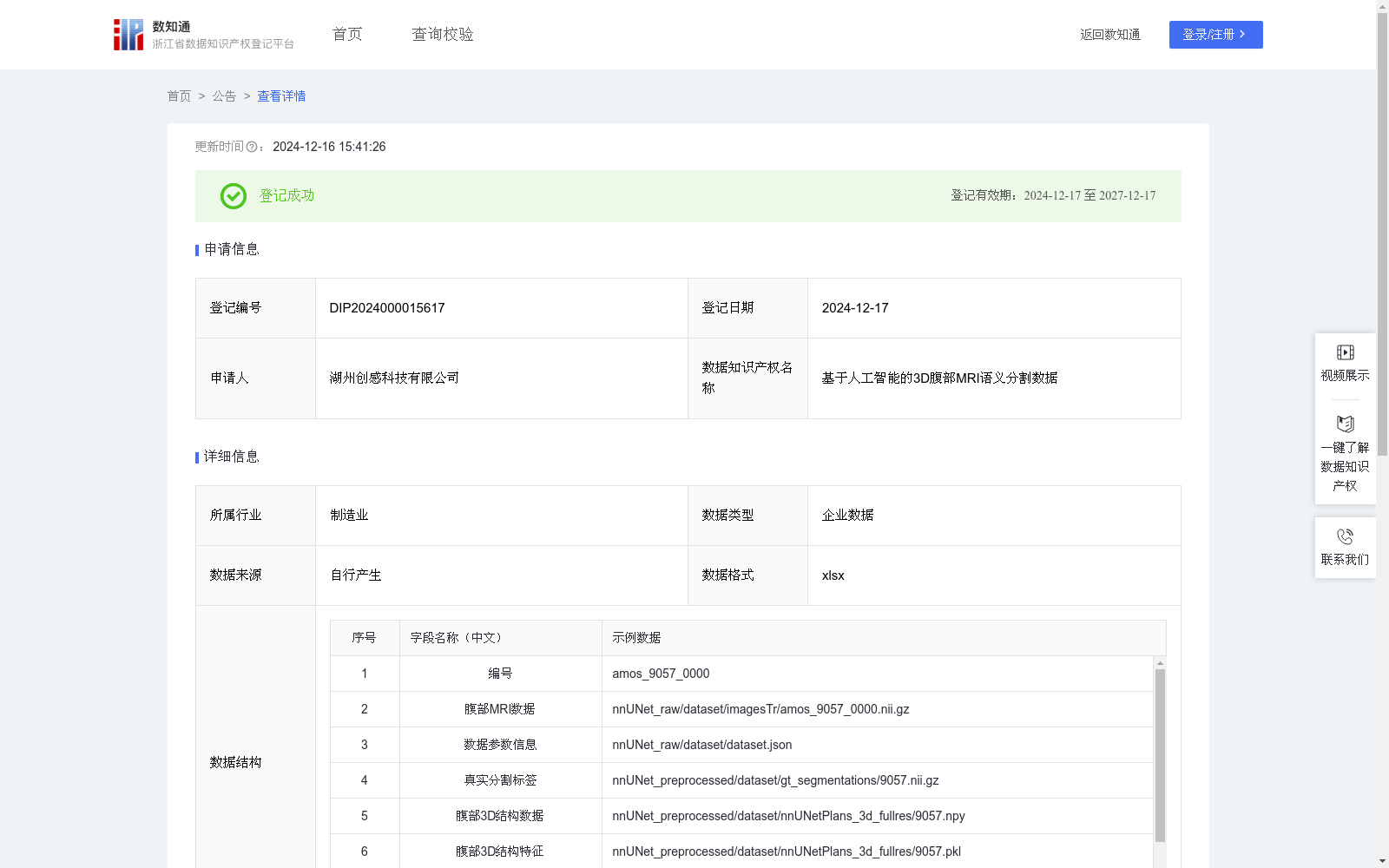
基于人工智能的3D腹部MRI语义分割数据
收藏浙江省数据知识产权登记平台2024-12-16 更新2024-12-17 收录
下载链接:
https://www.zjip.org.cn/home/announce/trends/104918
下载链接
链接失效反馈官方服务:
资源简介:
基于人工智能的3D腹部MRI语义分割技术在医学影像分析领域具有重要的应用价值,尤其在复杂腹部解剖结构的识别和疾病诊断中。3D腹部MRI图像相较于2D图像提供了更多的空间信息,能够更精确地进行多维度的解剖结构分割,帮助医生更好地理解和诊断腹部相关疾病,如肝脏疾病、肾脏病变、肠道问题等。这项技术在医学研究和临床实践中具有广泛的应用前景,特别是在自动化诊断、疾病监测和手术规划中,能够提高诊断效率,降低医生的工作负担,同时提供更为精准的疾病预警与治疗指导数据收集:在该算法中,首先收集腹部MRI数据以及相应的真实分割标签,作为模型训练和验证的基础。每个病例包括:腹部MRI数据(*.nii.gz格式文件),包含腹部MRI的原始数据。数据参数信息(*.json格式),用于记录MRI图像的具体参数,帮助模型更好地理解图像的特征。真实分割标签,表示不同组织或病变区域的真实标注信息,作为监督学习的目标数据。
数据预处理:首先对腹部MRI数据进行标准化处理,例如缩放、归一化等,使得数据适配神经网络的输入要求。然后,将MRI转换为适合训练的腹部3D结构数据(.npy格式),并生成预处理后的腹部3D结构数据特征(.pkl格式)。
模型构建:使用基于3D卷积神经网络来进行腹部MRI图像的语义分割。网络的输入是经过预处理的3D图像数据和对应的腹部3D结构特征,输出为预测的分割标签。具体算法公式如下:F_features = Encoder_features(3D_Structural_Features),Output_segmentation = Decoder_segmentation(F_image, F_features)。其中,Encoder_features是用于提取腹部3D结构特征(3D_Structural_Features)的编码器。Decoder_segmentation是用于生成预测分割标签(Output_segmentation)的解码器。通过这种方式,模型可以精确地进行三维分割,输出每个器官的分割结果。最后使用DSC和NSD指标进行评估。
AI-based 3D abdominal MRI semantic segmentation technology holds significant application value in the field of medical image analysis, particularly for the identification of complex abdominal anatomical structures and disease diagnosis. Compared with 2D images, 3D abdominal MRI images provide richer spatial information, enabling more precise multi-dimensional anatomical structure segmentation, which assists clinicians in better understanding and diagnosing abdominal-related diseases such as liver diseases, renal lesions, and intestinal disorders. This technology has broad application prospects in medical research and clinical practice, especially in automated diagnosis, disease monitoring, and surgical planning, as it can improve diagnostic efficiency, reduce the workload of clinicians, and deliver more accurate disease warning and treatment guidance.
Data collection: In this algorithm, abdominal MRI data and corresponding ground truth segmentation labels are first collected as the foundation for model training and validation. Each case includes:
1. Abdominal MRI data (files in *.nii.gz format), which contains the raw abdominal MRI data;
2. Data parameter information (files in *.json format), used to record the specific parameters of the MRI images to help the model better understand the image features;
3. Ground truth segmentation labels, which represent the real annotation information of different tissues or lesion regions, serving as the target data for supervised learning.
Data preprocessing: First, standardization processing such as scaling and normalization is applied to the abdominal MRI data to meet the input requirements of neural networks. Subsequently, the MRI data is converted into abdominal 3D structural data suitable for training (in *.npy format), and preprocessed abdominal 3D structural data features (in *.pkl format) are generated.
Model construction: A 3D convolutional neural network is employed for semantic segmentation of abdominal MRI images. The network takes the preprocessed 3D image data and the corresponding abdominal 3D structural features as inputs, and outputs the predicted segmentation labels. The specific algorithm formulas are as follows:
F_features = Encoder_features(3D_Structural_Features),
Output_segmentation = Decoder_segmentation(F_image, F_features).
Here, Encoder_features refers to the encoder used to extract abdominal 3D structural features (3D_Structural_Features), while Decoder_segmentation refers to the decoder used to generate the predicted segmentation labels (Output_segmentation). With this framework, the model can accurately perform 3D segmentation and output the segmentation results for each organ. Finally, the DSC and NSD metrics are utilized for model evaluation.
提供机构:
湖州创感科技有限公司
创建时间:
2024-11-14
搜集汇总
数据集介绍
特点
该数据集是一个基于人工智能的3D腹部MRI语义分割数据集,包含3461条数据,主要用于医学影像分析,特别是在复杂腹部解剖结构的识别和疾病诊断中。数据集通过3D卷积神经网络进行语义分割,应用场景广泛,包括自动化诊断、疾病监测和手术规划等。
以上内容由遇见数据集搜集并总结生成


