Misinformation-Dataset
收藏资源简介:
FakeNews Master Dataset 是一个合并、清理和去重的研究语料库,旨在研究不同上下文条件下的错误信息分类。它整合了 ClaimReview、Fakeddit、FakeNewsNet 和 MuMiN 的本地可用镜像,形成一个规范模式,同时保留源数据集来源。该数据集适用于实验,探讨开源模型在给定不同数量或质量的上下文(如完整上下文、最小上下文或误导性上下文)时是否能分类错误信息。数据规模方面,去重前总行数为 374,738,去重后为 360,348 行。数据来源包括 ClaimReview(265,884 行)、Fakeddit(85,577 行)、FakeNewsNet(21,889 行)和 MuMiN(1,388 行),保留率分别为 0.9809、0.8558、0.9437 和 0.9886。主要任务为二元错误信息分类,内部标签约定为 mapped_label: 0 = 真实,1 = 虚假;扁平导出标签约定为 Real: 1 = 真实,0 = 虚假。模态包括文本以及可用的图像/新闻元数据。数据集提供三种导出家族:测试、训练和验证分割用于适配器训练和评估;规范化记录用于实验和训练;主记录包含丰富的来源字段;扁平分析导出包含 id、Title、Claim、news source、Real 和 tweet_num 字段。关键字段包括 dataset(源数据集名称)、sample_id(源感知稳定样本标识符)、text(主要声明文本)、context_text(附加上下文)、original_label(源特定标签值)、mapped_label(内部二元标签)、split(数据集分割值)、modality(源模态描述符)、has_image(图像元数据可用性)、metadata(源特定来源和辅助字段)。扁平导出字段覆盖情况:Title 非空行 106,125(空值率 0.7055),Claim 非空行 360,348(空值率 0.0000),news source 非空行 360,348(空值率 0.0000),Real 非空行 360,348(空值率 0.0000),tweet_num 非空行 20,732(空值率 0.9425)。数据集适用于错误信息和假新闻分类研究、上下文消融实验、跨数据集和上下文设置的模型行为比较、适配器微调的确定性训练/验证/测试分割构建,以及合并错误信息数据集的源覆盖和字段可用性检查。不应作为自动化内容审核、无人工审查的真实世界事实核查、法律、医疗、选举、财务或安全关键决策的唯一真相来源。数据集存在源不平衡、收集方法差异、上下文有限、图像 URL 有效性不保证等偏差和限制。许可为其他,用户需遵守各上游数据集的条款。
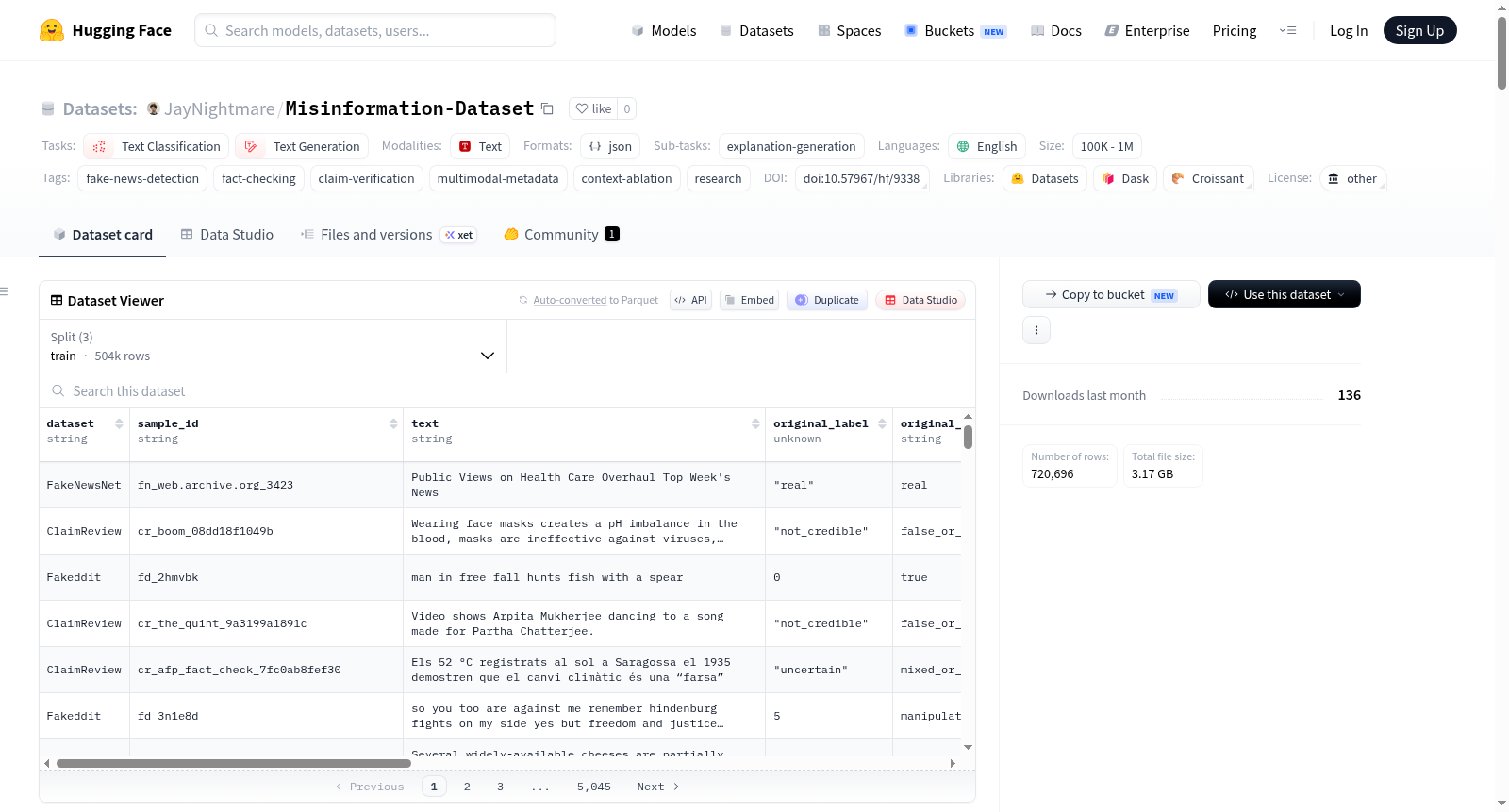
FakeNews Master Dataset is a merged, cleaned, and deduplicated research corpus designed to study misinformation classification under varying contextual conditions. It integrates locally available mirrors of ClaimReview, Fakeddit, FakeNewsNet, and MuMiN into a canonical schema while preserving source dataset provenance. The dataset is suitable for experiments exploring whether open-source models can classify misinformation given different amounts or qualities of context, such as full context, minimal context, or misleading context. In terms of data scale, the total number of rows before deduplication is 374,738, and after deduplication, it is 360,348 rows. Data sources include ClaimReview (265,884 rows), Fakeddit (85,577 rows), FakeNewsNet (21,889 rows), and MuMiN (1,388 rows), with retention rates of 0.9809, 0.8558, 0.9437, and 0.9886, respectively. The primary task is binary misinformation classification, with internal label conventions as mapped_label: 0 = true, 1 = false; and flat export label conventions as Real: 1 = true, 0 = false. Modalities include text and available image/news metadata. The dataset provides three export families: test, train, and validation splits for adapter training and evaluation; canonicalized records for experiments and training; master records with rich provenance fields; and flat analytical exports containing fields such as id, Title, Claim, news source, Real, and tweet_num. Key fields include dataset (source dataset name), sample_id (source-aware stable sample identifier), text (primary claim text), context_text (additional context), original_label (source-specific label value), mapped_label (internal binary label), split (dataset split value), modality (source modality descriptor), has_image (image metadata availability), and metadata (source-specific provenance and auxiliary fields). Flat export field coverage: Title has 106,125 non-null rows (null rate 0.7055), Claim has 360,348 non-null rows (null rate 0.0000), news source has 360,348 non-null rows (null rate 0.0000), Real has 360,348 non-null rows (null rate 0.0000), and tweet_num has 20,732 non-null rows (null rate 0.9425). The dataset is applicable for misinformation and fake news classification research, context ablation experiments, comparing model behaviors across datasets and contextual settings, constructing deterministic train/validation/test splits for adapter fine-tuning, and checking source coverage and field availability in merged misinformation datasets. It should not be used as the sole source of truth for automated content moderation, real-world fact-checking without human review, or legal, medical, electoral, financial, or safety-critical decisions. The dataset has biases and limitations such as source imbalance, differences in collection methods, limited context, and no guarantee of image URL validity. The license is other, and users must comply with the terms of each upstream dataset.