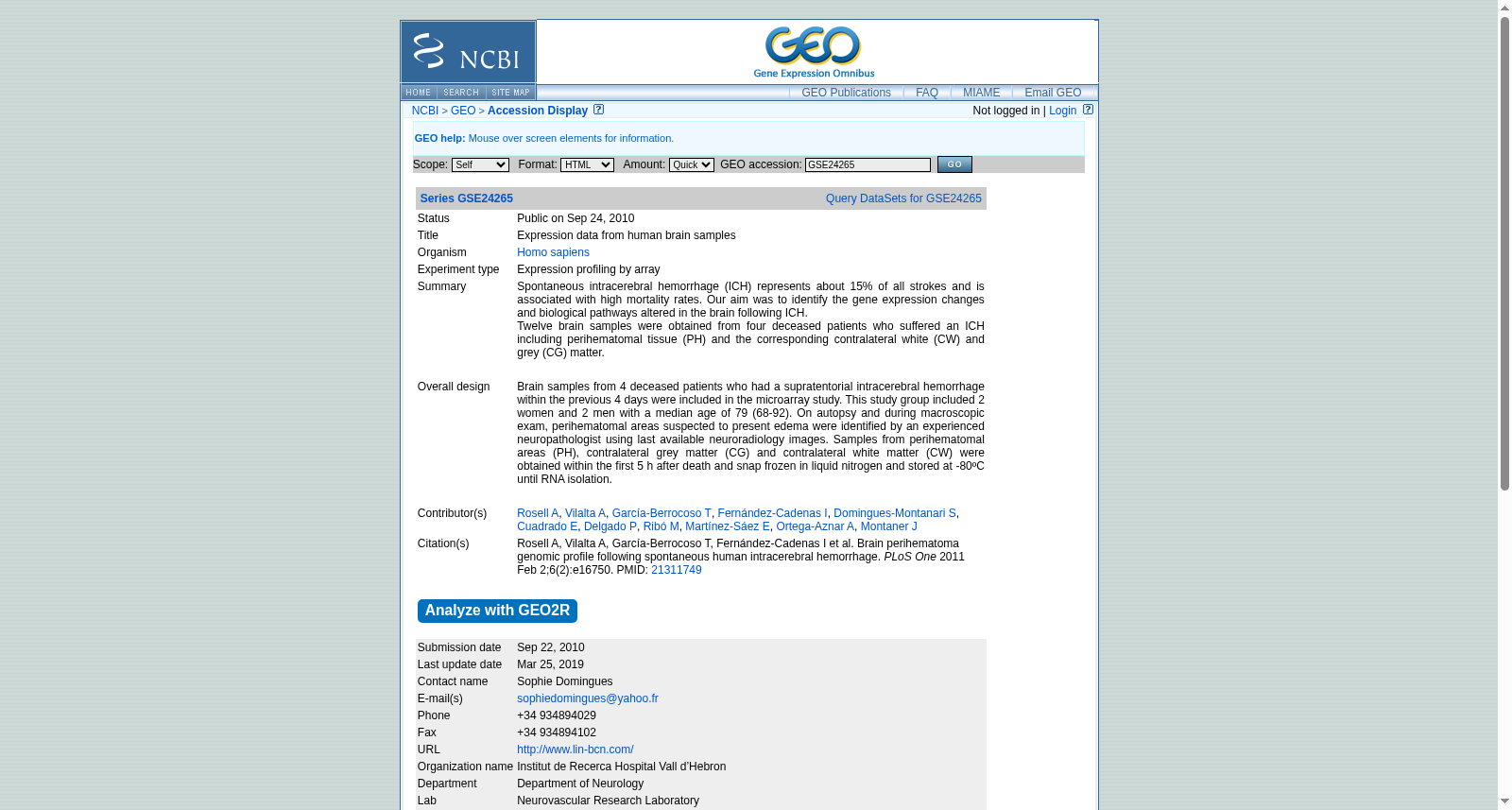
Expression data from human brain samples
收藏资源简介:
Spontaneous intracerebral hemorrhage (ICH) represents about 15% of all strokes and is associated with high mortality rates. Our aim was to identify the gene expression changes and biological pathways altered in the brain following ICH. Twelve brain samples were obtained from four deceased patients who suffered an ICH including perihematomal tissue (PH) and the corresponding contralateral white (CW) and grey (CG) matter. Brain samples from 4 deceased patients who had a supratentorial intracerebral hemorrhage within the previous 4 days were included in the microarray study. This study group included 2 women and 2 men with a median age of 79 (68-92). On autopsy and during macroscopic exam, perihematomal areas suspected to present edema were identified by an experienced neuropathologist using last available neuroradiology images. Samples from perihematomal areas (PH), contralateral grey matter (CG) and contralateral white matter (CW) were obtained within the first 5 h after death and snap frozen in liquid nitrogen and stored at -80ºC until RNA isolation.
自发性脑内出血(spontaneous intracerebral hemorrhage, ICH)占所有卒中病例的约15%,且伴随较高的病死率。本研究旨在明确脑内出血后大脑内发生的基因表达变化及异常生物学通路改变。本研究从4例确诊脑内出血的已故患者处获取12份脑组织样本,样本涵盖血肿周围组织(perihematomal tissue, PH)、对应对侧白质(contralateral white matter, CW)及对侧灰质(contralateral grey matter, CG)。本微阵列研究纳入了发病后4天内死亡的4例幕上脑内出血患者的脑组织样本。本研究队列包含2名女性与2名男性,中位年龄为79岁(范围68~92岁。经验丰富的神经病理学家结合最新可用的神经影像学图像,在尸检及大体标本检查中识别出疑似存在水肿的血肿周围区域。研究人员于患者死亡后5小时内采集血肿周围组织(PH)、对侧灰质(CG)及对侧白质(CW)样本,经液氮快速冷冻后保存于-80℃环境中,直至开展RNA提取。