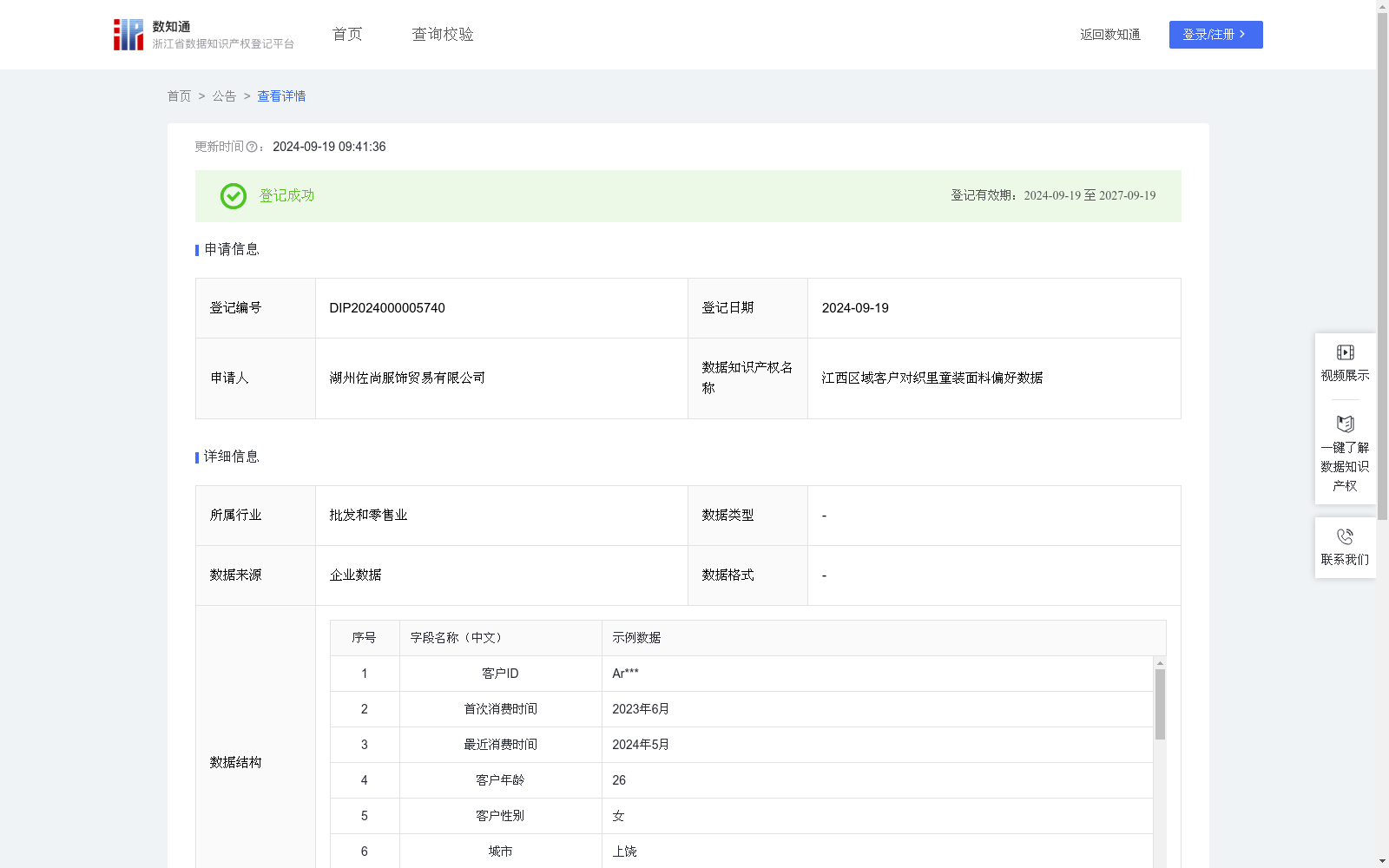
江西区域客户对织里童装面料偏好数据
收藏资源简介:
通过对各区域客户的偏好计算,可以了解相关产品在该区域的市场趋势,以便企业制定相应的生产策略,帮助企业提升服务质量,实现精准运营,优化推荐能更好地为用户提供个性化的商品和服务。通过市场趋势预测,了解客户偏好度,以此指导童装产业的生产创新方向,打造具有国际影响力的品牌。1.数据采集:采集平时客户对童装的相关交易数据。 2.数据处理:对采集到数据进行分类、合并、累加,便于分析使用。 3.算法加工织里童装偏好指数=(童装(纯棉类)浏览量占比+童装(纯棉类)收藏量占比+童装(纯棉类)购买量占比)*(50+童装(纯棉类)平均购买价格)*(100-年龄)*(最近消费时间-首次消费时间,按月份计)*性别系数(男性为1,女性为1.2)*城市系数(一线城市为1.2,二线城市为1.1,三线城市及以下为1)/10000。 4.应用场景:通过该算法可以了解客户对童装面料的偏好,从而了解产品是否在该区域畅销,制定生产策略,帮助企业提升服务质量,实现精准运营,优化推荐能更好地为用户提供个性化的商品和服务。
By calculating the preference profiles of customers across different regions, we can identify the market trends of relevant products in those regions, allowing enterprises to develop targeted production strategies, enhance service quality, achieve precise operations, and optimize recommendation systems to better deliver personalized goods and services to users. Through market trend forecasting and analysis of customer preference levels, we can guide the production and innovation directions of the children's clothing industry and cultivate brands with international influence. 1. Data Collection: Collect regular transaction data related to customers' children's clothing purchases. 2. Data Processing: Classify, merge and aggregate the collected data to support subsequent analysis. 3. Algorithm-based Preference Index Calculation: The Zhili Children's Clothing Preference Index is calculated via the following formula: (Proportion of cotton children's clothing views + Proportion of cotton children's clothing favorites + Proportion of cotton children's clothing purchases) × (50 + Average purchase price of cotton children's clothing) × (100 - Customer Age) × (Time elapsed since first consumption, calculated in months) × Gender Coefficient (1 for male, 1.2 for female) × City Coefficient (1.2 for first-tier cities, 1.1 for second-tier cities, 1 for third-tier cities and below) / 10000. 4. Application Scenarios: This algorithm can be used to identify customers' preferences for children's clothing fabrics, thereby judging whether a product line sells well in a given region, formulating targeted production strategies, helping enterprises enhance service quality, achieve precise operations, and optimize recommendation systems to better provide users with personalized goods and services.