generate-readme-eval
收藏资源简介:
generate-readme-eval数据集用于评估大型语言模型在总结GitHub仓库并生成README.md文件时的有效性。数据集包含训练集和测试集,分别用于微调和性能评估。数据集从GitHub上选取了400个至少有1000颗星和100个分叉的Python仓库,并限制仓库大小不超过100k个token。评估时,模型被要求根据仓库内容生成README.md文件,并通过多种指标来评估生成的README文件的质量。
The generate-readme-eval dataset is designed to evaluate the effectiveness of large language models (LLMs) when summarizing GitHub repositories and generating README.md files. The dataset comprises a training set and a test set, which are utilized for fine-tuning and performance evaluation, respectively. It includes 400 Python repositories selected from GitHub, each with at least 1000 stars and 100 forks, and the repository size is constrained to no more than 100k tokens. During the evaluation process, models are tasked with generating README.md files based on the content of the corresponding repositories, and the quality of the generated README files is assessed via multiple metrics.
Generate README Eval 数据集概述
数据集信息
- 特征:
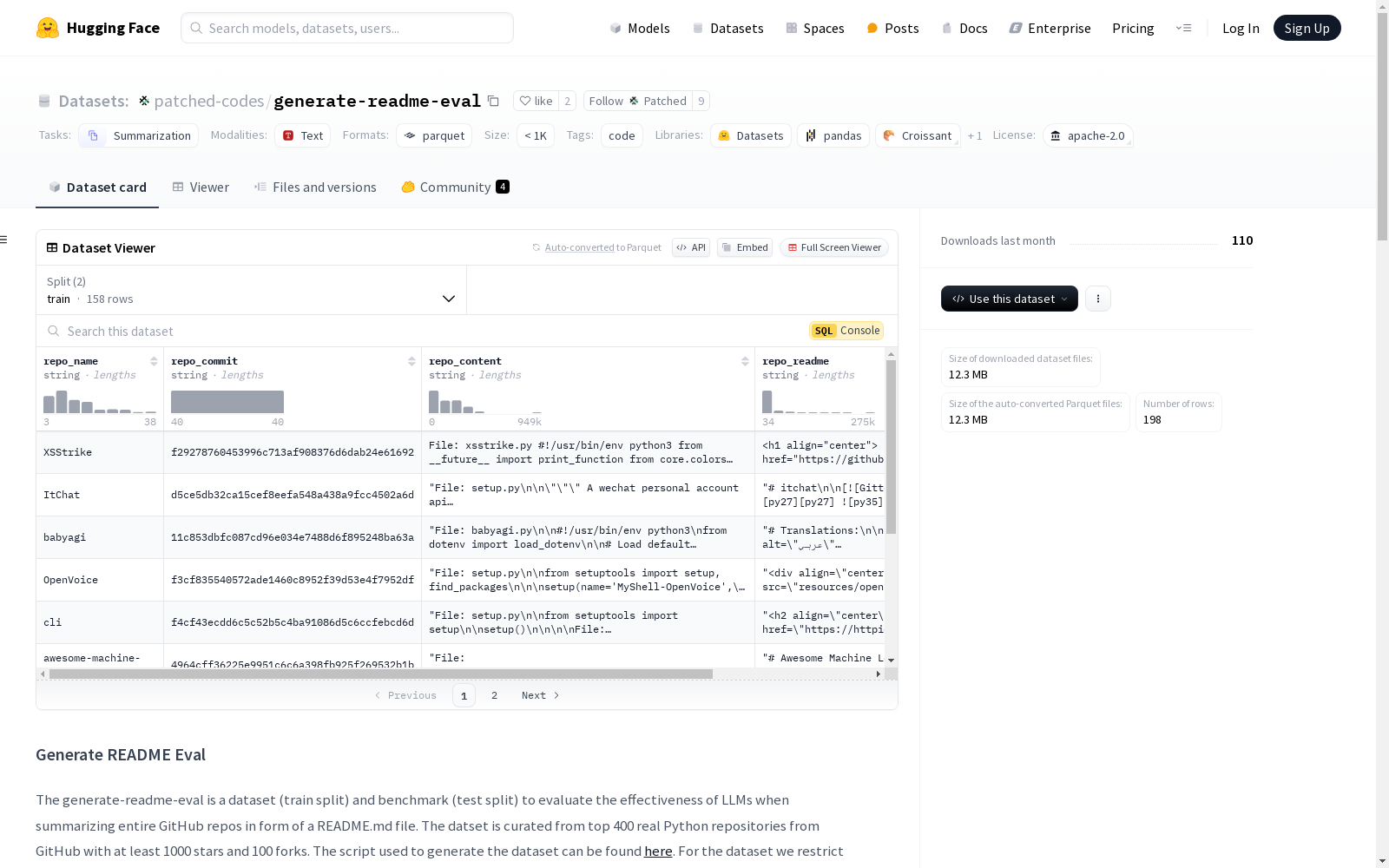
repo_name: 仓库名称,类型为字符串。repo_commit: 仓库提交信息,类型为字符串。repo_content: 仓库内容,类型为字符串。repo_readme: 仓库的README文件内容,类型为字符串。
- 分割:
train: 训练集,包含158个样本,大小为29227644字节。test: 测试集,包含40个样本,大小为8765331字节。
- 下载大小: 12307532字节
- 数据集大小: 37992975字节
- 配置:
default: 数据文件路径包括data/train-*和data/test-*。
- 许可证: Apache 2.0
- 任务类别: 摘要生成
- 标签: 代码
- 大小类别: n<1K
数据集描述
- 来源: 从GitHub上选取的400个Python仓库,每个仓库至少有1000颗星和100个分支。
- 限制: 仅包含大小小于100k tokens的仓库。
- 用途: 用于评估大型语言模型(LLMs)生成README.md文件的效果。
评估方法
-
评估脚本: 使用提供的脚本进行评估,脚本路径为
_script_for_eval.py。 -
评估指标: 包括BLEU、ROUGE、余弦相似度、结构相似度、信息检索、代码一致性和可读性(FRES)。
-
最终评分: 通过加权平均计算,权重如下: python weights = { bleu: 0.1, rouge-1: 0.033, rouge-2: 0.033, rouge-l: 0.034, cosine_similarity: 0.1, structural_similarity: 0.1, information_retrieval: 0.2, code_consistency: 0.2, readability: 0.2 }
-
评估结果: 评估脚本会输出各项指标并存储日志文件。
排行榜
- 当前SOTA模型: Gemini-1.5-Flash-Exp-0827,在零样本设置下表现最佳。
- 模型评分:
bleu: 0.0072rouge-1: 0.1196rouge-2: 0.0169rouge-l: 0.1151cosine_similarity: 0.3029structural_similarity: 0.2416information_retrieval: 0.4450code_consistency: 0.0796readability: 0.3790weighted_score: 0.2443
少样本学习
- 挑战: 由于上下文长度限制和准确性权衡,少样本学习难以显著提升性能。
- 实验结果: 1-shot效果最佳,增加样本数量后性能不再提升。